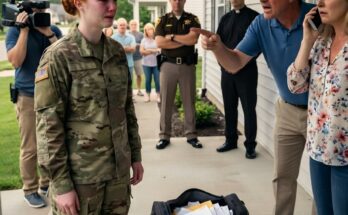
For Four Years, My Parents Told Everyone I Was in Prison… But I Was Actually Serving Overseas in the Military. When I Finally Came Home in Uniform, They Called the Police and Claimed I Was a Dangerous Criminal.
“Stay inside the truck,” Mr. Holloway said quietly, locking the doors with shaking hands. “Your mother just called 911 and told them an escaped prisoner is standing in her yard.”
I froze.
Outside the windshield sat the house I had dreamed about for four long years.
The white porch.
The cracked driveway.
The old birdbath beside the mailbox.
Home.
Or at least… what used to be home.
I was still wearing my Army uniform after returning from deployment overseas. My duffel bag rested on my lap, dust still clinging to my boots, discharge papers folded carefully inside my jacket pocket.
For years, I imagined this moment differently.
I thought my mother would cry.
I thought my father would hug me.
I thought someone would be proud I came back alive.
Instead, police sirens echoed down the street.
Three sheriff’s deputies pulled up first.
Then neighbors started gathering.
Teachers from my old school.
People from church.
And finally a local news van arrived, with a cameraman running across the lawn like he smelled blood in the water.
I looked at Mr. Holloway in disbelief.
“What exactly did my mother tell them?”
He swallowed hard before answering.
“She said you were dangerous. Said you got released early from prison. Said the military uniform was fake.”
It felt like the air disappeared from my lungs.
Then the front door opened slowly.
My mother stepped outside wearing a beige sweater, clutching her chest dramatically like she was performing for the crowd.
Behind her stood my father, red-faced and stiff, gripping the chain lock across the door.
“Sarah,” my mother called loudly enough for the entire neighborhood to hear, “please stop making this harder than it needs to be.”
The cameraman instantly swung toward me.
Sheriff Walker approached carefully.
“Everyone stay calm,” he said.
My voice cracked as I answered.
“I’m Staff Sergeant Sarah Mitchell. I just returned from overseas deployment.”
Whispers spread through the crowd immediately.
Mrs. Donnelly — my old middle school teacher — covered her mouth in shock.
Pastor Glenn stepped forward looking completely pale.
Then my mother pointed directly at me.
“That uniform is part of her manipulation,” she announced coldly. “She’s lied her whole life.”
I slowly reached into my pocket.
“Sheriff, I can show you my military ID—”
“Don’t touch anything she hands you!” my father suddenly screamed from the doorway.
The entire street went silent.
Then something unexpected happened.
Mr. Holloway climbed out of the truck.
“That girl sent letters home every month,” he said shakily. “I forwarded every single one after her parents refused the mail.”
For just a second, my mother’s face changed.
Not guilt.
Not sadness.
Rage.
Pure rage.
Then my father slammed the front door shut.
One lock clicked.
Then another.
Then another.
My parents locked themselves inside the house while my father shouted through the door:
“If she wants everyone to know the truth so badly… then show them what she buried!”
And suddenly, the entire crowd turned to stare at me.
The air inside Mr. Holloway’s rusted 1998 Ford F-150 smelled of stale peppermint, old vinyl, and the damp earth of a Georgia autumn. It was a familiar, grounding scent, one that had lingered in my memory across thousands of miles of arid desert, sterile military barracks, and the deafening roar of C-130 transport planes. But right now, that scent was entirely eclipsed by the sharp, metallic taste of fear.
Beside me, Mr. Holloway’s weathered hands gripped the steering wheel so tightly his knuckles shone like polished ivory. His breathing was shallow, his eyes darting continuously from the side-view mirror to the front windshield, where the flashing red and blue strobe lights of three county sheriff cruisers cut through the gathering twilight.
“Sarah,” he whispered, his voice cracking with the strain of seventy years of hard living. “I’ve known your family since before you were taking your first steps on this gravel. I’ve delivered their mail through ice storms and summer droughts. But what your mother just did… what she said to that dispatcher… it ain’t right. It ain’t Christian. You stay put. Don’t you dare step foot out of this cab until I tell you to.”
I didn’t answer. I couldn’t.
My hands, calloused from four years of handling heavy machinery, maintaining weapon systems, and digging defensive positions in foreign soil, were locked around the heavy canvas straps of my military duffel bag. I was wearing my Class A dress uniform—the fabric stiff, the brass buttons polished to a mirror shine, the Staff Sergeant stripes on my sleeves representing a rank bought with sweat, blood, and sleepless nights. On my chest, the ribbons of my service sat in neat, colorful rows: the National Defense Service Medal, the Global War on Terrorism Service Medal, and the Army Commendation Medal with two oak leaf clusters.
To the United States Army, I was a leader of soldiers. An asset. A protector.
To my mother, I was an escaped convict.
Through the rain-streaked windshield, I watched the scene unfold on the front lawn of the house where I had grown up. It was a modest, two-story colonial with peeling white paint and a sprawling oak tree that cast long, skeletal shadows across the grass. The birdbath I had helped my grandfather cement into the ground when I was twelve sat cracked and empty near the driveway, choked with dead leaves.
Sheriff Thomas Walker—a man who had pulled me over when I was sixteen for a broken taillight and let me off with a gentle warning—stepped out of the lead cruiser. He didn’t look like the friendly small-town cop I remembered. His hand was resting on the butt of his service weapon, his posture tense, his eyes scanning the truck with a mixture of professional caution and deep, underlying confusion.
Behind him, two younger deputies flanked the driveway, their boots crunching softly on the gravel.
But it wasn’t just the police.
Oak Creek was a small town where gossip traveled faster than a wildfire in July. The sound of sirens had acted like a siren song for the neighborhood. Across the street, Mrs. Donnelly, my old eighth-grade history teacher, stood on her porch, her cardigan pulled tight against the evening chill, her face pale as she whispered to her husband. Pastor Glenn, the spiritual leader of the Oak Creek Methodist Church—the man who had baptized me—had stopped his sedan at the edge of the road, stepping out with a look of profound, sorrowful bewilderment.
And then, the final blow.
A white van with the local news station’s logo—WKB TV, Channel 4 News—pulled up behind the police cruisers. The side door slid open instantly, and a young reporter in a trench coat stepped out, followed closely by a cameraman who immediately hoisted a heavy digital camera onto his shoulder, the red recording light glowing like a malevolent eye in the dimming light.
“They’re going to broadcast this,” I muttered, my voice barely a whisper. “They’re going to put my face on the evening news. They’re going to tell everyone I’m a criminal.”
“Not if I can help it,” Mr. Holloway growled. He turned the key, shutting off the truck’s engine, but kept his finger pressed firmly on the door-lock button. “Your parents have been spinning this yarn for forty-eight months, Sarah. Every time someone asked where you went, why you weren’t at the summer socials or the Christmas services, Helen would put on that tragic, long-suffering face of hers and say you were serving time in a federal penitentiary up north. Said you fell in with a bad crowd at college. Said it broke her heart, but she had to wash her hands of you.”
He turned to look at me, his eyes softening behind his thick glasses. “I knew it was a lie the second the first APO mail came through my sorting station. I saw the military postmarks. I saw the return addresses from Fort Bragg, from Germany, from Kuwait. I tried to tell people, Sarah. But your father… Richard is an elder at the church. He’s on the town council. People believed him. They thought I was just a senile old mailman making excuses for a girl who had gone bad.”
I closed my eyes, the memory of my deployment washing over me. I remembered the heat of Kandahar, the constant, low-frequency hum of generators, the dust that got into everything—your food, your water, your lungs. I had spent four years putting my life on the line, believing that even if my parents were angry at me for enlisting instead of pursuing the corporate path they had mapped out for me, they would eventually understand. I thought they would see my independence as a sign of strength.
I never imagined they would cover up my absence by murdering my reputation.
“Sarah!”
The voice came through the closed window of the truck, muffled but distinct. It was my mother.
She had fully emerged onto the front porch now. Helen Mitchell was a woman who took great pride in her appearance. Her silver-streaked hair was perfectly coiffed, her beige cashmere sweater draped elegantly over her shoulders. She looked like the picture-perfect image of a grieving, dignified matriarch. She had her hands pressed to her collarbone, her shoulders trembling slightly as she leaned against my father, Richard, who stood like a stone monolith beside her.
“Sarah, please!” she cried out again, her voice carrying across the quiet street. “Please don’t make this any worse than it already is! We loved you! We tried to help you! Just surrender to the officers! Don’t let them use force!”
The crowd of neighbors let out a collective, soft murmur. I could see the disgust on their faces—not directed at my mother, but at the “escaped convict” hiding inside the old mailman’s truck.
“I can’t stay in here, Mr. Holloway,” I said, my voice steadying. The initial shock was fading, replaced by a cold, familiar resolve. It was the same resolve I felt when my unit’s forward operating base took indirect fire—the systematic shutting down of unnecessary emotion to focus entirely on survival and execution.
“Sarah, no—”
“I am a Staff Sergeant in the United States Army,” I said, looking him dead in the eye. “I have commanded men and women in combat zones. I am not going to hide in the passenger seat of a pickup truck while my mother acts out a tragedy for the local news.”
Before he could argue, I reached over, clicked the manual lock unlock, and pushed the heavy truck door open.
The cool evening air hit me, carrying the scent of pine needles and approaching rain. The moment my black, highly polished leather low-quarters hit the gravel, the murmurs in the crowd died down to an absolute silence.
I stood up straight, my shoulders back, my chin level. I adjusted my green service cap, ensuring the brim was exactly two fingers above my brow, just as the regulations dictated. I pulled my duffel bag out of the footwell and slung it over my shoulder with a smooth, practiced motion.
Sheriff Walker took a step back, his hand dropping away from his holster. His eyes went from my boots, up the sharp creases of my trousers, past the glittering array of medals on my chest, to the serious, unyielding expression on my face.
“Sheriff,” I said, my voice projecting clearly across the lawn. “I am Staff Sergeant Sarah Mitchell, United States Army. Active duty, currently transitioning to terminal leave after completing my four-year enlistment.”
“Don’t listen to her!” my father’s voice boomed from the porch. He was a tall man, his face flushed a deep, angry red that contrasted sharply with his white button-down shirt. He took a step forward, his hand gripping the wooden railing of the porch so tightly the wood creaked. “She’s a liar! She’s been a liar since she was a child! That uniform is a prop! She bought it online! Sheriff, she is an escaped felon! She was sentenced to five years at the Federal Correctional Institution in Danbury! She escaped three days ago! We received a warning call!”
“Mr. Mitchell,” Sheriff Walker said, his voice cautious but firm. He turned back to look at me, his eyes narrowing as he tried to read the situation. “Sarah… if that is your name… I need you to keep your hands where I can see them. Drop the bag on the ground.”
I complied immediately. I let the heavy canvas duffel slide off my shoulder, landing with a dull thud on the grass. I kept my hands open, at my sides, away from my body.
“Sheriff, I have my military common access card, my active duty orders, and my DD-214 discharge paperwork in my breast pocket,” I said, keeping my tone professional and calm. “May I reach inside to retrieve them?”
“Don’t let her reach into her pockets!” Helen screamed, her voice reaching a theatrical crescendo. She buried her face in her hands, her shoulders heaving with fake sobs. “She could have a weapon! She threatened us before she was arrested! She told us she would kill us if we ever told the truth!”
The cameraman from WKB TV took several steps closer, his lens zooming in on my face. I didn’t look at him. I kept my eyes locked on Sheriff Walker.
“Sheriff,” I repeated, my voice dropping to a lower, more dangerous register. “You’ve known me since I was a teenager. You know I’ve never had a criminal record. I ask you, as an officer of the law, to verify my identification before you take any action based on the frantic accusations of two people who haven’t seen me in four years.”
Walker hesitated. He looked at the crowd of neighbors, then at the news camera, and finally back to me. The sheer absurdity of the situation seemed to be weighing on him. A girl in a highly detailed, perfectly tailored military dress uniform, standing calmly on a lawn while her parents claimed she was a dangerous federal fugitive.
“Alright,” Walker said, stepping forward. “Keep your hands where they are. Deputy Miller, search the duffel bag. Deputy Davis, cover him. I’m going to retrieve the ID myself.”
As Sheriff Walker approached me, the front door of the F-150 slammed shut.
Mr. Holloway walked around the front hood of his truck, his posture slightly bent but his steps purposeful. He carried a heavy, cardboard priority mail box under his arm—a box that was bulging at the seams, held together by layers of yellowed packing tape.
“Thomas!” Mr. Holloway called out, using the sheriff’s first name. “You stop right there and listen to reason. You’ve known me for forty years, and you know I don’t hold with lies.”
“Eugene,” Sheriff Walker said, pausing and looking at the old mail carrier with a frown. “This is police business. You need to step back.”
“This ain’t police business, this is a circus!” Mr. Holloway shouted, his voice ringing out over the quiet street. He marched right up to the edge of the lawn, stopping beside me. He held up the heavy cardboard box. “For four years, Thomas. Four years, every single month, this girl sent letters home. She sent them from Fort Sam Houston. She sent them from Fort Bragg. She sent them from an APO address in Germany, and then from a field unit in Kuwait. And do you know what her parents did with them?”
The crowd of neighbors pressed closer to the edge of the street. Mrs. Donnelly had stepped off her porch, her eyes wide as she stared at the cardboard box in Mr. Holloway’s arms.
“They returned them,” Mr. Holloway said, his voice shaking with a mixture of anger and sorrow. “The first three letters came back to the post office marked ‘Return to Sender—No Such Person at This Address.’ After that, Helen came down to the office herself. She told me to my face that if any more mail came from ‘that criminal,’ I was to throw it in the dead-letter bin. She said they had legally disowned her.”
“That’s a lie!” my father shouted from the porch, though his voice sounded slightly hollower now. “We never received any such mail! The post office is incompetent!”
“I ain’t incompetent, Richard!” Mr. Holloway roared back, pointing a thick, calloused finger at my father. “I kept ’em! I knew what you were telling people at the church. I heard you tell Pastor Glenn that Sarah was locked up for identity theft and wire fraud. I knew it was a blue-faced lie because I had her real letters in my hand! I couldn’t send them back to the military because I didn’t want this poor girl to know her own flesh and blood had discarded her like trash while she was sleeping on a cot in a desert! So I kept every single one of ’em in this box!”
A collective murmur of shock rippled through the neighbors.
Pastor Glenn stepped forward, his eyes darting from the cardboard box to my parents on the porch. “Richard… Helen… is this true? Did you receive letters from a military address?”
“Of course not!” Helen cried, her voice cracking as she tried to maintain her composure. “Pastor, you know us! You know our hearts! Eugene is old… he’s confused. He’s always had a soft spot for Sarah, even when she was stealing from us!”
“I didn’t steal a damn thing,” I said, my voice cutting through her theatrical defense like a knife.
I looked at Sheriff Walker, who had stopped just two feet away from me. He reached out and carefully unbuttoned the breast pocket of my uniform jacket. He slid his fingers inside and pulled out a small black leather wallet.
He opened it.
Inside was my green Active Duty Military Common Access Card (CAC). It featured a high-resolution photo of me in my utility uniform, my name, my rank of Staff Sergeant (E-6), and an expiration date set for several years in the future. Beside it was a folded sheet of heavy paper—my DD-214, certificate of release or discharge from active duty, bearing the official stamp of the Department of the Army.
Walker stared at the documents for a long, silent moment.
The cameraman tried to peer over the sheriff’s shoulder, but Deputy Davis stepped in the way, blocking the lens with his body.
“Thomas,” my father called out, his tone shifting from anger to a desperate, urgent pleading. “She’s clever. She had those forged. You know how easy it is to print high-quality fake IDs these days. She was always good with computers. That’s how she stole the money in the first place!”
Sheriff Walker slowly raised his head. He didn’t look at my father. He looked at me, his eyes filled with a deep, crushing realization of the monstrous lie that had been manufactured in his town.
“Richard,” Walker said, his voice flat and dangerous. “This is a real military ID. The chip is active. I can scan it in my cruiser right now, but I don’t need to. I’ve seen enough fake IDs in my thirty years on the force to know the difference. And this DD-214 has a federal seal on it. If I call the duty officer at Fort Bragg, they’re going to tell me exactly what I already know: that your daughter has been serving her country while you’ve been telling this town she was in a cell.”
A heavy, suffocating silence descended upon the lawn.
The neighbors stared at my parents. The news reporter was whispering rapidly into her microphone, her face alight with the thrill of a massive, local scandal unfolding live on her segment.
Helen’s hands dropped from her face. The tears were gone, replaced by a cold, hard expression that I recognized all too well from my childhood. It was the look she gave me whenever I refused to play the quiet, submissive role she had designed for me. It was the look of a woman who realized she was losing control of the narrative.
“So she was in the Army,” my mother said, her voice suddenly dropping its trembling, victimized tone, replaced by a sharp, venomous hiss. “Does that make her a saint? Does that erase what she did before she left? She ran away because she knew the police were coming for her. She enlisted under a false pretense to hide from her responsibilities!”
“Helen, stop,” Pastor Glenn said, his voice filled with a deep, sorrowful disappointment. “Please, just stop.”
“No, Pastor!” my father shouted, his eyes wild as he looked around at the judging faces of his neighbors. “You don’t understand! She wants to play the hero? She wants everyone to think she’s some kind of patriot? If she wants everyone to know the truth so badly… then tell them to show you what she buried!”
I froze.
The words felt like a physical blow to my chest.
What she buried.
The memory surfaced instantly, vivid and terrifying. Four years ago, the night before I left for basic training, the rain had been just like this—cold, relentless, turning the red Georgia clay into a thick, clinging mud. I remembered the heavy plastic container I had carried out to the old oak tree in the backyard, my hands shaking as I dug into the earth by the light of a small flashlight.
I had buried it because I knew my parents would search my room the second I was gone. I knew they would destroy anything that didn’t conform to their vision of who I was supposed to be.
“What is he talking about, Sarah?” Sheriff Walker asked, his eyes turning back to me with a fresh spark of suspicion. “Did you bury something on this property before you left?”
“She did!” my father screamed, leaning over the porch railing, pointing a trembling finger toward the back of the house. “In the backyard! Near the old oak! We found the freshly dug dirt the morning after she ran away, but we couldn’t dig it up because the roots were too thick and we didn’t want to damage the tree! But she knows what’s down there! It’s the evidence! The stolen accounts! The money she took from her grandfather’s estate before he died!”
The neighbors turned their heads in unison, staring at me as if waiting for me to deny it.
Even Mr. Holloway looked at me with a slight flicker of concern in his eyes. “Sarah? What’s he talking about?”
I looked at my father. He was smiling now—a small, desperate, triumphant smile. He believed he had trapped me. He believed that even if my military service was real, the existence of whatever was buried in the backyard would ruin me in the eyes of the town. He thought that whatever secrets I had hidden in that dirt would justify the four years of lies they had spun.
I let out a slow, steady breath.
The fear was gone. In its place was a cold, absolute certainty.
“Sheriff,” I said, my voice echoing clearly through the quiet evening. “Do you have a shovel in the trunk of one of those cruisers?”
Walker blinked, taken aback by my composure. “We have an emergency spade in the utility kit.”
“Get it,” I said, turning my body toward the narrow gravel path that led to the backyard. “And tell the cameraman to follow us. If my parents want to show the town what’s buried in the dirt… then let’s dig it up together.”
The backyard of my childhood home was dark, illuminated only by the powerful tactical flashlights held by Sheriff Walker and Deputy Miller. The rain was starting to fall harder now, the cold drops stinging my face and spotting the shoulders of my dress uniform.
The crowd of neighbors had followed us, stopping at the edge of the wooden fence that separated the yard from the driveway. Mrs. Donnelly, Pastor Glenn, and a dozen others stood huddled under umbrellas, their eyes fixed on the massive, ancient oak tree that dominated the center of the yard.
The cameraman from WKB TV stood just behind the sheriff, the lens of his camera focused on the patch of earth at the base of the tree’s massive, gnarled roots.
My father and mother had remained on the back porch, watching from the safety of the overhang. My father’s arms were crossed over his chest, his expression smug, while my mother clutched her sweater, her eyes darting nervously around the yard.
“Where is it, Sarah?” Sheriff Walker asked, handing the small, folding metal military shovel to Deputy Miller.
“Between the two largest roots on the eastern side,” I said, pointing to a small depression in the earth that had been covered by four years of fallen leaves and decaying organic matter. “About two feet down. It’s inside a heavy, waterproof Pelican case.”
Deputy Miller knelt in the wet grass, his uniform trousers instantly soaking through as he began to dig. The metal spade sliced through the damp earth with a wet, rhythmic crunch.
Crunch.
Crunch.
Nobody spoke. The only sounds were the rain, the scraping of the shovel, and the distant hum of the highway.
With every strike of the spade, I felt a layer of my past being peeled away. I remembered the night I buried that box. I had been nineteen years old, terrified of the future, and utterly broken by the emotional abuse my parents had subjected me to for years. They had tried to force me to sign a document—a power of attorney that would give them complete control over the inheritance my grandfather had left specifically to me in his private will.
When I refused, my father had thrown a glass across the room, shattering it against the wall, and told me that if I didn’t sign, they would make my life a living hell. They told me they would destroy my credit, tell everyone I was a thief, and ensure I could never get a job or an apartment in this state.
So, I enlisted.
And before I left, I took the original copy of my grandfather’s will, the deed to his house, and my personal savings bonds, and I put them into a waterproof military-grade case.
“I hit something,” Deputy Miller said, his voice cutting through the silence.
The camera zoomed in.
The shovel scraped against hard, black plastic. Miller cleared away the wet clay with his gloved hands, revealing the rectangular shape of a small, lockable Pelican case. He reached down, gripped the heavy handle, and pulled it free from the suction of the mud with a wet pop.
He wiped the dirt off the top of the case, revealing a heavy brass padlock that had rusted shut over the years.
“It’s locked,” Miller said, looking up at the sheriff.
“I have the key,” I said, reaching into the small pocket of my uniform trousers and pulling out a small, silver key on a dog-tag chain. “Or you can use a bolt cutter. The brass is soft.”
“Give me the key,” Sheriff Walker said, his voice quiet.
He took the key from my hand, his fingers cold against mine. He knelt beside the case, slid the key into the rusted lock, and turned it. With a sharp, metallic click, the padlock popped open.
Walker pulled the lock free, discarded it in the grass, and flipped the two heavy plastic latches on the front of the case.
He lifted the lid.
The tactical flashlights illuminated the contents of the box with a stark, white glare.
Inside, protected by thick foam inserts, were several neatly organized items:
- A thick, blue leather folder containing my grandfather’s original, notarized Last Will and Testament.
- A stack of paper savings bonds, issued in my name, totaling twenty-five thousand dollars—money my grandfather had saved for my college education.
- A small, black USB flash drive.
- A standard, military-issue green notebook containing several pages of my own handwriting.