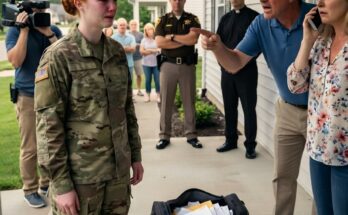
Sheriff Walker reached in and pulled out the blue leather folder first. He flipped it open, his eyes scanning the first page.
“This is the estate paperwork of Arthur Mitchell,” Walker murmured, reading the text. “It says here… he leaves the entirety of his personal estate, including the properties on Oak Creek and the cash accounts at First National Bank, to his granddaughter, Sarah Mitchell.”
“That’s a forged will!” my father shouted from the porch, his voice cracking with a sudden, desperate panic. “He was senile when he signed that! He meant to leave everything to us! She manipulated him!”
“My grandfather was of sound mind, Sheriff,” I said calmly. “The notary who signed that document is Mrs. Donnelly’s sister. She can verify the date and my grandfather’s mental state herself.”
Across the yard, Mrs. Donnelly gasped, her hand flying to her mouth. “Margaret notarized that? I remember! She told me Arthur was so proud of you, Sarah. She said he wanted to make sure you were taken care of.”
Sheriff Walker didn’t say a word. He reached back into the case and pulled out the small, black USB drive.
“What’s on the drive, Sarah?” he asked.
“My parents told this town I stole seventy thousand dollars from their business account,” I said, my voice carrying to the news camera and the neighbors. “But the truth is on that drive. Before I left, I made a digital backup of our family business’s financial ledger. It shows that my father had been embezzling money from his own clients’ accounts for three years to cover his gambling debts. He used my social security number to open dummy accounts to hide the transactions.”
A collective shout of disbelief rose from the crowd of neighbors.
My father’s face went from red to a terrifying, deathly pale. He took a step back on the porch, his hand slipping from the wooden railing.
“She’s lying!” he screamed, but his voice was thin, devoid of any real authority now. “She’s trying to ruin me! It’s a fabrication!”
“And there’s one more thing,” I continued, pointing to the green notebook in the case. “That notebook contains the log of every phone call, every text message, and every threat my parents made to me during my senior year of high school. It details how they threatened to frame me for my father’s financial crimes if I didn’t sign over my grandfather’s inheritance to them.”
Sheriff Walker slowly closed the case. He stood up, his face set in a grim, unyielding expression.
He looked at Deputy Miller. “Miller, secure this case. It’s official evidence now.”
He turned back to the crowd of neighbors, then to the news camera, and finally to my parents on the porch.
“Richard Mitchell,” Walker said, his voice echoing through the rainy night. “I suggest you and Helen step down from that porch with your hands where I can see them. We’re going to have a very long conversation down at the station about identity theft, forgery, and financial fraud.”
The scene that followed was one that the town of Oak Creek would talk about for decades.
My father tried to run.
He retreated inside the house, slamming the heavy wooden door shut and sliding the bolt locks into place. But Sheriff Walker and Deputy Miller didn’t hesitate. They marched up the steps, their boots heavy on the wooden planks, and began to knock with a force that shook the entire frame of the house.
“Richard! Open the door!” Walker roared. “Do not make this a resisting arrest charge! We have the warrants, and we have the authority to entry by force!”
Inside, my mother’s screams of panic could be heard through the closed windows.
Within ten minutes, the backup units arrived. Two more state trooper vehicles pulled into the driveway, their sirens silent but their lights casting a brilliant, multi-colored glow across the entire neighborhood.
The news camera captured every single moment.
I stood beside Mr. Holloway’s truck, my duffel bag at my feet, watching the house of cards my parents had built over four years finally collapse into the mud.
Mr. Holloway reached out and put a heavy, warm hand on my shoulder. “You did good, Sarah. You stood your ground like a soldier.”
“I just wanted them to love me,” I whispered, a single tear finally escaping my eye, hot against my cold face. “I just wanted to come home and have them be proud of me.”
“They weren’t capable of it, darlin’,” the old mailman said softly, his own eyes moist behind his glasses. “Some folks are so consumed by their own greed and their own fear that they can’t see the light when it’s standing right in front of them. You’re a hero to this country. And you’re a hero to this town, whether they know it yet or not.”
The front door of the house finally opened.
My father emerged first, his hands cuffed behind his back, his head bowed to avoid the glare of the news camera and the staring eyes of his neighbors. He looked broken. The powerful, arrogant man who had dominated my childhood had vanished, replaced by a pathetic, aging criminal facing the reality of a federal prison sentence.
My mother followed him, her face covered in running makeup, her beige sweater ruined by the rain. She was sobbing hysterically, but nobody stepped forward to comfort her.
The neighbors watched in absolute silence as the deputies escorted them to the back of the cruisers.
Pastor Glenn walked over to me, his expression filled with a deep, sorrowful regret. “Sarah… I don’t know what to say. We believed them. We were so wrong. Can you ever forgive us?”
I looked at the pastor, then at Mrs. Donnelly, who was crying silently on the sidewalk, and finally at the crowd of people who had spent four years believing I was a monster.
“You didn’t know,” I said quietly. “But from now on… when someone tells you a story that sounds too terrible to be true… I hope you’ll have the courage to ask for the evidence before you condemn them.”
The weeks that followed my return were a blur of legal proceedings, financial audits, and media attention.
The story of the “Soldier Framed by her Parents” went viral. The local segment on WKB TV was picked up by national news networks, and within forty-eight hours, my face was on the front page of newspapers across the country.
But I didn’t care about the fame.
I spent my days working with the county prosecutor and the military legal assistance office to untangle the web of financial crimes my parents had committed.
The audit of my grandfather’s estate revealed that my father had indeed managed to access several of the bank accounts using a forged signature, draining over forty thousand dollars of my inheritance to pay off his illegal gambling debts. But because the original will had been buried in the waterproof case, the court was able to freeze the remaining assets and return them to my sole control.
My parents were offered a plea deal by the state prosecutor. In exchange for a full confession and the restitution of the stolen funds, my father was sentenced to six years in a federal penitentiary for grand theft, identity fraud, and embezzlement. My mother, who had acted as an accessory after the fact, was sentenced to three years of probation and three hundred hours of community service.
The house on Oak Creek was put up for sale to cover the restitution costs.
The day before the auction, I walked through the empty rooms one last time.
The carpets had been pulled up, the furniture sold, the walls bare. The silence was absolute, but it was no longer a suffocating silence. It was the quiet of a blank slate.
I walked out onto the front porch, where the evening sun was casting a warm, golden glow across the lawn.
Mr. Holloway’s truck pulled up to the mailbox.
He climbed out, holding a small stack of letters. He walked up the driveway, a wide, genuine smile on his face.
“Got some mail for you, Staff Sergeant,” he said, handing me the envelopes.
I looked at them.
They were letters of support from people all over the world—soldiers who had served with me, strangers who had heard my story, and old friends from Oak Creek who wanted to welcome me home.
“Thank you, Eugene,” I said, smiling at him.
“What are you going to do now, Sarah?” he asked, leaning against the wooden railing.
I looked out over the quiet street, where the neighborhood children were playing in the grass under the golden light of the autumn sun.
“I’m going to rebuild my grandfather’s house on the lake,” I said. “And then… I’m going to start a program to help transitioning veterans find housing and legal support when they come home.”
“Sounds like a plan,” Mr. Holloway nodded, his eyes shining with pride. “A real, practical plan.”
I slung my duffel bag over my shoulder, took a final look at the empty house, and walked down the steps.
The uniform I wore was no longer a shield against my past. It was a symbol of my future—a future I had fought for, bled for, and finally reclaimed from the dirt of Oak Creek.
The property my grandfather had owned on Lake Lanier was twenty acres of dense pine forest and red Georgia clay, ending in a quiet, secluded cove where the water was as still as glass.
For four years, the small, two-bedroom cabin that sat near the water’s edge had been neglected, swallowed by blackberry brambles and wild kudzu. But to me, it was paradise. It was the only place in the world where my parents’ shadow had never fallen. My grandfather had built the cabin with his own hands in the 1970s, using rough-hewn cedar logs and a massive stone fireplace made of river rocks he had hauled from the water himself.
When I arrived with my first truckload of tools, the air was crisp and smelled of damp pine and lake water.
I set my military duffel bag on the dusty wooden floorboards of the porch and looked out over the cove. The sun was just beginning to dip below the tree line, painting the sky in deep shades of violet and orange.
The silence here was different from the silence in Oak Creek. It wasn’t the heavy, tense quiet of a neighborhood watching and judging. It was the peaceful, living silence of the forest—the wind rustling through the pine needles, the gentle lap of the water against the red clay shore, the distant call of an owl starting its nightly hunt.
I spent the next three months working from sunrise to sunset.
I cleared the brush with a heavy brush-cutter, my muscles burning with the familiar, satisfying ache of physical labor. I replaced the rotten floorboards on the porch, hammering each nail with a steady, rhythmic focus that became a form of meditation. I scrubbed the cedar walls, repaired the metal roof, and cleaned the massive stone fireplace until the river rocks shone in the light of the fire.
I wasn’t alone.
Almost every weekend, Mr. Holloway’s old Ford F-150 would rumble down the long, unpaved driveway. He would climb out of the cab, his tool belt strapped around his waist, carrying a thermos of hot coffee and a box of donuts from the bakery in town.
“You’re doing a fine job here, Sarah,” he said one morning, looking up at the newly repaired rafters. “Your granddaddy would be proud. He always said this place was meant for someone who knew the value of honest work.”
“I couldn’t have done it without you, Eugene,” I said, handing him a mug of coffee.
“Nonsense,” he scoffed, taking a sip. “I’m just an old mailman who likes to get out of the house. Besides, the town’s starting to change, Sarah. People are talking.”
I leaned against the porch railing, looking out over the water. “What are they saying?”
“They’re ashamed,” he said quietly. “Pastor Glenn held a sermon last Sunday about the dangers of bearing false witness. He didn’t mention your parents by name, but everyone knew who he was talking about. Mrs. Donnelly’s been organizing a fund to help veterans in the county. They want to make amends, Sarah. They just don’t know how to look you in the eye yet.”
“I don’t need their charity, Eugene,” I said softly.
“I know you don’t,” he agreed. “But they need to give it. It’s their way of digging themselves out of the mud they jumped into. You just keep building your cabin. The rest will follow.”
By the spring of 2026, the cabin was complete.
The cedar logs had been treated and stained a deep, rich brown that glowed in the sunlight. The interior was warm and simple, furnished with a few sturdy wooden pieces I had built myself, my grandfather’s old rocking chair, and a large oak desk that sat in front of the window overlooking the lake.
On the wall above the fireplace hung my dress uniform, dry-cleaned and preserved in a shadow box, flanked by the American flag that had flown over my unit’s headquarters in Kandahar and my grandfather’s old military service medals from the Korean War.
It was my sanctuary. But I knew I couldn’t stay hidden in the woods forever.
One morning, a sleek black sedan pulled down the driveway, kicking up dust.
I stepped out onto the porch, my hand instinctively dropping to my side out of habit, before I relaxed. The door of the sedan opened, and a woman in a sharp navy-blue business suit stepped out. She had short, dark hair, intelligent eyes, and carried a thick leather briefcase.
“Sarah Mitchell?” she asked, walking up the steps.
“I am,” I said.
“My name is Elizabeth Vance,” she said, offering me a firm, professional handshake. “I’m the director of the Georgia Veteran Services Coalition. We’ve been following your story, Sarah. And we’ve been following the legal battles you’ve been fighting to reclaim your grandfather’s estate.”
“If you’re here about the legal case, it’s settled,” I said, gesturing for her to sit in one of the wooden chairs on the porch. “My parents’ appeal was denied. The restitution is being paid from the sale of the Oak Creek house.”
“I’m not here about your parents, Sarah,” Elizabeth said, sitting down and opening her briefcase. She pulled out a thick document and laid it on the table between us. “I’m here about what you plan to do with the money.”
I looked at the document. It was a draft proposal for a non-profit organization titled The Sanctuary Initiative: Transitional Housing and Legal Advocacy for Returning Service Members.
“How did you get this?” I asked, my eyes narrowing. “This is on my private drive.”
Elizabeth smiled, a warm, genuine expression. “Your brother-in-arms, Staff Sergeant Marcus Miller, sent it to us. He said you’ve been working on these blueprints since you were stationed in Fort Bragg. He said you always talked about building a place where veterans who have been discarded by their families or the system could find a safe harbor, legal representation, and a chance to rebuild.”
She leaned forward, her eyes locked on mine. “Sarah, our coalition has the state grants and the administrative infrastructure, but we don’t have the leadership. We don’t have someone who has lived through the betrayal, who has worn the uniform, and who has the grit to fight the system. We want to fund your initiative. We want to buy the land adjacent to your property and build the first five transitional cottages.”
I looked out over the cove, the water reflecting the bright, blue spring sky.
For four years, my parents had tried to convince this town that I was a criminal, a parasite, a disappointment. They had tried to lock me in a cell built of lies and reputation.
But as I looked at the blueprints on the table, I realized that the dirt they had tried to bury me in was the very soil that would feed the roots of my true purpose.
“We don’t build cottages,” I said, looking back at Elizabeth with a sharp, determined smile. “We build cabins. Sturdy, cedar cabins that can withstand any storm.”
Elizabeth’s smile widened. “Cabins it is, Staff Sergeant.”
The dedication ceremony for The Sanctuary Initiative was held on a bright, crisp afternoon in October 2026.
Five beautiful, cedar cabins sat nestled in the pines along the ridge overlooking the lake, their metal roofs gleaming in the sun. A gravel path connected them to the main community center—a large, vaulted building we had constructed using the timber we cleared from the land.
Over fifty people had gathered on the lawn, including state representatives, veteran advocates, and soldiers from my old unit who had flown in to support the launch.
But there were other faces in the crowd, too.
Mrs. Donnelly stood near the back, holding a tray of baked goods she had brought for the reception. Pastor Glenn sat in the front row, his eyes filled with a quiet, peaceful warmth as he watched the proceedings. Even some of the neighbors from Oak Creek who had once stood on the street watching the police cars had come, their heads held high but their expressions humble.
Mr. Holloway sat in the seat of honor next to the podium, wearing his best Sunday suit, his silver hair combed back, his chest puffed out with a pride that could have rivaled any general’s.
I stood at the podium, wearing my uniform one final time before my official retirement from the service.
The wind carried the scent of pine and the clean, cool air of the lake. I looked out over the crowd, seeing the journey of my life reflected in the faces before me—the betrayal of the past, the struggle of the transition, and the absolute beauty of the redemption.
“Four years ago,” I began, my voice steady, carrying clearly across the quiet cove, “I came back to this county in this uniform. I came back hoping to find a home. Instead, I found a neighborhood lined with police cars, a news camera recording my shame, and parents who had locked their doors and called me a criminal.”
I paused, letting the memory settle over the crowd.
“For a long time, I asked myself why. Why would the people who brought me into this world choose to destroy my name? Why would they bury my letters and tell the world I was locked in a cage?
“The answer is simple: they were afraid. They were afraid of the truth of who I had become. They were afraid of a daughter who didn’t need their permission to be strong. They were afraid of a woman who was willing to fight for her own life, her own honor, and her own destiny.”
I looked down at the five cedar cabins along the ridge.
“This sanctuary is not just a place for veterans to sleep,” I said, my voice rising with a deep, unbreakable conviction. “It is a place where we unearth the truth. It is a place where we tell the men and women who have been discarded, forgotten, or lied about that their uniform is not a prop. Their service is not a mistake. And their honor is not something that can be locked away in a dark house or buried in the red clay of Georgia.”
I took a deep breath, looking directly at Mr. Holloway, who was wiping a tear from his eye with a wrinkled handkerchief.
“My name is Sarah Mitchell,” I said, my voice ringing out over the water. “I am a daughter. I am a soldier. And I am finally, truly, home.”
The applause started with Mr. Holloway, a slow, heavy clapping that was instantly joined by the soldiers of my old unit, and then by the state officials, the neighbors, the pastor, and every single person in the cove. It was a beautiful, thunderous roar that echoed off the cedar walls of the cabins and rolled out across the wide, blue waters of the lake, carrying the last remaining shadows of Oak Creek away into the light of the new day.