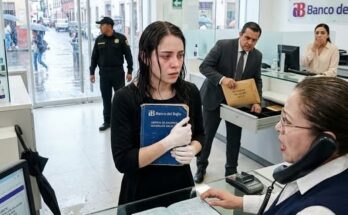
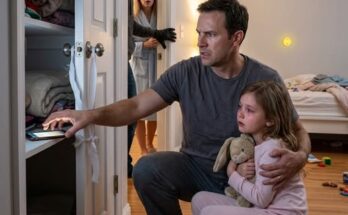
The paper inside the envelope did not accuse Lúcia. It accused me, quietly, scientifically, without rage, without mercy, without giving me anywhere to hide.
Probability of paternity: 99.9998%.
I read it once. Then again. Then a third time, because my eyes refused to obey my brain.
Outside the windshield, Curitiba moved like nothing had happened. Buses hissed. A motorcycle cut between cars. A woman carried bread under her arm.
Inside my car, I stopped being the betrayed husband in my imagination and became something worse.
I became the man who had doubted an innocent woman while she carried his child alone.
My hand shook so badly the paper rattled. I pressed it against the steering wheel, trying to breathe through my nose.
“No,” I whispered. “No, no, no.”
But the result did not change.
My son was mine.
And suddenly every month of silence returned to me like a sentence being read in court.
Lúcia asking if I wanted to talk. Me turning my back. Lúcia crying quietly in the bathroom. Me pretending not to hear.
The ultrasound where she smiled at the screen and I stared at the doctor’s shoes, convinced I was watching another man’s child.
The baby vitamins I bought like evidence. The receipts I saved like weapons. The smiles I gave neighbors like a corpse wearing skin.
I folded the DNA result, unfolded it, then laughed once, dry and ugly.
I had been waiting for proof of betrayal.
Instead, I found proof of my cruelty.
My phone buzzed on the passenger seat. Lúcia’s name appeared on the screen, soft and ordinary, like our life had not just split open.
“Alexandre, where are you?” she asked when I answered.
Her voice was tired. Behind her, I heard the small, hungry cry of the baby.
“I’m near the pharmacy,” I lied.
There was a pause long enough to bruise both of us.
“You forgot the diaper cream,” she said softly. “He’s irritated again.”
I closed my eyes. Even now, she was not accusing me. Even now, she was taking care of our son.
“I’ll bring it,” I said.
“Alexandre?”
“Yes?”
“Please don’t take too long.”
The way she said it made my throat close. She was not talking about the pharmacy.
She was talking about the months I had already been gone while standing beside her.
I drove to the lab instead of the pharmacy.
The receptionist looked up when I entered, still holding the envelope like it was burning through my fingers.
“I need to speak to someone,” I said. “There has to be a mistake.”
A woman in a white coat came out ten minutes later. Her badge said Dr. Helena Duarte.
She was calm in the way people are calm when your panic is not new to them.
“Mr. Gomes,” she said, “the probability is conclusive.”
“I had a vasectomy fourteen years ago.”
She did not blink.
“Vasectomies are highly effective, but no procedure is absolute forever. Recanalization is rare, but possible.”
“That’s impossible.”
“Rare is not impossible.”
I hated how gently she said it.
I pulled the old clinic document from my folder and slapped it onto her desk.
“Look. Signature. Stamp. Date. I have proof.”
She read it carefully, then looked at me with something close to pity.
“This proves you had the procedure. It does not prove you remained sterile afterward.”
I stared at her.
“The clinic should have requested follow-up semen analyses,” she continued. “Did you do them?”
The question landed harder than the result.
I remembered the doctor telling me to return. I remembered saying I would. I remembered overtime, bills, rain, laziness, pride.
“No,” I said.
Dr. Helena folded her hands.
“Then you carried certainty for fourteen years without confirming it.”
I stood there as if she had opened my chest with a scalpel.
Before leaving, I asked the question that made me feel smaller than any man in that building.
“Could my wife have known?”
Dr. Helena’s expression changed.
“Known that your vasectomy failed? Unless she had your test results, no. Pregnancy may have shocked her too.”
I walked out with two papers now.
One proved my son was mine.
The other proved I had built a prison out of arrogance and called it logic.
At the pharmacy, I bought diaper cream, wipes, fever drops, and a blue pacifier I did not need.
I stood in the baby aisle too long, staring at tiny socks shaped like animals.
A father beside me held up two bottles and asked his wife, “Which one did the nurse recommend?”
She answered, annoyed but smiling.
I nearly dropped the basket.
For months, I had denied myself that ordinary confusion. I had refused the right to learn because suspicion felt safer than love.
When I got home, the apartment was quiet.
Lúcia sat on the sofa with the baby against her shoulder. Her hair was tied carelessly, her face pale, her eyes swollen.
She looked at the pharmacy bag, then at my empty hands.
“Where is the receipt from the lab?” she asked.
My blood went cold.
I did not answer quickly enough.
Her chin trembled once, but her voice stayed steady.
“I found the swab wrapper in the bathroom trash.”
The room shrank around us.
Our son slept between us, warm and innocent, breathing in tiny uneven bursts.
“Lúcia,” I said.
“Did you test him?”
I put the pharmacy bag on the table.
“Yes.”
She nodded slowly, like something inside her had finally stopped fighting.
“For how long?” she asked.
“What?”
“For how long did you think I betrayed you?”
I wanted to say only since the test. Only since the pregnancy. Only since fear became louder than memory.
But she deserved the truth.
“Since the night you told me.”
Her eyes filled instantly, but she did not cry yet.
“All those appointments,” she whispered. “All those times you drove me. You were collecting evidence?”
I swallowed.
“Yes.”
She shifted the baby closer to her chest, as if protecting him from the air I breathed.
“And when I said he was ours?”
“I wanted to believe you.”
“No,” she said. “You wanted the result to decide whether I was still worth loving.”
That sentence did what the DNA test could not.
It made me look directly at the kind of man I had become.
I took the envelope from my jacket and placed it on the coffee table.
“He’s mine,” I said.
Lúcia stared at the paper, but she did not touch it.
“I know.”
The simplicity of her answer destroyed me.
“You know?”
She gave a broken laugh.
“I knew because I did not sleep with anyone else, Alexandre.”
I lowered my head.
The baby stirred, opened his mouth, and released a small complaint against her shoulder.
She kissed his hair automatically, even while staring at me like I was a stranger.
“I was terrified to tell you,” she said. “Not because I cheated. Because I knew what you would become.”
I looked up.
“What does that mean?”
“It means I watched you hate the idea of this child before he even had a heartbeat.”
I wanted to deny it, but memory betrayed me before my mouth could.
A barbecue at my cousin’s house. Someone joked about babies. I said I would rather sleep under a bridge than start over at thirty-nine.
Lúcia had been beside the sink, washing a plate. I had not noticed her silence then.
“I said that because I was tired,” I murmured.
“No,” she said. “You said it because you meant it.”
The room filled with everything we had never discussed.
The years she watched children outside her salon. The way she held customers’ babies too long. The birthday parties we avoided.
“I gave up motherhood for your fear,” she said. “Then life gave me a child anyway, and you punished me for receiving him.”
I covered my face with both hands.
“I was scared.”
“So was I.”
Her answer came fast, sharp, deserved.
“I was scared at the ultrasound. Scared during labor. Scared every night you lay beside me like I had contaminated the bed.”
I flinched.
She finally reached for the envelope and opened it with one hand.
Her eyes moved over the result. Her face did not change.
Then she placed it beside the baby cream.
“Congratulations,” she said. “You proved our son is yours.”
The words were colder than anger.
“But you also proved I am not safe with you.”
I stepped closer.
“Don’t say that.”
“Why not? You made me give birth under suspicion. You let strangers call you father while you secretly waited to erase me.”
“I never wanted to erase you.”
“You wanted to catch me.”
I had no answer.
She stood slowly, careful with the baby, and walked toward the bedroom.
“Where are you going?” I asked.
“To pack a bag.”
My legs moved before my pride could stop them.
“Lúcia, please.”
She turned at the doorway.
“Do not beg because the test cleared me. Beg because you understand what you did.”
I stood there, shaking, while she disappeared into the room where we had slept back to back for months.
Her suitcase wheels sounded louder than thunder.
When she came out, the baby was in the carrier, bundled in a gray blanket.
“Where will you go?”
“My mother’s.”
“Let me drive you.”
“No.”
“Please. It’s raining.”
She looked at me then, really looked, and I saw exhaustion older than the pregnancy.
“You worried about rain today?”
I deserved that too.
At the door, I blocked her path without meaning to.
She did not raise her voice.
“Move, Alexandre.”
I moved.
The elevator doors closed on my wife, my son, and the life I had accused before understanding it.
That night, I did not sleep.
I sat at the kitchen table with the old vasectomy document, the DNA result, and every receipt I had saved.
I arranged them in date order like an idiot preparing a trial after the judge had already condemned him.
At three in the morning, I opened the clinic folder again.
For the first time, I read the entire page instead of the parts that comforted me.
At the bottom, in small print, was a line I had ignored for fourteen years.
“Sterility must be confirmed by postoperative semen analysis.”
I laughed again, but this time it turned into something almost like a sob.
The proof had always been incomplete.
My certainty had not come from medicine. It had come from wanting control.
By morning, my mother called.
“Lúcia is at her mother’s?” she asked. “What did you do?”
I closed my eyes.
“Everything wrong.”
There was silence.
Then she said, “Did she betray you?”
“No.”
“Then why is your wife gone?”
Because I treated doubt like justice. Because I treated silence like dignity. Because I loved my pride more than her pain.
But aloud, I said, “Because I betrayed her first.”
At noon, Nelson from work called.
He was the one who had fed my suspicion from the beginning.
“Brother, I told you to do the test,” he said. “So? Was I right?”
I looked at the baby pacifier still unopened on the table.
“No.”
He chuckled awkwardly.
“What, the kid’s yours?”
“Yes.”
“Damn. Well, at least you know now.”
I felt something harden inside me.
“No, Nelson. I knew my wife for sixteen years. The test only proved I had forgotten that.”
He went quiet.
I hung up before he could turn my shame into a joke.
That afternoon, I went to Dona Marlene’s house, Lúcia’s mother.
She opened the gate before I knocked twice.
She was small, severe, and carrying a dish towel like a weapon.
“You have five minutes,” she said.
“I need to see Lúcia.”
“You needed to see her when she was pregnant and crying in my kitchen.”
The words hit clean.
“She came here?”
“Many times.”
I gripped the gate.
“What did she tell you?”
“That you were polite, helpful, present, and completely absent.”
Dona Marlene stepped closer.
“She defended you, even then. Said you were just scared. I told her fear is not an excuse to become cruel.”
I lowered my eyes.
“I know.”
“No,” she said. “You are beginning to know.”
She let me into the courtyard but not the house.
Through an open window, I heard my son crying.
My entire body moved toward the sound.
Dona Marlene blocked me with one hand.
“Not yet.”
“I’m his father.”
“Yes,” she said. “That is biology. Now earn the rest.”
Lúcia came to the door minutes later.
She looked smaller in her mother’s house robe, but her eyes were clearer than they had been at home.
“What do you want, Alexandre?”
I had rehearsed speeches in the car.
Explanations. Apologies. Medical facts. Childhood fears. Poverty. Debt. The terror of failing as a provider.
All of it died when I saw her.
“I came to say I’m sorry,” I said. “Not to bring you back. Not to defend myself. Just to say it properly.”
She crossed her arms.
“Then say it properly.”
I forced myself not to look away.
“I punished you for something you didn’t do. I made your pregnancy lonely. I used kindness as camouflage for suspicion.”
Her lips pressed together.
“I touched our son’s cheek for a secret test before I ever held him with an honest heart.”
Her face twisted, but she stayed still.
“I am ashamed,” I continued. “And I know shame does not repair anything.”
The baby cried again inside.
Lúcia glanced back, instinct pulling her.
“I don’t know how to trust you,” she said.
“I know.”
“And I don’t know if love is enough.”
“I know.”
Her eyes filled.
“That is what hurts most. I loved you the whole time, and you still made me feel dirty.”
I nodded, because denying it would have been another betrayal.
“I’ll pay for therapy,” I said. “For you, for us, or just for myself if you don’t want us.”
She looked surprised.
“And I’ll do a medical check, complete this time. No more paper pretending to be certainty.”
The corner of her mouth trembled, not into a smile.
“You think responsibility is a list?”
“No. But I need to start somewhere that isn’t another apology.”
For the first time, she looked less furious than tired.
“His name is Rafael,” she said.
My breath caught.
“You named him?”
“I waited three days for you to suggest one.”
I closed my eyes.
Rafael.
The name entered me like both gift and punishment.
“It’s beautiful,” I whispered.
“I chose it because it means healing,” she said. “I was hoping we would need some.”
Dona Marlene appeared behind her with Rafael in her arms.
He was awake now, tiny fists opening and closing, his face red from crying.
My son looked nothing like an accusation.
He looked like a beginning I had almost ruined.
Lúcia saw my expression and stepped aside just enough for me to see him better.
“You can hold him,” she said. “But only if you understand something first.”
“Anything.”
“He is not a prize you get because the DNA test says so.”
I nodded.
“He is a person. And I am not a suspect in your fear.”
My voice broke.
“I understand.”
She placed Rafael in my arms.
He was lighter than my guilt and heavier than every decision I had ever made.
His cheek rested against my wrist.
The same cheek I had swabbed in secret.
“I’m sorry,” I whispered to him, though he could not understand language yet.
Lúcia heard me anyway.
For weeks, she did not come home.
I visited every evening after work, never staying unless invited, never asking for forgiveness like it was rent overdue.
I changed diapers badly. I learned bottle temperatures. I memorized the difference between hungry crying and angry crying.
Once, at two in the morning, Lúcia called.
“Rafael won’t stop crying,” she said, voice ragged. “Can you come?”
I was dressed before she finished the sentence.
At her mother’s house, I walked Rafael in circles under a yellow hallway light.
Lúcia sat on the floor, exhausted, watching me as if she wanted to trust the scene but could not.
“He likes the humming,” she said.
“What song?”
“The same one you used to hum when the power went out.”
I hummed it, low and clumsy.
Rafael quieted against my chest.
Lúcia looked away quickly, but not before I saw tears.
One Sunday, we took Rafael to the park.
A woman from the neighborhood approached, smiling too brightly.
“So, Alexandre,” she said, “people were saying there was doubt about the baby.”
Lúcia froze beside me.
The old me would have laughed, denied, hidden, let the rumor float somewhere between us.
The new me stepped forward.
“There was doubt because I created it,” I said. “Lúcia did nothing wrong.”
The woman blinked.
“I didn’t mean—”
“Yes, you did,” I said. “So hear the whole story or don’t repeat half of it.”
Lúcia stared at me, stunned.
I continued, voice steady.
“I had a vasectomy, ignored medical follow-up, and blamed my wife for my ignorance. Rafael is my son. Lúcia is innocent.”
The woman mumbled an apology and disappeared toward the benches.
For a long moment, Lúcia said nothing.
Then she whispered, “You didn’t have to humiliate yourself.”
“Yes,” I said. “I did.”
She looked at Rafael sleeping in the stroller.
“Why?”
“Because I humiliated you in silence. The correction should not be private.”
Something shifted that day.
Not forgiveness. Not yet.
But a door somewhere unlocked.
Three months after Rafael’s birth, Lúcia returned to the apartment for dinner.
Not to move back. Not to promise anything. Just dinner.
I cooked badly. The rice was sticky, the chicken too salty, and the salad looked nervous.
She took one bite and raised an eyebrow.
“You still cook like a man afraid of seasoning.”
I laughed before I could stop myself.
The sound startled both of us.
Rafael slept in the carrier beside the table, one tiny hand resting near his face.
I placed the old clinic folder on the table.
Lúcia’s smile faded.
“What is that?”
“The last time I’ll bring this into our home.”
I opened it and removed the vasectomy paper, the DNA result, the receipts, the notes.
Then I placed a new envelope beside them.
“What’s that?” she asked.
End Part Here: Fourteen Years After My Vasectomy, My Wife Put a Baby in My Arms and the DNA Test Destroyed Me