Dinner had very little to do with food.
I realized that the moment Linda arrived the following evening.
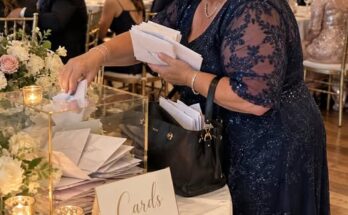
She swept into my mother’s house carrying an expensive bottle of wine and wearing the same confident smile she had worn while emptying our wedding card box.
Behind her came my husband, Daniel.
He looked miserable.
He had spent most of the previous day trying to convince me that his mother had simply “misunderstood” how wedding gifts worked.
I had asked him one question.
“Did you tell her she could take the envelopes?”
“No.”
“Then what exactly did she misunderstand?”
He hadn’t answered.
Now Mom greeted Linda warmly.
Too warmly.
“Come in,” she said. “I made pot roast.”
Linda smiled.
“Oh, how lovely.”
You would never have guessed that less than forty-eight hours earlier she had walked away from our wedding reception with a tote bag full of money intended for us.
We sat around Mom’s dining table.
Mom served potatoes.
Carrots.
Fresh bread.
She asked about the honeymoon.
She complimented Linda’s earrings.
She even poured her wine.
I spent the first fifteen minutes wondering whether my mother had lost her mind.
Linda apparently thought the same thing I had thought at first.
That there would be no consequences.
By dessert, she had completely relaxed.
Then Mom stood.
“I made something special.”
Linda smiled.
“Oh, you didn’t have to.”
“I wanted to.”
Mom disappeared into the kitchen.
When she returned, she wasn’t carrying cake.
She was carrying a large white binder.
She placed it directly in front of Linda.
Linda’s smile disappeared.
“What’s this?”
Mom sat down.
“The wedding.”
Linda laughed nervously.
“I’m sorry?”
“The accounting.”
Daniel looked at me.
I shrugged.
I genuinely had not seen the binder before.
Mom opened it.
Inside were copies of every wedding invoice.
Venue.
Catering.
Flowers.
Photography.
Music.
Decorations.
Cake.
Transportation.
Even the little personalized napkins Linda had insisted were absolutely necessary.
Mom turned the binder toward her.
“You said you took your half of the gifts because you paid for half the wedding.”
Linda crossed her arms.
“Well, yes. We contributed significantly.”
“Excellent.”
Mom smiled.
“Then this should be easy.”
She slid a calculator across the table.
Linda stared at it.
Mom continued.
“The total wedding cost was forty-two thousand six hundred and eighty dollars.”
I knew the wedding had been expensive.
But hearing the complete number aloud still made my stomach tighten.
Mom pointed to the first page.
“I paid twenty-one thousand three hundred and forty dollars.”
Then she looked at Linda.
“And according to my records, you and your husband paid eleven thousand.”
Linda’s face changed.
“That can’t be right.”
Mom calmly turned several pages.
“Venue deposit: me.”
Another page.
“Catering deposit: me.”
Another.
“Photographer: bride and groom.”
Another.
“Flowers: split between us.”
Then she reached the final sheet.
“Your total contribution was eleven thousand four hundred and twenty dollars.”
Linda looked toward Daniel.
“That isn’t everything.”
“It’s everything I could document,” Mom replied. “If I missed something, show me the receipt.”
Linda said nothing.
Mom folded her hands.
“So when you said you were taking ‘your half,’ I became curious.”
The room went quiet.
“How much did you take from the card box, Linda?”
She looked offended.
“I didn’t count it.”
Mom smiled.
“I thought you might say that.”
She reached for another folder.
This one was thinner.
My pulse quickened.
“The photographer recorded the gift table from approximately 9:42 until 10:06.”
Linda’s face went pale.
Daniel leaned forward.
“What?”
Mom turned toward him.
“Your photographer sent the raw footage this morning.”
Linda immediately spoke.
“You had no right to—”
“It was my daughter’s wedding footage,” Mom replied calmly. “She requested a copy.”
I had.
Although I hadn’t known why Mom wanted it so urgently.
She slid several printed photographs across the table.
There was Linda beside the card box.
Linda opening it.
Linda removing envelopes.
Linda placing them into her tote bag.
One photograph even captured her checking the hallway before reaching for another handful.
Daniel stared at the pictures.
“Mom.”
Linda’s eyes flashed.
“I told you. I was keeping them safe.”
Mom nodded.
“Wonderful. Then returning them shouldn’t be a problem.”
Linda pushed her chair back.
“I don’t appreciate being interrogated.”
“You’re not being interrogated.”
Mom’s voice remained almost pleasant.
“I’m giving you an opportunity.”
“For what?”
“To correct a very ugly mistake privately.”
The temperature in the room seemed to drop.
Mom reached into the binder and removed a list.
“At least seventeen guests have already contacted my daughter because their thank-you checks have not been deposited.”
My mouth fell open.
I hadn’t known that.
Mom continued.
“Several wrote checks directly to the newlyweds. Those checks obviously cannot be deposited by you.”
Linda’s lips tightened.
“But many guests gave cash.”
Nobody spoke.
Mom leaned back.
“And that is where this becomes interesting.”
Daniel looked at his mother.
“How much was in the bag?”
Linda glared at him.
“You’re taking her side?”
“It’s not about sides. How much money did you take?”
“I paid for your wedding!”
“You paid part of it.”
“I raised you!”
Daniel stared at her.
“That has nothing to do with stealing wedding gifts.”
Linda stood.
“Stealing?”
Her voice rose.
“You’re calling me a thief?”
For the first time, Mom’s pleasant expression vanished.
“You walked into my daughter’s wedding, opened a gift box that did not belong to you, removed envelopes addressed to the bride and groom, and carried them home without permission.”
She paused.
“What word would you prefer?”
Linda stared at her.
I had spent the entire previous day imagining myself screaming those exact accusations.
But Mom didn’t need to raise her voice.
That somehow made every word hit harder.
Linda grabbed her purse.
“I’m leaving.”
Mom didn’t move.
“Of course.”
Then she added quietly:
“But if the envelopes are not returned by noon tomorrow, my daughter will contact every guest whose gift is missing and ask them to confirm what they gave.”
Linda froze.
Mom continued.
“And then she will take the photographer’s footage and those statements to the police.”
Daniel closed his eyes.
“Mom, please just return everything.”
Linda turned toward him.
“You would embarrass your own mother?”
Daniel looked exhausted.
“You embarrassed yourself.”
She left without dessert.
The front door slammed so hard one of Mom’s framed photographs rattled.
For several seconds, none of us spoke.
Then I looked at my mother.
“You planned all of this?”
She picked up her coffee.
“I planned enough.”
“Why didn’t you let me confront her at the wedding?”
Mom looked toward me.
“Because there were nearly two hundred guests there.”
“So?”
“So if you had confronted her while you were angry, she would have cried.”
I thought about it.
“She would have said you misunderstood.”
Probably.
“She would have accused you of ruining your own reception.”
Definitely.
“And everyone would have remembered the fight instead of your wedding.”
I slowly sat back.
Mom reached across the table and squeezed my hand.
“She wanted you emotional.”
“Why?”
“Because emotional people are easier to dismiss.”
That sentence stayed with me.
The following morning, at 10:17, Daniel received a message from his mother.
Come get the bag.
We drove to Linda’s house together.
She didn’t invite us inside.
She opened the front door, handed Daniel the same large tote bag from the wedding, and said,
“I hope you’re happy.”
Daniel looked inside.
The envelopes were there.
Some had been opened.
That hurt.
She hadn’t simply taken the gifts.
She had read what people wrote.
She had counted the money.
At home, Daniel and I spent nearly three hours going through everything.
The final amount stunned us.
$14,760 in cash and checks.
Fourteen thousand seven hundred and sixty dollars.
Linda’s supposed “half.”
More than she had contributed to the entire wedding.
There were cards from my coworkers.
My elderly aunt.
Daniel’s childhood friends.
My mother’s neighbors.
One envelope contained two hundred dollars from my former elementary-school teacher, along with a handwritten note saying she hoped we would use it toward our first home.
I started crying.
Not because of the money.
Because Linda had looked at all those expressions of love and seen reimbursement.
Daniel sat beside me.
“I’m sorry.”
I wiped my face.
“You didn’t take them.”
“No.”
He stared at the envelopes.
“But I spent years pretending this kind of behavior was normal.”
I looked at him.
He continued.
“When she controlled birthday money, I called it parenting. When she demanded part of my graduation gifts, I called it helping with expenses. When she asked how much you earned before she asked what you did for work…”
He shook his head.
“I should have seen this.”
I reached for his hand.
“You see it now.”
But I also made something clear.
“I’m not spending our marriage fighting your mother for you.”
“You shouldn’t have to.”
“If she crosses a boundary, I need you beside me. Not explaining her to me.”
He nodded.
“You will have me.”
And he kept that promise.
At first, Linda refused to apologize.
For three months, she told relatives that my mother had “humiliated” her.
Unfortunately for Linda, she also told everyone she had merely taken back the exact amount she paid toward the wedding.
Then my uncle asked the obvious question.
“If you only paid eleven thousand, why did you take almost fifteen?”
The story changed after that.
Suddenly it was a misunderstanding.
Then a bookkeeping error.
Then she claimed she had intended to return the extra money later.
Each explanation contradicted the previous one.
Eventually, people stopped asking.
Daniel and I didn’t cut her out of our lives completely.
But things changed.
Holidays became shorter.
Money was never discussed.
She never had access to our house keys.
And when our daughter was born three years later, Linda discovered something she had never experienced with Daniel before.
Boundaries.
One Christmas, she complained that my mother was allowed to babysit overnight while she wasn’t.
Daniel answered before I could.
“My mother-in-law has never stolen fourteen thousand dollars from us.”
I nearly choked on my coffee.
Linda did not find it funny.
Five years after our wedding, Mom and I were cleaning out an old cabinet when we found the white binder.
“The famous dinner,” I said.
Mom smiled.
“You remember.”
“How could I forget?”
I flipped through the pages.
Receipts.
Invoices.
Photographs.
Every detail.
Then I looked at her.
“Were you really going to call the police?”
Mom raised an eyebrow.
“Absolutely.”
I laughed.
“You looked so calm.”
“That was the point.”
I closed the binder.
For years, I thought the lesson of that dinner was that my mother had outsmarted my mother-in-law.
But eventually I realized it was bigger than that.
Mom had taught me how to deal with people who depended on your discomfort to escape consequences.
You don’t always need to scream.
You don’t need a public scene.
And you certainly don’t need to become cruel simply because someone treated you badly.
Sometimes you sit them down.
Serve dinner.
Put the receipts on the table.
And let the truth become uncomfortable enough all by itself.
Linda thought she had taken her share from our wedding.
Instead, she gave us something far more valuable.
She taught Daniel and me exactly what kind of marriage we needed to build—
one where love did not excuse bad behavior,
family did not erase boundaries,
and nobody, no matter whose mother they were, got to reach into our life and take whatever they believed they deserved.