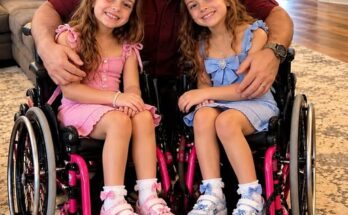
PART 2 — THE SECRET THEIR MOTHER BURIED
For several seconds, I couldn’t hear anything except the refrigerator humming behind me.
The paper in my hands trembled.
Patient prognosis was never considered definitively permanent.
Below those words was Colette’s signature.
My former wife.
The woman who had walked out of our house twelve years earlier because, according to her, she couldn’t spend the rest of her life raising two daughters who would never walk.
“Dad?”
Brielle’s voice sounded distant.
I read the sentence again.
Then again.
It didn’t change.
“What does this mean?” I asked.
Neither girl answered immediately.
Taryn turned her wheelchair slightly toward me.
“It means the doctors weren’t as certain as you were told.”
I looked at her.
“As
I
was told?”
Brielle lowered her eyes.
My stomach twisted.
“There’s more, isn’t there?”
She nodded.
I stood too quickly and nearly knocked the chair over behind me.
“Tell me.”
“Dad—”
“Please.”
My voice broke on the word.
That frightened them more than shouting would have.
I had spent eighteen years trying not to let my daughters see fear control me.
When they were little, I smiled through surgeries.
I joked during hospital stays.
I learned how to repair wheelchair brakes at midnight, how to argue with insurance companies without losing my temper, how to carry two sleeping six-year-olds from the car when both of them had cried themselves exhausted after physical therapy.
I had promised myself I would always be the solid thing in their lives.
But now my hands were shaking.
Taryn reached toward the folder.
“There was an experimental treatment program when we were younger.”
I stared at her.
“What?”
“At a pediatric spinal research center,” Brielle said. “The treatment wasn’t guaranteed, but the notes say both of us showed markers that made us possible candidates.”
My throat tightened.
“When?”
Brielle hesitated.
“Right before Mom left.”
The kitchen seemed to tilt beneath me.
I sat down again.
“No.”
Taryn pulled another sheet from the folder.
“There were consultations.”
“Consultations with who?”
“Specialists.”
I grabbed the paper.
Dates.
Hospital names.
Evaluation summaries.
Notes about nerve response.
Possible future mobility improvement.
And beside several appointments was the same name.
Colette Mercer — Mother / Guardian Present.
I searched for mine.
Nothing.
“Why wasn’t I there?”
Neither girl spoke.
I flipped another page.
Then another.
“What the hell was happening?”
“Dad,” Brielle whispered.
I looked up.
Her expression was full of something I hated seeing on my daughters.
Pity.
“Don’t look at me like that.”
She blinked.
“I’m not.”
“Yes, you are.”
I stood again and walked toward the sink because I suddenly needed distance from those papers.
Twelve years.
For twelve years, I had believed the same story.
Permanent.
No meaningful recovery.
Adapt your expectations.
Focus on independence rather than restoration.
Those phrases had shaped our entire lives.
I had rebuilt the bathroom.
Lowered countertops.
Installed ramps.
Fought with school administrators.
Moved bedrooms downstairs.
Taken extra shifts to afford therapy insurance wouldn’t cover.
None of that had been a burden.
Not once.
I would have rebuilt the whole world for my girls.
But if there had been another possibility—
If someone had hidden it—
I turned around.
“Where did you get this?”
Taryn exchanged a glance with Brielle.
“That’s complicated.”
“Try me.”
Brielle folded her hands.
“Dr. Mercer requested our childhood records after she noticed the reflex.”
“Dr. Mercer?”
I remembered the name from the folder.
Their new specialist.
“Yes.”
“And she found this?”
“Some of it.”
“Some?”
Taryn nodded.
“The hospital archives were incomplete.”
My jaw tightened.
“Why?”
“According to them, several records were transferred out years ago.”
“Transferred where?”
“They don’t know.”
I laughed once, without humor.
“Medical records don’t just disappear.”
Brielle looked down.
“Apparently these did.”
I stared at the folder again.
Then something caught my attention.
“Wait.”
I picked up the first report.
“Mercer.”
The girls went still.
I looked at Brielle.
“Your doctor’s name is Mercer?”
“Yes.”
“And Colette’s maiden name was Mercer.”
Neither of them answered.
My heartbeat changed.
Slow.
Heavy.
Dangerous.
“Who is this doctor?”
Taryn’s face went pale.
“Dad…”
“Who is she?”
Brielle whispered, “Dr. Evelyn Mercer.”
I knew that name.
I had not heard it in nearly twenty years, but I knew it.
Colette had an older sister.
A brilliant older sister she almost never spoke about.
Evelyn.
Medical school.
Neurology, I thought.
There had been some kind of falling-out before Colette and I married.
I had never met her.
“Evelyn Mercer is your aunt.”
“Yes,” Brielle said.
The word hit harder than anything else had.
I stared at both of them.
“You’ve been seeing Colette’s sister?”
“She contacted us first,” Taryn said quickly.
“When?”
“Four months ago.”
“How?”
“Through the university hospital.”
“And you didn’t tell me?”
“We didn’t know who she was at first.”
I pressed my palms against the table.
“Then you found out.”
“Yes.”
“And still said nothing.”
Brielle’s voice tightened.
“Because we knew what Mom did to you.”
“What your mother did to
you
.”
“That too.”
“No, Brielle. Not ‘that too.’ You were six years old.”
My voice rose despite myself.
“She left two six-year-old girls.”
Brielle flinched.
Immediately, guilt crashed through me.
I shut my eyes.
“I’m sorry.”
“It’s okay.”
“No, it isn’t.”
I sank back into the chair.
“I’m not angry at you.”
Taryn gave me a small, sad smile.
“You look pretty angry.”
“I’m angry at twelve years of lies.”
That silenced all three of us.
After a moment, Brielle rolled closer.
“Dad, Aunt Evelyn thinks Mom may not have been the only person hiding things.”
I looked at her.
“What does that mean?”
“She said some of our early records don’t make medical sense.”
My skin prickled.
“How?”
Taryn picked up a report.
“She found differences between the scans described in the physician notes and the prognosis we were eventually given.”
“Say that in English.”
Brielle took a breath.
“The damage was serious. Very serious. But the early notes say there was preserved nerve activity below the injury.”
I stared at her.
“And that matters?”
“A lot.”
“Enough that you could have walked?”
“No one can say that.”
Her answer was careful.
Almost clinical.
I hated how familiar she had become with speaking that way.
“But,” Taryn added, “it could have justified more aggressive treatment.”
“What kind of treatment?”
“Electrical stimulation. Intensive neurorehabilitation. Experimental programs.”
“And you’re doing those things now?”
“Some of them.”
I looked at Brielle.
“That’s why you stood?”
She nodded.
“Partly.”
I swallowed hard.
“And your foot?”
Taryn smiled faintly.
“Started moving three weeks ago.”
I stared at my daughters.
For twelve years, I had trained myself not to dream about this.
Hope could be cruel when doctors kept taking it away.
When the girls were little, every twitch used to send me running for a camera.
Every movement became a possibility.
Then a specialist would explain reflexes.
Muscle spasms.
Involuntary contractions.
Eventually, I stopped asking if they might walk someday.
Not because I stopped caring.
Because I saw what the question did to them.
I refused to make them feel that the lives they already had were somehow unfinished.
“You should have told me,” I whispered.
Brielle reached for my hand.
“We wanted to.”
“When?”
“Every day.”
“Then why didn’t you?”
Her eyes filled again.
“Because you gave us everything.”
I frowned.
“That doesn’t answer me.”
“Yes, it does.”
Her fingers tightened around mine.
“You spent twelve years making sure we never felt broken.”
I looked away.
“You learned every curb in this town that didn’t have a proper ramp. You drove two hours for therapists. You fought our middle school for an elevator key. You slept in a chair for six nights after my surgery.”
“Any father would.”
“No,” Taryn said quietly. “Not any father.”
I looked at her.
She continued.
“We wanted one thing that wasn’t another problem you had to solve.”
The anger inside me cracked.
Underneath it was something much worse.
Love.
Fear.
Grief for years I couldn’t get back.
“You two were never problems.”
“We know.”
“Do you?”
Brielle nodded.
“That’s why we waited.”
Before I could respond, my phone vibrated on the counter.
Unknown number.
Normally I would have ignored it.
Something made me answer.
“Hello?”
Silence.
Then a woman spoke.
“Emmett?”
Every muscle in my body locked.
There are voices time doesn’t erase.
Older.
Softer.
Changed around the edges.
But recognizable.
Colette.
I stood slowly.
Brielle and Taryn watched my face.
“Where did you get this number?”
A pause.
“Evelyn gave it to me.”
I looked at the girls.
Neither appeared surprised.
“You knew she might call?”
“No,” Taryn said immediately.
I turned away.
“What do you want, Colette?”
“I need to talk to you.”
“Twelve years late.”
“I know.”
“No, I don’t think you do.”
“Emmett—”
“You walked out.”
“I know.”
“You told me our daughters would never improve.”
“I know.”
“You knew that might not be true.”
Silence.
That silence answered me.
My grip tightened around the phone.
“Why?”
Her breath caught.
“I can explain.”
“Explain why you abandoned them?”
“No explanation fixes that.”
At least she had the decency to say it.
“Then what exactly are you offering?”
“The truth.”
I laughed bitterly.
“You should have tried that in 2014.”
Brielle looked at me sharply.
I walked into the living room.
“Did you know they were candidates for treatment?”
“Yes.”
One word.
Quiet.
Devastating.
I closed my eyes.
“Did you hide it from me?”
Another pause.
“Yes.”
My knees nearly gave out.
I grabbed the back of the couch.
“Why?”
“Because I was terrified.”
“Of what?”
She started crying.
I felt nothing.
Or maybe I felt too much.
“You don’t get to cry now.”
“I know.”
“Stop saying that.”
“I was twenty-nine, Emmett. We were drowning in bills. The girls needed more care every month. Then Dr. Halpern told me the experimental program could take years, might fail, and insurance wouldn’t cover most of it.”
“So you decided I didn’t deserve to know?”
“No.”
“That is exactly what you decided.”
“I made a terrible choice.”
“You made hundreds of terrible choices. Every day you stayed gone was another one.”
There was a long silence.
Then she said something that changed the conversation.
“I didn’t leave because of the girls.”
My breathing stopped.
“What?”
“I lied about that.”
I stared toward the kitchen.
Both daughters were watching me.
“What are you saying?”
“I left because I found out what had been done.”
Cold spread across my shoulders.
“What had been done by who?”
“Emmett, not over the phone.”
“No. You don’t get to control this conversation.”
“I’m trying to protect—”
“Don’t.”
My voice came out sharper than I intended.
“Do not use that word with me.”
She went quiet.
“You haven’t protected those girls in twelve years.”
“I know.”
“Then tell me now.”
I heard her breathing.
Finally, she whispered, “The diagnosis you received wasn’t the original diagnosis.”
I froze.
“What?”
“The report you were given had been changed.”
Behind me, Brielle gasped.
Taryn covered her mouth.
I turned the phone to speaker.
“Say that again.”
Colette hesitated.
“The final prognosis was changed.”
“By who?”
“I don’t know.”
“You expect me to believe that?”
“I know who signed it. I don’t know who ordered it.”
“What does that even mean?”
“There were two versions.”
My mind raced.
“One said improvement was unlikely but possible,” she continued. “The other said the damage was permanent.”
“Why would anyone change that?”
“That’s what I was trying to find out.”
“Twelve years ago?”
“Yes.”
I looked at the folder on the table.
“And instead of telling me, you disappeared.”
“I thought I was being watched.”
I almost hung up.
“This is insane.”
“I know how it sounds.”
“No, Colette. You don’t get to turn abandoning your family into some conspiracy.”
“I’m not.”
“Then prove it.”
She fell silent.
Finally, she said, “Look at page thirty-seven.”
Brielle immediately started flipping through the folder.
Thirty-four.
Thirty-five.
Thirty-six.
Thirty-seven.
There was a photocopied neurological assessment.
“Bottom-right corner,” Colette said.
I leaned over Brielle’s shoulder.
A physician’s signature.
Dr. Warren Halpern.
“I see it.”
“Now look at the date.”
April 8.
Twelve years earlier.
“Okay.”
“Now look at the hospital discharge paperwork from the week after.”
Taryn found it.
Another signature.
Halpern again.
“What am I looking for?”
“The middle initial.”
I compared them.
The first signature read Warren
J.
Halpern.
The second read Warren
T.
Halpern.
I stared.
“That could be a typo.”
“It isn’t.”
“How do you know?”
“Because Warren Halpern’s middle name is James.”
A chill crept through me.
“Then who signed the other document?”
“I don’t know.”
Brielle whispered, “Oh my God.”
Colette continued.
“I found it three weeks before I left.”
“And you told no one?”
“I confronted Halpern.”
“What did he say?”
“He denied ever signing the permanent-prognosis report.”
The room went completely still.
“What?”
“He said the document wasn’t his.”
My pulse hammered.
“Did you report it?”
“I tried.”
“To who?”
“Hospital administration.”
“And?”
“Two days later, the original records vanished.”
Taryn looked at me.
Her face had gone white.
I spoke carefully.
“You expect me to believe hospital records disappeared because you asked questions?”
“No.”
For the first time, there was something in Colette’s voice that sounded different.
Not shame.
Fear.
“I expect you to believe they disappeared because someone didn’t want us asking why two six-year-old girls had been written off medically when their tests didn’t support it.”
I looked at Brielle.
Then Taryn.
Both were silent.
“What happened next?” I asked.
Colette breathed in slowly.
“I received a letter.”
“What letter?”
“There was no return address.”
“What did it say?”
Her voice cracked.
“It said if I kept investigating, the girls could lose access to every specialist in the network.”
I laughed in disbelief.
“That’s ridiculous.”
“I thought so too.”
“Then why leave?”
“Because three days later your insurance denied Brielle’s therapy.”
I stopped.
I remembered that.
Of course I remembered.
It had been one of the worst months of my life.
Brielle’s coverage had suddenly been terminated.
I had spent two weeks calling insurers.
Eventually, someone said it was an administrative mistake.
Coverage was restored.
At the time, I thought nothing of it beyond bureaucratic incompetence.
“You think that was connected?”
“I knew it was.”
“How?”
“Because the letter predicted it.”
My mouth went dry.
Taryn whispered, “Dad…”
I raised a hand.
“Why didn’t you tell me?”
Colette started crying again.
“Because you would have fought.”
“Damn right I would have.”
“That was exactly why.”
My anger surged.
“So instead you abandoned us?”
“I thought if I disappeared, they would stop.”
“Who is
they
?”
“I didn’t know.”
“That isn’t good enough.”
“I KNOW!”
It was the first time she shouted.
Then her voice collapsed.
“I know, Emmett.”
Silence stretched between us.
When she spoke again, she sounded exhausted.
“I convinced myself leaving was temporary. That I would investigate from a distance. That once I knew who was responsible, I would come home.”
“Twelve years isn’t temporary.”
“I was ashamed.”
“That’s not an excuse.”
“No.”
“You could have called.”
“Yes.”
“You could have written.”
“Yes.”
“You could have come back when they were eight. Ten. Twelve. Sixteen.”
“Yes.”
Every answer made me angrier.
“I don’t care what scared you, Colette. You missed their entire childhood.”
“I know.”
“Stop saying—”
“I have cancer.”
The words cut through me.
I said nothing.
Brielle’s hand went rigid beneath mine.
Taryn stared at the phone.
Colette continued quietly.
“Pancreatic. Stage four.”
My anger didn’t disappear.
But it changed shape.
“Evelyn knows?”
“Yes.”
“How long?”
“Seven months.”
“And that’s why she contacted the girls?”
“No.”
Colette inhaled unevenly.
“I asked her not to.”
“Why?”
“Because I didn’t deserve to reappear just because I was dying.”
Brielle’s eyes filled with tears.
Taryn turned away.
I hated Colette for that.
Even now, twelve years later, she could hurt them simply by existing.
“Then why call?”
“Because Evelyn found the archive.”
My attention sharpened.
“What archive?”
“The missing files.”
I looked at the folder.
“Where?”
“In storage belonging to a medical research foundation that closed eight years ago.”
My heart pounded.
“What was in them?”
“I don’t know everything.”
“Then tell me what you do know.”
“There were files on thirty-one children.”
Brielle frowned.
“Thirty-one?”
“All with spinal conditions.”
I stared at the phone.
“What does that have to do with Brielle and Taryn?”
“They were part of a research cohort.”
The word meant little to me.
“What kind of cohort?”
“Children being evaluated for a nerve-regeneration study.”
Taryn looked stunned.
“We were in a study?”
“Candidates,” Colette corrected.
“But several children were removed from the program before treatment began.”
“Why?”
“I don’t know.”
I looked at Brielle.
“How many?”
Colette hesitated.
“Eleven.”
“And the girls?”
“Two of the eleven.”
My chest tightened.
“What happened to the others?”
“I don’t know.”
“You keep saying that.”
“Because every time I tried to find out, I hit a wall.”
I turned toward the window.
Outside, our street looked exactly as it had an hour earlier.
A neighbor washing his truck.
A child riding a bicycle.
Sunlight flashing across the pavement.
Nothing in the world looked different.
Yet my daughters’ entire medical history had just shifted beneath my feet.
“When can we see these files?”
Colette said nothing.
“Colette?”
“Evelyn has copies.”
“Good.”
“But there’s something else.”
Of course there was.
“What?”
“One file wasn’t stored with the others.”
“Whose?”
She hesitated.
“Taryn’s.”
Taryn’s face changed.
“My file?”
“Yes.”
“Why?”
“We don’t know.”
Brielle immediately took her sister’s hand.
I felt something primal rise inside me.
“What exactly was missing?”
“Her early imaging.”
I stepped closer to Taryn.
“All of it?”
“Almost.”
“Why hers and not Brielle’s?”
“That’s what Evelyn has been trying to determine.”
Taryn looked down at her legs.
For the first time that morning, I saw fear replace excitement.
I crouched beside her.
“Hey.”
She looked at me.
“Whatever this is, we handle it together.”
She tried to smile.
“What if something was wrong with me that they never told you?”
“Then we find out.”
“What if—”
“We find out.”
I took her hand.
“You hear me?”
She nodded.
Brielle wiped her cheek.
Then Colette spoke again.
“There’s one more reason I called today.”
I stood.
“What?”
“Evelyn believes Taryn’s missing scans may still exist.”
“Where?”
“In a private archive belonging to Warren Halpern.”
My jaw tightened.
“The doctor?”
“He retired nine years ago.”
“Where does he live?”
“Emmett—”
“Where?”
“I don’t think confronting him is smart.”
“I didn’t ask if it was smart.”
Brielle gave me a look.
“Dad.”
I ignored her.
“Where is he?”
Colette remained silent long enough that I thought she might refuse.
Then she said, “He’s dead.”
I stopped.
“What?”
“Three years ago.”
A strange disappointment hit me.
Not grief.
Something closer to rage losing its target.
“Then the archive belongs to his family?”
“No.”
“Who has it?”
“That’s the problem.”
I waited.
“His files were donated to the Mercer Neurological Foundation.”
Brielle frowned.
“Mercer?”
Colette didn’t answer.
Neither did Evelyn, because she wasn’t there.
But the name hung between us.
Mercer.
Colette’s maiden name.
Evelyn’s surname.
I slowly straightened.
“Your family owned the foundation?”
“My father founded it.”
I stared at the phone.
In twenty years, Colette had barely spoken about her father.
I knew he had died before we met.
I knew he had money.
I knew she hated discussing him.
That was nearly everything.
“What did your father do?”
“He was a neurosurgeon.”
My skin went cold.
“Was he involved with the girls’ treatment?”
“No.”
The answer came too quickly.
“Colette.”
“No. Not directly.”
“Not directly?”
She started crying again.
“Emmett, my father financed the research program.”
Nobody spoke.
I looked at my daughters.
The entire room seemed to narrow around them.
“So let me understand this,” I said slowly. “Your father funded the study my daughters were candidates for.”
“Yes.”
“And the records saying their condition might improve were changed.”
“Yes.”
“And eleven children were removed from that study.”
“Yes.”
“And you knew there was something wrong twelve years ago.”
“Yes.”
My voice dropped.
“What aren’t you telling me?”
Silence.
“Colette.”
“I didn’t find out until later.”
“Find out what?”
Her breathing turned shallow.
“Why the girls were removed.”
Brielle’s fingers tightened around mine.
“Why?” she asked.
Colette didn’t answer immediately.
When she did, her voice was barely audible.
“Because you refused something.”
I stared at the phone.
“I refused what?”
“A consent form.”
“What consent form?”
“You probably don’t remember.”
“I remember every form I ever signed for them.”
“You didn’t sign this one.”
My mind raced backward.
Hospital corridors.
Clipboards.
Consent packets.
Insurance authorizations.
Research questionnaires.
Then I remembered.
A young physician had approached me while the girls were hospitalized at five.
He wanted permission to collect spinal fluid and tissue samples for a long-term study.
The procedure carried risks.
I asked if it would directly benefit Brielle and Taryn.
He said no.
So I refused.
“That research sample form.”
“Yes.”
I felt sick.
“You’re telling me they were removed from treatment because I wouldn’t let someone use them for research?”
“I don’t know if that was the only reason.”
“But it was a reason?”
“Yes.”
Taryn whispered, “That’s illegal.”
Colette’s voice cracked.
“That’s why the records were changed.”
The sentence landed like a bomb.
I couldn’t speak.
Brielle could.
“Mom.”
It was the first time either girl had addressed her directly.
Colette made a sound somewhere between a gasp and a sob.
“Brielle?”
My daughter’s face hardened.
“You knew Dad blamed himself every time therapy failed.”
“Brielle…”
“You knew he thought there was nothing else he could have done.”
“I’m sorry.”
“You let him believe that?”
“I was trying—”
“Don’t say you were protecting us.”
Colette went silent.
Brielle’s tears spilled over.
“You don’t get to use us to excuse leaving.”
I put my hand on her shoulder.
She shook her head.
“No, Dad. She needs to hear it.”
Taryn stared at the speaker.
“So do we.”
Colette cried quietly.
“I know.”
Taryn’s voice trembled.
“No. You know now because we’re saying it.”
That silenced her.
Then Brielle said, “If you have anything else, send it to Aunt Evelyn.”
“Brielle—”
“We’re not ready to talk to you.”
“I understand.”
“No, you don’t.”
Brielle ended the call.
The kitchen fell silent.
I looked at her.
“You okay?”
She laughed through tears.
“No.”
“Me neither.”
That made Taryn laugh once.
Then all three of us did.
It wasn’t funny.
Nothing about it was funny.
But sometimes people laugh when grief has nowhere else to go.
I pulled both girls close.
For a long time, none of us spoke.
Then Taryn’s phone vibrated.
She glanced down.
Her expression changed.
“What?”
She held up the screen.
“Aunt Evelyn.”
Brielle leaned over.
There was a message.
I found something in Taryn’s archived file. Call me immediately. Do not contact Colette until we speak.
My stomach tightened.
Taryn pressed the call button.
Evelyn answered before the first full ring.
“Taryn?”
“We’re all here.”
There was a pause.
“Your father too?”
“Yes.”
“Put me on speaker.”
Taryn did.
Evelyn’s voice sounded controlled, professional.
Too controlled.
“Emmett, we haven’t met.”
“No.”
“I wish this introduction were happening differently.”
“What did you find?”
She exhaled.
“I recovered one image from Taryn’s original scan series.”
I looked at Taryn.
“And?”
“It doesn’t match the scans taken later.”
My pulse accelerated.
“What does that mean?”
“It means the anatomy is different.”
Taryn whispered, “Different how?”
Evelyn hesitated.
“Your spinal abnormality appears different in the earliest scan.”
Brielle frowned.
“Could the scan be mislabeled?”
“That was my first thought.”
“And?”
“I checked identifiers.”
My hand tightened around the edge of the table.
“It’s hers?”
“Yes.”
I stared at Taryn.
“What are you saying, Evelyn?”
Another pause.
Then she said words I would remember for the rest of my life.
“I’m saying Taryn’s later injury may not have been congenital.”
Nobody moved.
I felt all the air leave my lungs.
Taryn turned ghost-white.
“What?”
Evelyn continued carefully.
“The earliest scan suggests a condition that may have been treatable. The later scans show damage that appears more severe.”
“How much later?” I asked.
“About eleven months.”
My mind stopped.
“What happened during those eleven months?”
“I don’t know yet.”
“Was she injured?”
“I can’t say.”
“You just said—”
“I said the imaging suggests progression or additional damage. I need more records before I can determine why.”
Brielle squeezed Taryn’s hand.
Then Evelyn added, “But there’s something else.”
I shut my eyes briefly.
“Of course there is.”
“The recovered scan had a notation.”
“What notation?”
“It wasn’t made by Warren Halpern.”
“Who made it?”
Evelyn didn’t answer for several seconds.
When she finally spoke, her professional calm was gone.
“My father.”
Colette’s father.
The man who funded the program.
The grandfather Brielle and Taryn had never met.
“What did he write?”
Evelyn swallowed audibly.
Then she read it.
“
Do not enroll either twin until paternal consent issue is resolved. Maintain standard prognosis externally.
”
I stared at the phone.
“Maintain standard prognosis externally?”
Evelyn’s voice lowered.
“I believe that meant they intended to tell you something different from what the internal team knew.”
I felt physically sick.
Taryn whispered, “Because Dad refused the research?”
“Possibly.”
Brielle looked furious.
“That’s monstrous.”
Evelyn said nothing.
I looked at the Father’s Day card supplies still sitting unopened on the counter.
Colored paper.
Markers.
Glue.
The girls must have planned something before deciding to tell me the truth.
Such ordinary things.
Beside a folder that now contained the wreckage of twelve years.
I took a slow breath.
“Evelyn, I want everything.”
“You’ll have it.”
“Every scan.”
“Yes.”
“Every note.”
“Yes.”
“Every name connected to that research program.”
A pause.
“Yes.”
“And I want to know why your sister really left.”
Silence.
Longer this time.
“Emmett…”
“What?”
“There’s something Colette didn’t tell you.”
My jaw clenched.
“What now?”
“I don’t think she left only because she was afraid.”
Brielle stared at the phone.
Taryn stopped breathing for a moment.
“What does that mean?” I asked.
Evelyn’s voice became very quiet.
“She was paid.”
The kitchen vanished around me.
“What?”
“Three weeks after she left you, Colette received a transfer.”
“How much?”
Evelyn hesitated.
“Two hundred and fifty thousand dollars.”
Brielle covered her mouth.
Taryn’s eyes widened.
I felt something inside me go still.
“From who?”
“I only found that part this morning.”
“Evelyn.”
“From the Mercer Neurological Foundation.”
My hands became fists.
“So her own family paid her to disappear?”
“I don’t know what the payment was for.”
“I think we can make a pretty good guess.”
“There’s more.”
I laughed bitterly.
“There’s always more.”
“The transfer authorization wasn’t signed by my father.”
“Who signed it?”
I expected another doctor.
An administrator.
A lawyer.
Instead, Evelyn gave me a name I knew immediately.
A name that had been part of my life for nearly two decades.
A man who had helped build wheelchair ramps at our house.
A man who had watched Brielle and Taryn grow up.
A man who had eaten Thanksgiving dinner at our table almost every year.
“Daniel Cross.”
My throat closed.
Brielle stared at me.
Taryn whispered, “Uncle Daniel?”
He wasn’t really their uncle.
He was my best friend.
My business partner.
The person I had trusted most after Colette left.
I couldn’t speak.
Evelyn continued.
“Emmett, according to the foundation records, Daniel authorized Colette’s payment.”
I reached for the nearest chair.
“And there’s one final document.”
I barely managed the words.
“What document?”
“A visitor log from the research wing.”
My heartbeat thundered.
“The night Taryn’s medical records were altered, someone entered the archive room at 11:42 p.m.”
I knew what she was about to say before she said it.
Still, hearing it almost broke me.
“The visitor signed in as Daniel Cross.”
At that exact moment, someone knocked on my front door.
Three slow knocks.
Brielle looked toward the hallway.
Taryn froze.
Then my phone lit up with a text.
From Daniel.
Happy Father’s Day, brother. I’m outside. We need to talk.