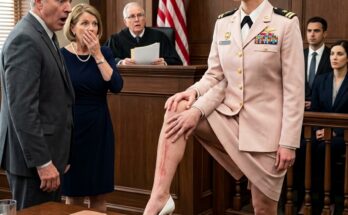
I stood slowly and picked up the copy of the so-called Property Relinquishment form.
For a moment, I said nothing.
My father’s attorney mistook my silence for fear.
My father mistook it for defeat.
He leaned toward my mother and whispered something that made her smile.
Then he looked directly at me.
“Give up,” he said quietly. “You’re a disgrace in that uniform.”
The words barely registered.
I had heard worse in deserts, on ships, in hospitals, and during nights when pain made sleep impossible.
I looked down at the document again.
October 14, 2019.
Military notary: Lieutenant Commander Thomas Lewis.
My chest tightened.
Judge Simmons cleared his throat.
“Commander Carter?”
I looked up.
“Yes, Your Honor.”
I stepped toward the bench.
“The signature attributed to me is false.”
My father’s attorney immediately stood.
“Your Honor, the document was properly notarized.”
“No,” I said.
My voice was calm.
Too calm.
“The notary certification is also false.”
My father laughed under his breath.
Judge Simmons looked at me carefully.
“On what basis are you making that statement?”
I turned the page toward him and pointed to the notary name.
“Because Lieutenant Commander Thomas Lewis could not have notarized this document on October 14, 2019.”
The room became quiet.
My father’s attorney frowned.
“And why is that?”
I looked at him.
“Because Thomas Lewis died on June 3, 2012.”
My mother’s face changed.
Not much.
Just enough.
Judge Simmons sat forward.
“Commander Carter, how do you know that?”
I swallowed.
“Because he died in my arms.”
No one moved.
Even my father stopped smiling.
Lewis had been my closest friend.
We had served together overseas.
He had been beside me when the convoy was hit.
I still remembered the smoke.
The screaming.
The twisted metal.
And Lewis pressing his field dressing against my leg while blood soaked through his own uniform.
He saved my life.
He did not survive long enough to save his own.
I reached into the folder I had brought with me.
“Your Honor, I have his official casualty report, his death certificate, and the Department of Defense record confirming the date of death.”
I placed the certified documents on the evidence table.
Judge Simmons read them slowly.
My father’s attorney went pale.
Then the judge looked at the forged document again.
“This notary stamp is dated seven years after Lieutenant Commander Lewis died.”
“Yes, Your Honor.”
The room erupted in whispers.
Judge Simmons struck his gavel.
“Order.”
My father stood.
“This is ridiculous. Evelyn could have forged those records.”
That was the moment everything changed.
I turned toward him.
“You really want to continue?”
He glared at me.
“You think wearing medals makes you better than us?”
“No.”
I held his stare.
“But forging the identity of a dead service member to steal property makes you worse than I thought.”
My mother whispered sharply, “Robert, stop talking.”
Judge Simmons heard her.
So did I.
The judge looked toward my parents’ attorney.
“Counsel, did you independently verify this notarization before submitting it?”
The attorney looked terrified.
“I was provided the document by my clients, Your Honor. They represented it as authentic.”
My father snapped toward him.
“You said this would work.”
The courtroom went completely silent.
My mother grabbed his arm.
“Robert!”
But it was too late.
Judge Simmons slowly removed his glasses.
“Mr. Carter, I strongly recommend that you stop speaking.”
My father realized what he had said.
His face drained of color.
I opened a second folder.
“There is more.”
Judge Simmons looked at me.
“What else?”
“This document contains a military case reference number.”
I pointed to the lower corner.
“It is designed to look like an archived Naval Legal Service record.”
The judge nodded.
“But?”
“That numbering system did not exist in 2019.”
My father’s attorney lowered himself into his chair.
I continued.
“And the seal used here belongs to a command that was decommissioned in 2015.”
My mother’s hand began shaking.
“How would you know that?” she asked.
I looked at her.
“Because I served in that command.”
My father slammed both palms against the table.
“This is all technical nonsense!”
Judge Simmons struck the gavel again.
“Sit down, Mr. Carter!”
He did.
Barely.
I turned back toward the judge.
“There is one more issue, Your Honor.”
I removed a sealed envelope.
“My grandfather anticipated that someone might challenge the transfer.”
My mother froze.
My father did not.
Not yet.
Judge Simmons accepted the envelope.
Inside was a letter written by my grandfather three months before he died.
The judge read silently.
Then his expression changed.
He looked toward my parents.
“Mr. Carter, were you aware your father executed a supplemental estate affidavit?”
My father said nothing.
The judge continued reading.
The affidavit stated that my grandfather had transferred the farmhouse and surrounding acreage to me intentionally and irrevocably.
It also explained why.
My grandfather knew my father had serious gambling debts.
He knew my parents had repeatedly pressured him to sell the farm.
And he knew they intended to use the proceeds to settle private debts.
So he had protected the property.
Not from strangers.
From his own son.
My father finally spoke.
“That old man hated me.”
I felt something in me break.
Not from pain.
From clarity.
Grandpa had never hated him.
He had simply stopped trusting him.
Judge Simmons continued.
“The affidavit also states that any attempt by Robert Carter or Margaret Carter to claim ownership should trigger an automatic review by the estate trustee.”
He looked toward me.
“Who is the trustee?”
I reached into my folder and placed another document on the table.
“Retired Judge Nathan Cole.”
My father went completely still.
Nathan Cole had served on the state appellate court for twenty-six years.
He had also been my grandfather’s closest friend.
And he was sitting in the back row of the courtroom.
I turned.
Judge Cole rose.
My mother gasped.
My father whispered, “No.”
Judge Simmons stared at him.
“Judge Cole, are you prepared to testify regarding the authenticity of the original trust documents?”
“Yes, Your Honor.”
That was the moment my father’s confidence disappeared.
Over the next forty minutes, everything unraveled.
Judge Cole confirmed the original property transfer.
A handwriting expert, already retained through the trustee, confirmed the relinquishment signature was forged.
Court records showed the document had been uploaded through an account linked to a private estate consultant hired by my parents.
Then came the detail that turned civil fraud into something much more serious.
The consultant had used the same dead military notary on six other documents.
Six.
All involving disputed property.
All involving elderly owners or estranged family members.
Judge Simmons immediately ordered copies preserved for criminal investigation.
My parents’ attorney requested permission to withdraw.
Granted.
My father began shouting.
“This is our family property!”
I finally turned toward him.
“No.”
My voice was quiet.
“That is the problem. You always thought family meant ownership.”
His face twisted.
“We raised you!”
“You punished me for becoming someone you couldn’t control.”
My mother looked away.
I continued.
“You didn’t come to my graduation.”
Silence.
“You didn’t come when I was injured.”
More silence.
“You didn’t ask whether I could walk again.”
My father’s jaw tightened.
“But twelve years later, you found me the moment you thought you could take thirty-one million dollars’ worth of land.”
The judge looked sharply at the appraisal.
The farmhouse itself was modest.
The land was not.
A development group had recently valued the acreage, mineral rights, and easements at just over thirty-one million dollars.
That was why my parents had suddenly remembered they had a daughter.
Not love.
Not regret.
Money.
Judge Simmons ruled the forged waiver invalid.
The deed remained mine.
But the hearing did not end there.
He referred the case to the district attorney.
Then he ordered the forged document, filing records, and associated trust papers preserved as evidence.
My father sat motionless.
My mother cried.
This time, there were no dramatic sobs.
Only quiet tears.
As I gathered my papers, my father looked at me.
“You destroyed this family.”
I paused.
Then I looked at him one last time.
“No.”
“You tried to destroy me.”
I glanced toward the forged document.
“You just finally left evidence.”
Three months later, my father and the estate consultant were indicted on fraud, forgery, conspiracy, and attempted theft charges.
My mother accepted a plea agreement and admitted she had known the waiver was fake.
She also admitted something I had suspected for years.
My father had spent decades telling her that my grandfather intended to leave everything to him.
When Grandpa chose me instead, my father became obsessed.
It was never about the farmhouse.
It was about being told no.
The estate consultant eventually cooperated with investigators.
The six other fraudulent property cases were reopened.
Two families recovered homes they had nearly lost.
One elderly veteran regained land that had belonged to his family since the 1940s.
That mattered to me more than my own case.
I kept the farmhouse.
Not because it was worth millions.
Because Grandpa had taught me how to repair fences there.
Because Lewis had once spent Christmas there when he had nowhere else to go.
Because after the explosion overseas, it was the first place where I managed to sleep through the night.
A year after the hearing, I stood on the porch watching contractors repair the old barn.
I had rejected three development offers.
Instead, I placed most of the acreage into a conservation trust.
The farmhouse remained mine.
The rest could never be sold for quick profit.
On the wall inside my study hung two things.
My grandfather’s letter.
And a photograph of Lewis.
Sometimes visitors asked why I kept the forged waiver framed beneath them.
I always gave the same answer.
Because it reminded me of something important.
My father thought the uniform made me weak.
He thought loyalty made me naive.
He thought distance meant I had forgotten who I was.
He was wrong.
The uniform never made me powerful.
The medals never made me powerful.
What mattered was that I had learned, long before Courtroom 4B, how to stay calm when someone believed they had already won.
And at 10:00 that morning, my father walked into court believing he had stolen my future with one perfect piece of paper.
By noon, that same piece of paper had become the evidence that destroyed his entire scheme.