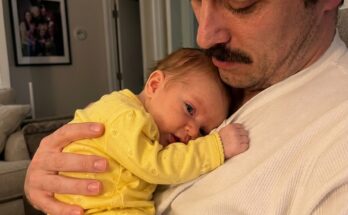
The first thing I noticed about the baby was the missing sock. The second was the familiar birthmark on her cheek. By the time I saw her mother’s name in the file, I already knew I was not leaving the transitional care placement unchanged.
I ran into Greg at a diner off Route 9 for the first time in nine years. He told me he’d been the 20th family to say no to a baby girl. “Twentieth,” he said. “They actually told us the number. Like it was supposed to make us feel better.”
I stared at him over my coffee.
“No to what?” He turned his cup around twice before answering. “She has Down syndrome. We got the call, we said yes, and then we read the file and we just… couldn’t.” Greg had always talked with his hands when we were kids. That morning, they stayed wrapped around his coffee cup.
I asked how long she’d been waiting.
“Fourteen months. She’s in a transitional care placement in Colfax.” He looked at the table. “You’ve got money. You’re on your own. Maybe you could send something. Cover a few things for her.”
“I’ll think about it.” Greg nodded.
For a while we talked about easier things.
People we’d gone to school with. Businesses that had closed. How strange it felt that the old bowling alley was now a pharmacy. Then I asked the question I’d been avoiding since I came back. “Do you ever hear from Rachel?”
Greg stopped moving his cup.
Rachel had been my first real love. Not my first girlfriend. My first love. We started dating at 17 and stayed together through most of college. I thought we’d get married.
She thought so too, at least for a while.
Then life got complicated.
I took a job in Chicago. She stayed behind to care for her mother. We tried long distance. We failed at it.
There was no betrayal. No screaming breakup.
Just two people becoming exhausted by distance until every phone call started sounding like an obligation. The last time I spoke to Rachel, nine years earlier, she told me she couldn’t keep waiting for a life that might never happen. I told her I understood. I didn’t. Greg rubbed his jaw.
“Nobody really sees her anymore.”
“What does that mean?” He hesitated. “I heard she died.” My stomach tightened. “What?”
“I don’t know if it’s true.”
“Who told you?” “Someone told someone. You know this town.” “How long ago?” “A year, maybe.” I stared at him. Rachel was 37.
People like Rachel weren’t supposed to become rumors.
I left the diner an hour later, but both stories followed me. Rachel, and the little girl in Colfax. I barely slept that night. The next morning, I drove to Colfax. I didn’t call ahead.
That was my first mistake.
The care center was a small building connected to a larger pediatric services campus. A woman at the front desk explained that I couldn’t simply walk in.
I couldn’t just meet a child because someone had mentioned her over breakfast. That was fair enough. I told her Greg’s name.
I explained what he’d told me.
She made several calls. Then she asked for my driver’s license and had me wait. Forty minutes later, a case aide named Nora came back carrying a little girl in a yellow sleeper. “You’re Pete?” “Yes.”
“This is Maisie.”
Maisie had one sock on. Her dark hair stuck up slightly on one side. She stared at me with wide brown eyes. Nora said, “Would you like to hold her?” I wasn’t sure why I said yes. Maybe because I’d driven 30 minutes.
Maybe because I already felt foolish standing there.
Nora handed her to me carefully. Maisie was warm and heavier than I expected. For about five seconds, she simply studied my face. Then she grabbed the edge of my collar and held on. Nora smiled.
“She is quite friendly.”
I laughed softly. “I can see that.” Maisie made a tiny sound that was somewhere between a hum and a sigh. Then she turned her face toward me. That’s when I saw it.
A pale brown birthmark high on her left cheek.
It was small and almost oval. My chest tightened. Rachel had one in nearly the same place.
When we were 19, she used to complain about it. I’d kiss that spot and tell her it was my favorite thing about her face.
Maisie reached for my chin.
I nearly dropped her from the shock of the memory. “Are you okay?” Nora asked. “Yeah.” I wasn’t. I stood there longer than I meant to.
Then I asked, “Can I see her file?”
Nora hesitated. “I can show you the nonconfidential placement summary if you’re seriously interested in learning about her. Some information is protected.” “That’s fine.” She brought me into an office. Maisie stayed with another staff member.
Nora set a folder in front of me.
“It’s mostly medical and placement history.”
I opened it. Date of birth. Weight. Diagnosis confirmed shortly after birth.
Cardiac screening.
Early intervention notes. Developmental evaluations. Then I turned to the second page. I read one line twice. Mother: Rachel.
I couldn’t breathe.
“Can I use your phone?” I asked. Nora looked confused. “My phone’s in the car.” She pushed the desk phone toward me. I dialed a number I hadn’t called in nine years: Rachel’s.
I still knew it.
It rang and rang, and no one answered.
There was no voicemail, nothing. I hung up. Then I called again. The same thing happened.
Nora watched me carefully.
I looked at the file. “What happened to Maisie’s mother?” Nora’s expression changed. “She died during childbirth.” I stared at her. “That’s tragic.”
I don’t remember sitting down, but suddenly I was sitting.
For several seconds, I heard nothing except the hum of the air conditioner. Rachel had been dead for 14 months. The Rachel with the same birthmark Maisie has. The Rachel who was my first love. Her daughter had been sitting 20 feet away from me.
And I had found out because Greg happened to mention a baby nobody wanted.
I covered my face. Nora gave me time. Eventually, I asked, “What about family?” “Her maternal grandmother was contacted.” “And?” “She declined placement.”
That didn’t surprise me as much as it should have.
Rachel’s mother, Marlene, had been drinking for as long as I’d known her. Sometimes she stayed sober for months. Then something would happen, and she’d disappear into alcohol again. Rachel had spent half her childhood taking care of the woman who was supposed to take care of her. Her father had walked out when she was eight.
I remembered Rachel telling me about it once.
“He packed his bags and left,” she said. “He decided none of us were worth staying for.”
I asked Nora about Maisie’s father. “The records indicate he was identified, but he did not pursue custody. I can’t give you more than that.” I nodded. I wasn’t entitled to more.
I left Colfax two hours later.
I should have gone home like I intended to. Instead, I drove to Marlene’s house. I still remembered the address. The neighborhood looked smaller than it had when I was young. Marlene’s house looked worse.
The grass was high.
One shutter hung crooked. There were empty cans beside the recycling bin. I knocked. Nobody answered. I knocked again.
Eventually the door opened.
Marlene looked 30 years older than I remembered. She stared at me. Then she said, “Who are you?” “Hi, Marlene. I’m Pete. I don’t know if you remember me.” Her eyes were fixed on my face, and then her expression changed.
She grabbed the doorframe. “You heard.”
“I just learned about it today. I would have come earlier had I known. I’ve also met Maisie.” For a second, I thought she was going to cry. Her eyes flooded. “You saw her?” “Yes.” Marlene looked away.
“She looks like Rachel.”
“I know.” She let me inside. The house smelled stale.
There were bottles on the kitchen counter. One was open.
Marlene didn’t bother hiding it.
I sat across from her at the same kitchen table where Rachel and I used to do homework. “What happened?” I asked. Marlene took a long breath. “Rachel met someone.” “Who?” “Derek. A good-for-nothing man. He was a floor manager at the restaurant she worked at.”
“Was he Maisie’s father?”
“Yes.” “What happened to him?” Marlene gave a bitter laugh. “He was wonderful until things got hard.” I already knew the type. Rachel had spent her entire life afraid of becoming attached to someone who would leave.
Somehow she had found one anyway.
Marlene continued. “When Rachel got pregnant, he stayed. When the doctors said there might be complications, he got nervous. Then Rachel died.” She stopped. Her mouth trembled. “And when they told him Maisie had Down syndrome, he was gone within days.”
I stared at her.
“He abandoned his daughter?” “He said he couldn’t do it.” “Couldn’t or wouldn’t?” “You tell me.” I looked around the kitchen.
Then I asked the harder question.
“Why didn’t you take her?” Marlene looked straight at me. “Look at me, Pete.”
I did. “I’m still drinking.”
I realized then that her speech was also slurring.
“I couldn’t raise Rachel right half the time,” she said. “You think I should take a baby who needs appointments, therapy, and stability?” “You could get help.” “And then what happens when I disappear into this again?” She tapped the bottle. I didn’t know what to say.
Her eyes filled.
“Not taking Maisie is probably the first responsible thing I’ve done in years.” That sentence stayed with me. Before I left, I asked where Rachel was buried. Marlene gave me directions. The cemetery was on the edge of town.
I found Rachel’s grave beneath a maple tree.
Her headstone was simple. Rachel. Beloved Daughter and Mother. I sat in the grass. For a long time, I said nothing. Then I laughed once because I didn’t know what else to do.
“Nine years,” I said.
The wind moved through the branches. “I thought about calling you a thousand times.” My voice broke. “I didn’t.” I looked at her name.
“I’m sorry.”
I told her about Maisie. About the yellow sleeper. The missing sock. The way she grabbed my collar. “I saw the birthmark.”
I wiped my face.
“She’s beautiful, Rach.” Then I said the only promise I felt I had the right to make. “If they’ll let me, I’m going to make sure she has someone who stays.” The next morning, I called Nora. “I want to know what I have to do.”
There was a pause.
“To do what?” “To be considered for Maisie’s placement.” That began the longest process of my life. I stayed in town. That wasn’t difficult financially.
My parents had died six years earlier, within 11 months of each other.
I never sold their house. I couldn’t. I had paid a local company to maintain it, keep utilities running, handle repairs, and stop it from falling apart.
For years, I thought keeping it had been an expensive emotional weakness. Suddenly, I needed this home.
I was no longer just visiting. I was moving back in.
My work as a financial consultant was mostly remote anyway. Then came the paperwork. Applications. References. Background checks. Fingerprinting.
Financial records.
Health forms. Training. Home inspections. Interviews. The social worker assigned to me, Diane, was polite but relentless.
“Who helps you if you’re sick?”
“My friend Greg.”
She raised an eyebrow. “Anyone else?” I built a list. My cousin Rebecca lived an hour away.
An old family friend named Marcus lived nearby.
I found a pediatrician. I researched early intervention programs. I attended appointments with permission. I learned more about Down syndrome in six months than I had learned in my entire life. One afternoon, Diane sat across from me in my parents’ living room.
“I need to ask something uncomfortable.”
“Okay.” “Are you doing this because of Rachel?” I looked at her. “Partly.” She waited. I continued.
“Rachel is why I walked through the door.”
“And Maisie?” I thought about the little girl who now laughed every time I pretended to sneeze. “Maisie is why I’m staying.” Diane nodded. That was all. Months passed.
I visited constantly.
Maisie learned me. I learned her. She loved playing peekaboo. She hated peas. She pulled off her socks whenever nobody was looking.
Her laugh started quietly and then took over her entire body.
Sometimes I would leave after a visit and sit in my car crying because I had no guarantee she would ever come home with me. Then, finally, placement was approved.
Not an adoption. Not yet. An approved pre-adoptive placement while the legal process continued.
Diane met me at the office with the packet.
“Take your time,” she said. “You’ve seen most of this already, but read everything.”