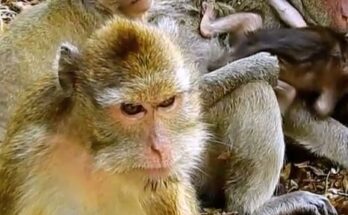
At first glance, it looked like a heartbreaking little scene in the mud.
A tiny newborn monkey lay helpless on the wet ground, his fragile body covered in dirt, his little arms spread weakly as if he did not even know how to protect himself yet. His mouth was open in what looked like a cry, and his small body seemed far too delicate for the cold, muddy world around him.
Beside him was another young monkey — not the mother, not a strong adult, not someone big enough to solve everything.
Just a brother.
And yet, the way he stayed near the newborn made the moment feel deeper than words could explain.
It was as if he had looked at that tiny baby and understood something immediately:
This little one should not be alone.
That is what made the image so emotional.
The newborn looked overwhelmed. He was too small, too weak, and too vulnerable to face the world by himself. The mud around him was messy and unforgiving. It clung to his body, covered his delicate skin, and made him look even more helpless. He was not resting peacefully. He looked like a baby crying out for comfort, warmth, and safety.
And in that difficult moment, his brother stayed beside him.
Maybe he could not feed him.
Maybe he could not fully protect him from every danger.
Maybe he did not understand the whole situation the way an adult would.
But he understood enough to stay.
Sometimes, people think love only matters when it comes from someone powerful enough to fix everything. But that is not always true. Sometimes, the purest form of love comes from the one who cannot do much at all — except refuse to walk away.
That is exactly what made this moment so touching.
The newborn was still at the beginning of life. He did not know how hard the world could be. He did not know how to stand, how to fight, or how to ask for what he needed. He only knew discomfort, fear, and the instinct to cry when he felt unsafe.
And in that moment, the one who answered that cry was not a mother’s arms.
It was a brother’s presence.
There is something incredibly painful and beautiful about that.
The little brother may have been small, but he seemed determined not to let the newborn face that moment alone. The way he stayed close, the way his body leaned toward the baby, and the way he seemed to hover protectively over him all suggested one silent message:
“If no one else is here right now… I will be.”
That is a kind of love that touches the heart deeply.
Because it reminds us that family is not only about who gives life. Family is also about who stays when life becomes difficult. It is about who notices pain. It is about who cannot bear to see someone smaller, weaker, and more helpless suffer alone.
The newborn could not understand all of that, of course.
He may only have felt the mud beneath him.
The coldness around him.
The fear of not being comforted right away.
The ache of being too small in a world too rough.
But perhaps, even in that fragile little moment, he could feel that someone had not abandoned him.
Someone was near.
Someone cared.
Someone was refusing to leave.
That matters more than people often realize.
Sometimes, when a child is hurting, the greatest gift is not the power to change everything instantly. Sometimes the greatest gift is simply presence. The reassurance that even if the pain is still there, even if the mud is still cold, even if the mother is not the one giving comfort in that second, the child is not completely alone.
This image feels emotional because it shows a kind of protection that is quiet and instinctive.
The brother was not a hero in the dramatic sense. He did not rescue the newborn from every difficulty. He did not lift him into a perfect, safe place. He did not erase the discomfort or the fear.
But he did something just as powerful.
He stayed near a suffering baby when he could have walked away.
And for a newborn lying in the mud, that kind of love may mean everything.
There is also something especially heartbreaking in the idea that the brother did not want the mother to leave the baby alone. Whether he fully understood it or simply felt it, he seemed to know that this newborn still needed care. He still needed attention. He still needed tenderness. He still needed to be watched over.
The baby was not ready to face the world without that.
Maybe the brother sensed it in the newborn’s cries.
Maybe he saw it in the way the tiny body struggled.
Maybe he felt it in the helplessness of the moment.
Whatever the reason, his response was simple and pure:
He stayed close.
That kind of love is often overlooked because it is not loud. It does not announce itself. It does not come with grand gestures. It appears in small acts — in refusing to leave, in remaining beside the weak, in choosing closeness over indifference.
And often, those small acts become the most unforgettable ones.
Many people may look at this moment and only see two young monkeys in the mud.
But if you look with your heart, you see much more.
You see a newborn too fragile to protect himself.
You see a brother too loving to walk away.
You see the quiet pain of a little life that needs care.
And you see the beautiful truth that sometimes love comes from the smallest protector of all.
That is why this image stays in the heart.
Because it reminds us that love is not always about strength.
Sometimes love is about tenderness.
Sometimes love is about loyalty.
Sometimes love is about standing beside someone weaker than you because your heart simply cannot do otherwise.
The newborn may have been crying.
The mud may have been cold.
The world may have looked harsh and unfair.
But even in that difficult moment, he was not completely alone.
His brother was there.
And sometimes, for a frightened little life, that is enough to keep the world from feeling completely empty.
He was only a little brother.
But in that muddy, painful moment, he became something much bigger:
A tiny guardian for a baby who needed love.
Watch the full video to see the touching moment between the newborn and the brother who refused to leave him alone.