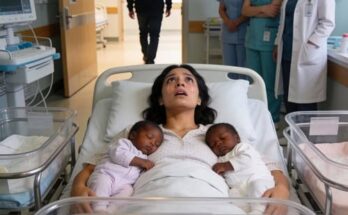
I don’t want a wife… I want someone who won’t let my children die.
That was the first thing Martín Salcedo, a widowed soldier with a hard gaze, told me when he appeared in the San Miguel del Monte square with seven children behind him and an order to return to the front folded in his pocket.
My name was Lucía Vargas, I was twenty-three years old, I had two worn-out dresses and a debt at Don Ramiro’s store that I was already ashamed to look at. My mother had died of a fever and my father had gone to work up north, promising to return before Christmas. He never came back.
He washed other people’s clothes in the stream, ground nixtamal for coins, and there were days when he drank black coffee just to deceive his hunger.
That’s why, when Martín proposed to me, I didn’t think about love. I thought about bread.
Her children looked like shadows. The eldest, Diego, thirteen, stared at me as if I had come to steal the last of his strength. Sofía carried the twins, Ángel and Toño, as if she were already a mother herself. Ramón, Elisa, and little Lupita walked barefoot, their clothes clinging to their bodies, their eyes too serious for their age.
“Do you want a wife or a maid?” I asked him.
Martin was not offended.
—I want them to eat while I’m gone… if I go back.
We got married three days later, without music, without flowers, and with half the town murmuring at the church door.
“The hungry one has already found a house,” said a neighbor.
“Not a house, a job,” another replied. “That man bought it out of necessity.”
And perhaps they were right.
When I arrived at the Salcedo ranch, I understood that this was not a home. It was a house in ruins. There were plates of dried beans, beds without blankets, piles of dirty clothes, and a silence that hurt more than the screams.
Lupita, the youngest, hid behind a chair.
“Are you leaving too?” he asked me.
I swallowed the knot.
-Not today.
That night, Martin left some coins on the table.
—This should last two months.
Diego let out a bitter laugh.
—You don’t even know how much we eat.
Martin wanted to hug him before leaving, but the boy moved away.
“My mother died waiting for him,” she told him. “We’re not going to wait for anyone anymore.”
Martín left without answering. I watched him walk away through the dust of the road, rifle slung over his shoulder and guilt weighing heavily on his back.
I was left with seven children who didn’t want me.
The first day they hid the salt from me. The second day, Toño threw away the pot of atole. The third day, Diego told me:
—You’re not my mom. Don’t think you’re so important.
“I didn’t come here to be your mother,” I replied. “I came here so you wouldn’t go to bed hungry.”
I sold my copper earrings to buy corn. I mended shirts until my fingers burned. I made broth with bones, I washed, I swept, I scared off debt collectors, and I put up with Doña Refugio, Martín’s mother, who arrived dressed in black and with a tongue sharper than a machete.
“My son left his house in the hands of a starving woman,” he said.
I was making tortillas.
—Then pray that this starving woman knows how to cook.
Sofia giggled softly.
It was the first laugh I heard in that house.
But the months passed, the letters stopped arriving, and the town began to say that Martín had died. Doña Refugio appeared one day with a black dress for me.
—Put it on. At least feign respect for the man who gave you a roof over your head.
That night I cried in the kitchen because I didn’t know how to feed them the next day.
Diego saw me.
He said nothing.
But at dawn he returned with a load of firewood on his back.
From then on, the children started to get closer. Sofia kneaded dough with me. The twins collected eggs. Ramon looked after Lupita. Diego stopped calling me “that woman.”
Until one early morning, the dogs barked as if they had recognized a dead body.
I opened the door.
Under the rain, limping, with his uniform torn and his face sunken, Martín Salcedo had returned.
And then I knew I couldn’t believe what was about to happen…
PART 2
Martin stood in the yard, soaked, looking at his own house as if he had come to the wrong place.
The roof was no longer leaking. There were pots of rue and basil by the entrance. Clean clothes hung under the eaves. The kitchen smelled of cornbread, coffee brewed in a pot, and freshly lit firewood.
Then he looked at his children.
They weren’t dirty. They weren’t thin. They weren’t lost.
They were alive.
Lupita grabbed my skirt. Sofia hugged Elisa. The twins hid behind Diego, and Diego, with a machete in his hand, stepped forward.
“Dad,” she said, her voice breaking, “before you go in you need to know something about Lucia.”
Martin lowered his hat.
—Dime.
—She didn’t just take care of us. She saved us.
I felt my face burning.
—Don’t exaggerate, Diego.
“Yes, he’s exaggerating,” interrupted a voice from the road.
Doña Refugio appeared behind Martín, covered with her black shawl, accompanied by Don Ramiro, the shopkeeper, and by Evaristo Molina, a moneylender who always smiled as if he already knew how much people’s misfortune was worth.
—This girl has bewitched your children—said Doña Refugio—. They receive you as a stranger and her as a saint.
Martin looked at her, confused.
—Mother, what are you doing here?
—I came to set things right. Your house is in the hands of a garbage collector.
Sofia clenched her fists.
—The house was worse when you came to shout.
Doña Refugio raised her hand.
—Shut up, kid!
Lupita hid further behind me.
Martin saw that gesture. And something in his face changed.
—Why are my children afraid of him?
No one answered.
Yes, Diego.
—Because when you stopped writing, she said you were dead.
Martin frowned.
—I wrote. I sent letters. And I sent money from Zacatecas, from Aguascalientes, from wherever I could.
The silence fell heavily.
Doña Refugio clutched the rosary.
—Things are lost in times of war.
“How strange,” said Diego. “What was never lost was what suited you.”
Martin turned towards his mother.
Where is my money?
She lifted her chin.
—I managed it. I’m your mother.
Then I understood the nights I boiled peels to fill the children’s stomachs. The days I sold soap in the plaza. The time I traded my blue shawl for medicine for Lupita. The debts Doña Refugio said I had caused.
It wasn’t carelessness.
It was cruelty.
I went to the kitchen and came back with an old cookie tin. Inside I kept receipts, bills, signed slips of paper, everything I had paid for with work, eggs, bread, sewing, and shame.
“Here’s everything,” I said. “What I borrowed, what I paid, and what your mother withdrew in your name.”
Martin took the papers with trembling hands.
He read one. Then another.
—It says here that my pay was collected in the municipal capital.
“For me,” said Doña Refugio. “To protect your assets.”
—And here it says that Lucía paid for flour, medicine, boards for the roof and even Lupita’s doctor.
Evaristo let out a dry laugh.
—Poor women write accounts to appear as martyrs.
Diego raised the machete.
Martin stopped him with a look.
“Did you go hungry?” he asked.
Nobody spoke.
But Lupita, in her small voice, said:
—Lucía said she had already eaten, but I saw her biting her hand at night.
I lost my breath.
Sofia added:
—And when Lupita had a fever, she walked alone to the village in the rain to bring the doctor.
Elisa whispered:
—And he hit Don Evaristo with a broom when he tried to take her to the corral.
Martin slowly looked up.
Evaristo stepped back.
—It was a misunderstanding.
I took a deep breath.
“It wasn’t a misunderstanding. He told me that a hungry woman can’t afford to pretend to be decent.”
Martin dropped the papers on the table.
—Get out of my house.
—Captain, I came to help with the debts…
—Leave before I forget my children are watching.
Evaristo left without saying goodbye.
Doña Refugio trembled with courage.
—That woman is turning you against your own blood.
Martin looked at her, his eyes filled with a new sadness.
—My blood is behind her.
The phrase left the house speechless.
I wanted to go to the kitchen, but Lupita clung to my skirt.
—Don’t go, Mama Lucia.
Everyone stood still.
Until Martin.
Diego lowered the machete and wiped a tear with his sleeve.
I looked at Martin, and he looked at me as if he had just discovered that, while he was surviving the war, another battle had been fought in his house.
Doña Refugio took a step towards Sofía.
“This woman is leaving tomorrow. The children need a family woman.”
—Like you? —said Sofia.
Doña Refugio tried to slap her.
I stopped his hand in mid-air.
And there, right there, Martín saw the truth that no one had yet dared to fully express…
PART 3
“Not them,” I said, holding Doña Refugio’s wrist.
For a year I had endured his insults, his glares, and his venom. But I wasn’t going to let him touch the children I had seen crying in their sleep, trembling with hunger, and learning to laugh all over again.
Martin took his mother’s hand and pulled it away.
-Go away.
Doña Refugio looked at him as if she did not recognize the son she had given birth to.
—Are you kicking me out for this starving woman?
Martin took a deep breath.
—The woman you call that kept my children alive while you stole their bread.
—I protected you.
—No. You protected your pride.
The old woman opened her mouth, but she couldn’t find the strength.
“Your real wife was Teresa,” he murmured. “She would never have spoken to me like that.”
Martín looked at the small altar in the living room. There was a photo of Teresa, his first wife, with a lit candle and fresh flowers. Lupita had left her rag doll to one side.
“Teresa wouldn’t have let her children go hungry just to keep ruling,” he said.
Doña Refugio left in the rain without saying goodbye.
None of the children ran after her.
That night no one went to bed early. I made coffee because Martín was shivering from the cold. Sofía heated up some beans. Diego cut the bread. The twins fought over who got to sit near their father, and Lupita wouldn’t let go of her sleeve even when she fell asleep.
Martin heard everything.
How Diego learned to chop wood when he should still be playing marbles. How Sofía made tortillas while carrying Elisa. How the twins cared for the chickens as if they were treasures. How Lupita cried when the sky thundered, until I made her atole with cinnamon.
I served dishes to keep my hands busy.
When the children fell asleep, I went out into the yard. The rain had stopped and the puddles sparkled in the moonlight.
Martin came out behind me, leaning on a cane.
“You shouldn’t be standing,” I told him.
—I’ve been worse.
—That doesn’t make it a good idea.
He barely smiled.
—Lucía… when I left, I left you with a burden that wasn’t yours.
—Since I accepted, she became mine.
—You got married because you were hungry.
—And you out of desperation.
The silence between them was heavy.
—But that was at the beginning—he said.
I didn’t answer.
Because the truth was, it scared me.
I wasn’t there for food anymore. I had stayed because the children had gotten into my heart. Because that broken house had also mended me. Because, without realizing it, I had learned to wake up thinking about seven voices, seven plates, seven blankets.
“I don’t know what I am here now that you’ve returned,” I confessed.
Martin reached into his wet jacket and pulled out some papers.
—I passed through the town before coming here. I also put the house and the cornfield in your name.
I was frozen.
—Why did he do that?
—Because if I die again, no one will be able to get you out. Not my mother, not a loan shark, not the town.
—I don’t need you to pay me.
—It’s not payment, Lucia. It’s respect.
That word hurt me deeply.
I respect.
No pity. No charity. No hunger.
The next day, Martín walked with me to the market. He had a limp, but he kept his back straight. Diego was beside him and Lupita was in his arms.
At Don Ramiro’s store, he left coins on the counter.
—My wife’s debt.
The shopkeeper lowered his gaze.
—Captain, I didn’t want any trouble…
—All of it —Martin ordered.
And for the first time, nobody made fun of me.
Afterwards we went to the church. There was no re-wedding ceremony, because we were already married. But Martín asked to speak in front of Father Julián and his children.
“The first time I offered her shelter,” she said, her voice breaking. “Today I offer her a place. A name. Respect. And a home where no one will ever treat her like a servant again.”
Everyone looked at me.
I looked at the children.
Diego’s eyes were filled with tears. Sofia barely smiled. Lupita hugged her one-eyed doll.
“I agree to stay,” I said. “But not as a servant.”
Martin bowed his head.
-Anymore.
—And if he leaves again without leaving the truth behind, I’ll close the door myself.
Father Julian coughed to hide his laughter.
—That vote is pretty clear.
The months passed. Martín didn’t return to the front lines; his leg ached when the weather changed, but he learned to sow slowly, to listen more and command less. Diego stopped carrying the machete as if he had to defend the house from the world. Sofía started singing again while making dough. The twins grew mischievous. Lupita continued calling me Mama Lucía without asking permission.
One afternoon, Doña Refugio returned.
End Part Here: We got married three days later, without music, without flowers, and with half the town murmuring at the church door.