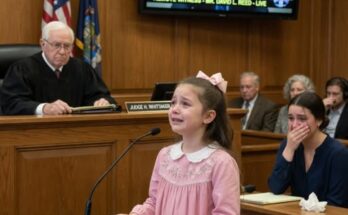
My husband used to beat me because “I wouldn’t give him a son,” but at the hospital, they discovered an X-ray that exposed his family’s cruelest lie.
I stared at Raúl’s hand crushing the X-ray, and for one strange second, I was not afraid of him anymore.
I was afraid of what would happen if I kept lying.
The doctor asked him to step outside, but Raúl did not move. His eyes were fixed on my stomach.
Pregnant.
That word should have sounded like hope.
Instead, it sounded like a door closing behind me.
“You knew?” he whispered.
I shook my head, but my voice would not come out.
The doctor stood between us.
“She needs rest, protection, and follow-up care. What she does not need is more pressure.”
Raúl laughed once, but there was no humor in it.
“Protection from whom, doctor?”
The room became silent.
And in that silence, I saw the choice forming in front of me.
Tell the truth, and my daughters might finally be safe.
Stay quiet, and maybe Raúl would calm down.
Maybe.
That word had ruined seven years of my life.
The doctor turned to me.
“Lucía, do you feel safe going home today?”
Raúl’s face changed immediately.
Not angry.
Worse.
Careful.
He looked like a man choosing which mask to wear.
“My wife is confused,” he said softly. “She has always been delicate.”
I looked at him.
Then I thought of Camila covering Renata’s eyes.
I thought of the way my daughters flinched when keys turned in the lock.
And I answered with the smallest voice I had.
“No.”
Raúl froze.
The doctor did not look surprised.
He simply nodded, as if he had been waiting for me to find that word.
“No,” I repeated.
This time, louder.
Raúl took one step toward me, but two nurses entered before he reached the bed.
“Sir, you need to leave,” one of them said.
He looked at me as if I had destroyed him.
But I knew the truth.
He had destroyed the version of me that believed silence was love.
When they led him out, he did not shout.
That scared me more.
Because Raúl never accepted losing in public.
He only collected humiliation and returned it later at home.
The doctor came closer and lowered his voice.
“Do you have somewhere to go?”
I opened my mouth.
My mother had d!3d years earlier.
My father barely spoke to me since I married Raúl against his wishes.
My sisters lived far away and called only on holidays.
And the house was not mine.
Nothing was mine.
Except my daughters.
“I need my girls,” I whispered.
The doctor nodded.
“We can call social services. We can also contact the authorities.”
My heart started pounding.
Authorities meant reports.
Reports meant questions.
Questions meant neighbors.
Neighbors meant shame.
And shame was the leash Raúl’s family had used on me for years.
“Please,” I said. “Not yet.”
The doctor sighed, not impatiently, but sadly.
“Lucía, waiting can become dangerous.”
“I know.”
But knowing and doing were two different things.
At noon, a social worker named Mariana came in.
She had tired eyes and a warm voice.
She did not ask why I stayed.
She asked what I needed to leave.
That difference made me cry.
Not loudly.
Just quietly, like water leaking through a cracked wall.
“I need my daughters,” I said again.
Mariana sat beside me.
“Where are they now?”
“With my mother-in-law.”
Her face tightened.
“Doña Eulalia?”
I looked at her.
“You know her?”
“Small towns are not really small,” Mariana said.
That was all she needed to say.
Everyone knew something.
Nobody had said anything.
By evening, my father arrived.
I did not know who called him.
Maybe Mariana.
Maybe the doctor.
He came wearing the same brown jacket he had worn since I was a teenager.
His hair was whiter.
His face harder.
For seven years, I had told myself he did not care.
But when he saw me lying there, something in him broke.
Not loudly.
My father was not a loud man.
He simply removed his hat and held it against his chest.
“Lucía,” he said.
I turned my face away.
“I told you not to marry him,” he whispered.
The words cut deeper because they were true.
I expected blame.
Instead, his voice cracked.
“But I should have come for you anyway.”
I covered my mouth.
That was the first apology anyone had given me in years.
He stepped closer.
“Where are the girls?”
“With Eulalia.”
His jaw tightened.
“Then we go get them.”
I shook my head.
“You don’t understand. Raúl will be there.”
My father looked at me, and for the first time, I saw that he was old.
Not weak.
Old.
Still, his answer did not tremble.
“Then he will see me.”
Mariana stopped him.
“We need to do this carefully.”
Carefully.
That word followed me from the hospital bed to the police desk.
Carefully, I described years of fear without using the ugliest words.
Carefully, I signed papers with hands that shook.
Carefully, I admitted I was pregnant and terrified.
Every sentence felt like betrayal.
Not of Raúl.
Of the life I had pretended was normal.
At nine that night, we went to the house.
Two officers came with us.
I sat in the back of the patrol car, holding my stomach, feeling every bump in the road.
San Martín looked different from behind that window.
The bakery lights.
The corner store.
The church tower.
The same streets where people had seen me limp and looked away.
When we arrived, the house was bright.
Too bright.
Doña Eulalia had every light on, as if preparing for visitors.
Camila and Renata were sitting on the sofa in their pajamas.
Their braids were undone.
Their faces were swollen from crying.
“Mamá!”
They ran toward me, but Eulalia grabbed Renata’s arm.
“Girls stay with family,” she said coldly.
My father stepped forward.
“She is their mother.”
Eulalia looked at my bruised face and smiled with pity.
“A mother who destroys a home over a hospital mistake?”
A hospital mistake.
That was how quickly truth became gossip in her mouth.
Raúl appeared behind her.
His face was calm.
Too calm.
“Lucía,” he said softly. “Come inside. We can talk.”
For a second, I wanted to believe him.
Not because he deserved it.
Because believing was easier than leaving.
Camila pulled free and ran into my arms.
Renata followed, sobbing against my leg.
And that was when Raúl’s mask slipped.
“Take one more step,” he said, “and you will never see them again.”
The officers heard it.
Everyone heard it.
Even Eulalia closed her mouth.
Mariana turned to me.
“Lucía, say it clearly.”
My throat tightened.
This was the moment.
The one I had avoided for seven years.
The truth stood on one side.
Fear stood on the other.
And between them were my daughters, holding onto my dress.
I looked at Raúl.
Then I looked at Camila.
Her eyes were begging me not to disappear again.
“I am not going back,” I said.
Raúl stared at me.
“I am taking my daughters.”
My voice shook, but it did not break.
“And I am telling everything.”
Eulalia crossed herself as if I were the sinner.
“You will ruin my son.”
I almost laughed.
Ruin.
What a soft word for what he had done to us.
“No,” I said. “I am only stopping him.”
That night, I left with one plastic bag of clothes, two frightened girls, and a life I did not recognize.
I did not take the wedding album.
I did not take the dishes.
I did not take the gold earrings Eulalia had given me to remind me who owned me.
I took birth certificates, school papers, one photo of my mother, and my daughters’ favorite stuffed rabbit.
At my father’s house, Camila refused to sleep unless the door stayed open.
Renata wet the bed and cried like she had committed a crime.
I cleaned her up and told her accidents were not shameful.
Then I went to the bathroom and cried into a towel so they would not hear.
The next morning, Raúl’s family began their war.
Not with fists.
With whispers.
At the market, someone asked whether I had another man.
At the pharmacy, someone said pregnancy made women dramatic.
At the church, Eulalia told people I had attacked her son’s honor.
Honor.
Another soft word.
People love soft words when hard truths make them uncomfortable.
Three days later, Raúl sent flowers to my father’s house.
White lilies.
The same flowers from our wedding.
The card said:
Come home. The baby needs a father.
I tore it in half.
Then I taped it back together.
Not because I wanted him.
Because I needed evidence.
Mariana told me that evidence mattered.
Dates mattered.
Messages mattered.
Photos mattered.
My pain only mattered when it could be organized into folders.
That was another cruel lesson.
A week later, the doctor called.
He wanted me to return for more tests.
My father drove me in silence.
At the hospital, the doctor showed me the X-rays again.
Old injuries.
New injuries.
A map of everything I had hidden under long sleeves and excuses.
But there was another image.
An older scan from seven years ago, attached to my file by mistake.
I stared at it, confused.
“That is not mine,” I said.
The doctor looked troubled.
“It belongs to Raúl.”
My breath stopped.
Raúl had been treated years ago after a work accident.
His pelvic area had been examined.
There were notes.
Medical terms.
Words I barely understood.
The doctor spoke carefully.
“Lucía, this suggests he had a condition that may affect fertility.”
I blinked.
“What does that mean?”
“It means his family may have known he had difficulty fathering children.”
The room tilted.
For seven years, they had blamed me.
For seven years, they had called my daughters proof of my failure.
And all along, they had hidden this.
“Are you saying…”
“I cannot say more without proper authorization,” he said.
But his eyes told me enough.
The cruelest lie was not that I had failed to give him a son.
It was that they had always known the shame was never mine.
That afternoon, I confronted my father with the truth.
He did not shout.
He simply sat at the kitchen table, hands folded.
“They knew,” I said.
My voice sounded empty.
“They knew and still let him punish me.”
My father closed his eyes.
“Some families protect their name more than they protect people.”
I thought of Eulalia praying the rosary.
I thought of Raúl shouting about sons.
I thought of my daughters learning fear before multiplication.
And then I thought of the baby inside me.
A baby whose existence could become another weapon.
Another excuse.
Another chain.
That night, I did not sleep.
I watched my daughters breathing on the mattress beside me.
Camila’s hand rested on Renata’s shoulder, even in sleep.
She had become a little mother because I had not been able to be a brave one sooner.
At dawn, I made a decision.
Not the dramatic kind people imagine.
No music.
No shouting.
Just a woman sitting at a kitchen table, signing her name on a legal complaint.
The pen felt heavier than any stone.
Mariana met me at the office.
“You understand what this means?” she asked.
I nodded.
“It means people will talk.”
“They already talk.”
“It means he may deny everything.”
“He already does.”
“It means the process may hurt.”
I looked down at my stomach.
“Staying hurt too.”
So I signed.
The next weeks were not freedom.
They were paperwork, appointments, interviews, and days when I doubted myself so deeply I could barely stand.
Raúl cried in front of officials.
He said he loved me.
He said I was confused.
He said my father had poisoned me against him.
Then, when no one was watching, he sent one message:
You will regret making me look small.
I saved it.
The first hearing happened on a rainy Thursday.
I wore a plain blue dress because it was the only one with sleeves long enough.
Raúl arrived with Eulalia and two cousins.
They looked like mourners at a funeral.
Maybe they were.
Maybe they had come to bury my truth.
Raúl’s lawyer painted me as unstable.
A bitter wife.
A woman influenced by doctors and outsiders.
A mother who wanted attention.
Then they asked the question I feared most.
“If he was so terrible, why did you stay?”
The room became very quiet.
I looked at the table.
There were many answers.
Because I was afraid.
Because I had nowhere to go.
Because I thought daughters needed a father, even a bad one.
Because shame is a cage you carry inside your body.
But none of those felt complete.
So I said the only truth I could hold.
“Because I believed leaving would break my daughters.”
I raised my eyes.
“Then I realized staying was breaking them already.”
For the first time, Raúl looked away.
Not because he felt guilty.
Because the room believed me.
After the hearing, Eulalia cornered me near the bathroom.
Her face was pale with fury.
“You think truth will save you?”
I held my bag tight.
“I think lies almost ended me.”
She leaned closer.
“That baby may be a boy. Think carefully before you throw away his name.”
There it was.
The last hook.
A son.
The dream they had used to torture me.
For one second, I imagined it.
Raúl promising to change.
Eulalia holding the baby.
Neighbors congratulating us.
The girls finally being treated better because a boy existed.
It was an ugly thought.
But honest.
Part of me wanted the easy door.
The door back into a story everyone understood.
Wife forgives.
Husband improves.
Family saved.
But then Camila’s voice came from behind me.
“Mamá?”
She had followed Mariana from the waiting room.
Her face was small and worried.
Eulalia stepped back, suddenly sweet.
“Come here, my child.”
Camila hid behind my skirt.
And I knew.
A son would not save my daughters.
A son would only teach them that their safety depended on being less important than someone else.
I took Camila’s hand.
“We’re leaving,” I said.
Months passed.