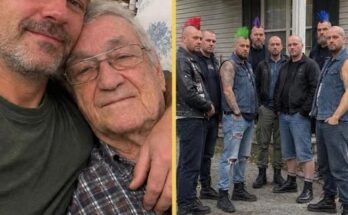
I thought I knew everything about my father and the life we’d shared. But a shocking encounter outside our home was about to change how I remembered my family’s past.
“Where are you?!” my neighbor screamed into the phone.
“At work. Why?!”
“There’s a crowd of skinheads outside your house!”
My stomach dropped. “What?!”
“Where are you?!”
“You need to come home now!”
***
Thirty minutes earlier, I’d left my seriously ill father with the 14-year-old girl next door.
Now, several intimidating strangers were standing outside our home.
I had no idea they were about to reveal something my father had kept from me for decades.
“You need to come home now!”
***
My name is Nathan. I’m 45, and my father, Frank, sadly became seriously ill that year.
At 74, he was weak, spent most of his time in bed, and sometimes forgot whether he’d already taken his medication.
So I switched to remote work to stay home with him.
“Dad, you already took that pill.”
“I did?”
He was weak.
“Yeah, old man. Ten minutes ago.”
He’d laugh. “Good thing I have you!”
***
Then, one morning, my boss, Richard, called. “Nathan, I need you in the office! It’s urgent!”
“I can’t leave my father alone!”
“Just for an hour or two! Please!”
“It’s urgent!”
I panicked.
Then I thought of Emma next door.
She was 14, a Girl Scout, and probably the most responsible teenager I’d ever met.
She sometimes brought us leftover cookies from troop events and earned pocket money walking dogs, watering plants, and collecting mail for neighbors who were away.
I panicked.
More than once, she’d walked our dog when Dad had an appointment.
***
I knocked on her door. “Emma, I need a huge favor!”
“Sure. What happened?”
“I have to go to work unexpectedly. Could you sit with Dad until I get back? You don’t need to do anything medical. Just make sure he’s okay and call me if he needs something.”
I knocked on her door.
She smiled. “Of course!”
Her mother, Jennifer, also agreed to stay next door in case Emma needed assistance.
“I’ll pay you,” I said to the teenager.
“You really don’t have to.”
“I’m paying you.”
Emma laughed. “Okay, deal.”
“I’ll pay you.”
***
Before leaving, I brought Dad some water, checked his medication schedule myself, and left my phone number beside the bed.
“Two hours maximum,” I promised.
***
I hadn’t even been gone 30 minutes when my other neighbor, Mrs. Patterson, called, screaming about the men outside!
I left work immediately and drove straight home.
I promised.
***
At least eight men were gathered outside our house! Most had shaved heads, heavy boots, and dark jackets. Several neighbors were watching from their porches.
“Get away from my house!” I shouted, jumping out of the car. “My father’s sick, and there’s a 14-year-old girl inside! Leave now, or I’m calling the police!”
The men fell silent.
“Get away from my house!”
One stepped forward. He was broad-shouldered, in his 40s or 50s, with a shaved head, a scar above his eyebrow, and tattoos running down both arms.
“You’re his son?” he asked.
“Yes! Who are you?!”
“Mark.”
“I don’t care about your name! Why are you here?!”
“You’re his son?”
He looked toward the front door. “Because Emma called us.”
I stared at him. “Emma? She’s 14! How does she even know you?!”
“Your father gave her my number.”
“That’s impossible! He can barely get out of bed!”
“I know. That’s why we’re here.”
“Because Emma called us.”
Before I could respond, the front door opened.
Emma stepped outside, slowly helping Dad by the arm.
He looked at the men, then back at me. “Son. It’s time you knew the truth about what really happened 30 years ago, when we lost your mother.”
Emma stepped outside.
I rushed toward Dad. “You’re supposed to be resting!”
“I’m alright, Nate.”
“No, you’re not! Sit down!”
I helped him into a porch chair while Emma fetched water.
Then I looked at Mark. “What does my mother have to do with you?”
“I’m alright, Nate.”
Dad answered before Mark could. “These men knew Helen.”
Helen was my mother.
She died when I was 15.
“How?” I asked, calmer now.
Dad looked at the men. “They were friends of hers. She helped them when they were young.”
I frowned. “Then why are they here?”
“These men knew Helen.”
“Because I asked Mark for help.”
I looked toward the neighbors watching us.
Whatever Dad was hiding, I didn’t want the entire street listening.
“Would you gentlemen come inside?” I asked. “We need to discuss this privately.”
Mark nodded. “Of course.”
“I asked Mark for help.”
***
I helped Dad back into bed.
Emma explained that my dad had asked her to call a number written in his notebook. He’d said Mark was an old friend who was coming to collect something.
“You didn’t do anything wrong,” I assured her.
After paying and thanking her, I sent her home.
I helped Dad back into bed.
***
Then I joined the men in the living room.
Mark was holding a photo. “Your mother gave us this.”
I looked closer.
Eight teenage boys surrounded a smiling woman outside a community center.
My mother.
“Your mother gave us this.”
But what caught my attention was the handwriting on the back.
I’d recognize it anywhere.
***
Mom used to write little notes inside my lunchbox.
“Remember your homework.”
“Be kind.”
“Love you, always.”
I’d recognize it anywhere.
She also packed extra sandwiches.
When I complained, she’d say, “Somebody might need one.”
Every Saturday, my mom volunteered at a community center.
I never knew exactly what she did there.
“Somebody might need one.”
When she died following a sudden illness, Dad stopped mentioning the center.
We packed away her belongings because everything reminded us of her.
Now, eight strangers sat in our living room, holding proof that they’d known a side of Mom I never understood.
***
“That’s you?” I asked Mark, pointing at the photo.
Dad stopped mentioning the center.
He smiled. “Yeah, 17 years old. Terrible haircut.”
A man beside him laughed. “You’ve still got the same haircut.”
Everyone chuckled.
I didn’t. “Please explain.”
Mark grew serious. “Your mother worked with us at the youth center. She helped when nobody else wanted to.”
Everyone chuckled.
“Helped how?”
“School. Jobs. Finding somewhere to live. Sometimes, she just listened.”
Another man, who introduced himself as Peter, leaned forward. “She helped me get my first mechanic’s apprenticeship.”
David, sitting beside him, smiled. “She made me practice job interviews until I stopped answering every question with ‘whatever.'”
The men laughed again.
“Helped how?”
I looked around. “All eight of you knew her?”
Mark nodded. “She called us her ‘boys.'”
I swallowed.
Then, he added something that made me sit down. “Your mother was the first person who ever told me I deserved a future.”
“She called us her ‘boys.'”
***
Mark explained that they’d met through a youth program.
Several had grown up in foster care. Others came from unstable homes.
They’d belonged to a music scene where shaved heads and heavy boots were common.
Their appearance frightened people, though the men said that their group hadn’t supported extremist beliefs.
Several had grown up in foster care.
“People judged us before we opened our mouths,” Mark said. “Your mother didn’t.”
Helen helped them find training programs, complete applications, and prepare for interviews.
But the little things mattered most.
Peter remembered her bringing him a bus pass when he couldn’t afford transportation.
David remembered her helping him study for a qualifying exam.
“Your mother didn’t.”
Mark remembered something else. “She came to my 18th birthday.”
I frowned. “And?”
He looked down. “Nobody in my family remembered it.”
My throat tightened.
“She brought a cake,” he continued. “Chocolate. She spelled my name wrong.”
The men laughed.
My throat tightened.
“She wrote Mark with a ‘C.’ I didn’t correct her. It was the first birthday cake anybody had bought me in years.”
I stared at the photo.
I remembered Mom baking cakes on Saturday mornings.
Sometimes, she’d let me lick the spoon.
I’d never wondered where those cakes went.
I stared at the photo.
“Why didn’t Dad tell me about you?”
Mark glanced toward the hallway. “That’s something he needs to answer.”
***
Dad was awake when I entered his bedroom. “Did they tell you?” he asked.
“Some of it.”
He nodded. “Good men, aren’t they?”
“Did they tell you?”
“Maybe. But why keep them a secret?”
Dad stared at his blanket. “After your mother died, you barely spoke for months. I didn’t want to bring strangers into your grief.”
“And afterward?”
“I kept putting it off. Eventually, I didn’t know how to begin.”
I sat beside him. “You should’ve told me.”
“I know, son. I’m sorry.”
“And afterward?”
Then he reached into his bedside drawer.
He handed me a folder.
Inside were old letters, receipts, and photos.
At the top was a document bearing Mom’s signature.
“What is this?”
“Something she started before she died.”
He handed me a folder.
I read the heading.
“Helen M. Education Fund.”
Dad watched my expression. “Your mother saved a little money to help teenagers leaving foster care pay for books and job training.”
“She started a scholarship?”
He nodded. “After she passed, I couldn’t bear to let it disappear.”
“She started a scholarship?”
My dad explained that the community center administered the fund, while he helped organize donations and maintain records.
Mark and the others began contributing once they found steady work.
For 30 years, they’d kept it going.
I stared at him. “You’ve been doing this all along?”
“With help.”
“Why didn’t you tell me?”
They’d kept it going.
“I thought I was protecting you from more sadness. Then it became our little way of remembering her.” His eyes filled. “But now I’m sick. I can’t handle the paperwork anymore.”
Finally, I understood why Mark had come. “Why wait until I left?”
Dad squeezed my hand. “Because you’ve given up enough to care for me. I didn’t want you thinking you had another responsibility.”
“Why wait until I left?”
He’d called Mark earlier that week, asking him to collect the records.
When he learned I was going to the office, he’d asked Emma to arrange the visit.
He’d expected Mark to come alone.
The other men had heard that Frank was unwell and decided to come too.
He’d called Mark.
“I wanted everything settled before telling you,” Dad admitted.
I shook my head. “You should’ve trusted me.”
“I know.”
Then he whispered, “Your mother would’ve told me the same thing.”
“You should’ve trusted me.”
***
Back in the living room, I asked Mark how many people the fund had helped.
“Forty-three.”
I blinked. “Forty-three people?!”
“Over three decades. Some got money for textbooks. Others received help to pay for certification courses.”
Peter smiled. “Last year, we helped a young woman qualify as a nursing assistant.”
I sat down.
“Forty-three people?!”
My mother had been gone for so long, yet something she’d started was still changing lives.
“Why did you keep contributing?” I asked.
Mark looked surprised. “Because she helped us.”
“But for so long?”
He smiled. “Nathan, your mother didn’t ask us for anything in return. Helping somebody else seemed like the least we could do.”
“Why did you keep contributing?”
Then, he turned the photo over.
Mom had written: “Everybody deserves someone who believes they’ll become better.”
I read it slowly.
Suddenly, I remembered something from childhood.
When I was 14, I’d complained about Mom leaving for the community center.
Suddenly, I remembered something from childhood.
“Why can’t you stay home like other moms?”
She’d sat beside me. “Because some children don’t have anyone waiting at home for them.”
I’d rolled my eyes.
She’d kissed my forehead, anyway.
Now, I understood.
I looked at Mark. “Did you attend her funeral?”
I’d rolled my eyes.
He nodded. “All eight of us.”
“I don’t remember seeing you.”
“We sat near the back.” His voice broke. “We wanted her to know we came.”
Then Peter reached into his wallet and showed me a faded card. “My mechanic’s license,” he said. “Got it the year after she died. I showed it to Frank first.”
“We sat near the back.”
Mark smiled through tears. “We all wanted to make her proud.”
I covered my face.
They visited with Dad before leaving.
For 30 years, I’d believed Mom’s story ended when we buried her.
But eight men had been carrying pieces of her forward.
I covered my face.
***
Over the following weeks, I met Mark several times.
He showed me how the scholarship worked.
The community center handled applications and payments. Volunteers organized donations and reviewed requests.
Dad mainly kept records and coordinated with supporters.
I offered to take over his role.
I met Mark several times.
When I told him, Dad immediately protested. “Nate, you’ve already got your job and me to worry about!”
“I know.”
“Then why?”
“Because Mom started something worth keeping.”
He looked at me.
“And because you kept it alive for decades.”
Dad immediately protested.
Dad began crying. “I never wanted to burden you.”
“You’re not.”
I pulled my chair beside his bed. “I want to know more about her, Dad. Not just how we lost her. I want to know how she lived.”
***
That afternoon, Dad told me stories I’d never heard.
“You’re not.”
Mom teaching Peter to fill out applications.
Mom arguing with a manager who wouldn’t interview Mark.
Mom celebrating when David passed his exams.
For once, remembering her made us laugh!
Mom arguing with a manager.
***
Two months later, the community center held its annual scholarship ceremony.
Dad was well enough to attend in a wheelchair.
Mark and the others joined us.
Emma came with her mother after I’d told them what had happened that morning.
Mark and the others joined us.
Three young adults received scholarships.
One was Caleb, 19, who wanted to become an electrician.
When he accepted his certificate, his hands shook. “I’ve spent most of my life thinking I wasn’t good at anything,” he said.
Then he looked toward Mark. “But somebody told me I deserved a chance.”
I looked at Dad.
Tears were running down his cheeks.
His hands shook.
***
Afterward, Caleb approached us. “Mr. Nathan? I heard your mother started this fund.”
I nodded. “She did.”
“Thank you for keeping it going.”
I glanced at Mark and the other seven men. “Actually, I’m just joining the people who never stopped.”
Caleb smiled.
Afterward, Caleb approached us.
Dad reached for my hand. “Your mother would’ve loved today,” he whispered.
I squeezed his fingers. “I know.”
***
That evening, I placed the old photo on Dad’s nightstand.
He studied it. “She was proud of those boys.”
“She had every reason to be.”
I squeezed his fingers.
Dad smiled. “And she’d be proud of you.”
I leaned down and hugged him.
For 30 years, I’d thought losing Mom meant losing everything she could’ve taught me.
I was wrong.
Her lessons survived in eight men who remembered her kindness and passed it on to others.
“She’d be proud of you.”
Dad still needed care, and our days weren’t always easy.
But now Mark and the others visited regularly. They brought groceries, called to check on Dad, and helped whenever they could.
Sometimes, Emma brought cookies, and Dad saved a few for his “boys.”
He still calls those men “boys.”
They love it!
Dad still needed care.
And whenever I look at that picture, I remember something Mom used to say.
“You never know how far one small kindness can go.”
Years later, I finally understood.
My mother hadn’t simply helped eight boys find their way.
She’d taught them to reach back for someone else. And now, I was proud to carry that lesson forward.
I remember something Mom used to say.