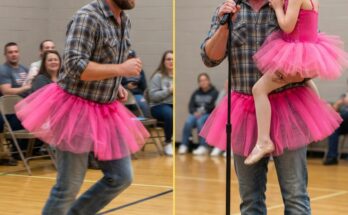
For two years, my daughter asked why her father had stopped calling. I never had an answer. At her school performance, she stood alone onstage, staring at an empty chair. Then a man came rushing down the aisle. What happened next made the entire room go silent.
Two years ago, my husband, Russell, stood in our kitchen and told me he needed a break.
He didn’t shout.
He didn’t accuse me of anything.
He just stared at the coffee he’d made and said, “I need some space to figure things out.”
I asked if there was someone else.
“No.”
“Did I do something?”
“No, honey. I just can’t do this right now.”
Our daughter, Maisie, was six.
She came running into the kitchen with her stuffed bunny, asking Daddy to fix its loose ear.
Russell knelt, kissed her forehead, and promised he’d see her soon.
Then he left.
For the first few weeks, he answered my calls.
He said he was staying with a friend and wasn’t ready to talk.
When I asked to bring Maisie to see him, he always found a reason why it wasn’t possible.
His replies got shorter.
Eventually, the phone went straight to voicemail.
One night Maisie crawled into my bed.
“Does Daddy not love me anymore?”
I held her while she cried.
“Of course he loves you, sweetheart.”
I wanted to believe it.
I called Russell’s friends, his former coworkers, even his brother.
Nobody would tell me where he was.
His brother, Paul, said only that Russell was safe and needed time.
I was furious with Paul.
But every conversation ended the same way.
“Please tell him Maisie is asking for him,” I’d say.
“I will.”
Nothing changed.
I kept working, paying the bills, and learning how to answer questions no mother wants to hear.
I stopped making promises about when Daddy might visit.
After her seventh birthday passed without a card, Maisie stopped asking quite so often.
That hurt in a different way.
Last week, her school announced a father-daughter ballet performance.
Maisie came home holding a pink flyer.
“Mommy, can Daddy come? Just this once?”
“I’ll try to ensure he does.”
I called Russell 17 times over the next several days.
I left messages telling him the date, the time, and how much it mattered.
I got no answer.
On the morning of the show, Maisie put on her pink tutu and tied a ribbon around her bunny’s neck.
“Maybe Daddy will recognize me if I wear his favorite color.”
I had to turn away.
At school, fathers were adjusting tiaras, carrying costume bags, and taking photographs.
Maisie held my hand while her eyes kept finding the entrance.
When her class was called, she walked onto the stage alone.
Her teacher had assured me that Maisie could dance with another adult if she wanted, but she’d insisted on leaving a space for Russell.
The music began.
She didn’t move.
Then a voice shouted from the back of the hall.
“Wait! Please!”
Russell came stumbling down the aisle, breathless, wearing a ridiculous pink tutu over his jeans.
“Daddy!”
Maisie raced down the stage steps before her teacher could stop her.
Russell dropped to one knee and caught her.
He lifted her carefully, turning once as she clung to his neck.
People applauded.
Someone laughed at the tutu.
I was smiling before I realized I was doing it.
Then Russell put Maisie down and asked her teacher for the microphone.
He held up the small metal disc, his hands shaking.
“Excuse me, everyone. There’s something important I need to say.”
My smile vanished.
He reached inside his shirt and pulled something out.
His hands were shaking.
“I know none of this excuses what I did. But there’s something you need to know about why I had to leave my family. I can’t hide the truth anymore.”
And with his next words, my knees nearly gave out.
“Two years ago, I was addicted to painkillers. I left my family to get treatment, and I was too ashamed to tell them.”
The room went silent.
Russell held up the disc.
“This is my sobriety medal. I should have told my wife the truth a long time ago. I’m sorry.”
My knees felt weak.
The teacher stepped forward.
“Thank you, Russell. We need to continue the performance now.”
She gently took back the microphone and asked everyone to give the children room.
I was grateful.
Maisie was still hugging Russell’s leg, and several parents were looking straight at us.
Russell crouched beside her. “Can I watch you dance?”
“You’re supposed to dance with me.”
He glanced at the teacher, who nodded.
He took Maisie’s hand and guided her back toward the stage.
He couldn’t remember the steps, so she showed him where to stand.
When the music restarted, he followed her movements as best he could.
Maisie smiled the whole time.
I watched from my chair, feeling joy and rage so close together I couldn’t separate them.
Afterward, she made Russell pose for photographs with her bunny.
He looked thinner than I remembered.
His hair was shorter, and there were lines beside his mouth I’d never seen.
“Are you coming home?” she asked him.
Russell’s smile disappeared.
He looked at me.
“We need to talk about that, sweetie.”
Maisie’s shoulders sank.
I stepped closer. “Daddy and I have some grown-up things to discuss. It doesn’t mean you did anything wrong.”
She hugged her bunny harder.
My friend Nina, whose daughter was in the same class, offered to take Maisie for ice cream while Russell and I spoke.
Maisie agreed only after Russell promised he’d say goodbye before leaving.
We found an empty classroom.
I shut the door.
“Two years,” I said.
Russell nodded.
“Two years, and you decided to tell me via an announcement at school?”
“I didn’t plan to say that much.”
“But you did.”
“I was scared you’d make me leave before I could explain.”
“You could have called me. You could have written a letter. You could have answered one of the 17 calls I made this week.”
He looked down. “I saw them.”
That hurt worse than an excuse about a dead phone.
“You saw them.”
“Yes.”
“And you let her walk onto that stage thinking you weren’t coming.”
“I didn’t know if I could face you both.”
“How did we get here?”
Six months before he left, Russell had hurt his back moving equipment at work.
A doctor prescribed pain medication for a short period.
I remembered the injury and the weeks he spent stretched out on our couch.
When physical therapy began, he’d told me he no longer needed the pills.
He hadn’t been telling the truth.
“I started taking more than prescribed,” he said. “Then I got them from other people. I kept telling myself I’d stop.”
I remembered how often he’d been tired.
Sometimes he’d snap over small things.
He’d even stopped wanting to take Maisie to the park.
I’d assumed he was still in pain.
“Why didn’t you tell me?”
“Because I thought you’d be disgusted.”
“I might have been frightened. I might have been angry. But I would’ve helped you find treatment.”
“I know that now.”
He admitted he’d once fallen asleep on the couch while Maisie was watching cartoons.
She’d tried to wake him and couldn’t.
She eventually called his name until he stirred.
Russell’s voice broke.
“That scared me. I didn’t trust myself alone with her anymore.”
“So you left her for two years?”
“I went into residential treatment right after I moved out.”
His first stay lasted several weeks.
Paul had helped him find the program and taken him there.
Russell had stopped taking the pills under medical supervision.
He then continued with treatment and recovery meetings.
He’d been sober since the beginning of that program, nearly two full years.
There had been difficult periods afterward.
He’d struggled with cravings, lost a job, and moved between temporary rooms before finding steady work again.
He hadn’t returned to using pills, but he kept delaying contact.
“Every month I told myself I’d call when I was doing better,” he said.
“And every month Maisie got older without you.”
“I know.”
“Paul knew?”
Russell nodded.
“He was helping with my treatment.”
“He could’ve told me you were safe and getting help.”
“I asked him not to tell you anything.”
“There’s something else,” Russell said.
I looked up.
“Before I left, I took money from our savings.”
I went still.
Three months after he disappeared, I’d discovered that our emergency account was nearly empty.
Six thousand eight hundred dollars had been withdrawn in several transactions.
I thought he’d taken the money to pay for a place to live.
I spent weeks covering bills with credit cards.
“I spent most of it on pills before I left,” he said.
“I had to postpone Maisie’s dental work. I worked weekends to keep our mortgage current. And you knew why we were short.”
“Yes.”
“Did you ever think about sending money back?”
“I started putting some aside once I found steady work.”
“That’s not what I asked.”
“No. Not soon enough.”
“You didn’t just disappear, Russell. You left me paying for something I didn’t even know had happened.”
“I brought statements. I can show you what I owe.”
“Don’t hand me paperwork and expect me to thank you.”
“I’m not asking you to.”
“Then why are you here?”
“My sponsor asked me a question a month ago. He said, ‘Are you staying away because they need space, or because you’re afraid they’ll tell you how much you hurt them?'”
“He was right,” I said.
“Yes. I kept calling my silence respect. It wasn’t. It was easier for me.”
“How did you know about the performance?”
“I saw the announcement in the school’s public newsletter. I had to come. I kept thinking about Maisie.”
“So you bought a tutu and decided everything would be fine?”
“No. I bought it because I didn’t know what else to do.”
His eyes filled.
“I know I can’t fix this today.”
“Good. Because she asked if you no longer love her.”
Russell covered his mouth.
For the first time since entering the classroom, he couldn’t speak.
I let the silence stay.
Then I asked, “Are you still in treatment?”
“I attend recovery meetings twice a week. I see a counselor. I have a job at a parts warehouse, and I rent a small apartment.”
“How long have you been working?”
“Eleven months.”
“Eleven months,” I repeated. “You had a job, a home, and a phone. You still didn’t contact your daughter.”
“You’re right.”
I wanted to hear him defend himself so I could argue.
Instead, he agreed with every terrible thing I said.
It made the conversation harder, not easier.
Nina came with Maisie.
“She wanted to see her dad before we leave,” she said quietly.
Maisie stepped past her.
“Daddy, are you sick?”
Russell knelt in front of her.
“I was very sick for a while. I needed doctors and people who knew how to help me.”
“Did you have to stay at the hospital?”
“For part of the time, yes.”
“Then why didn’t you call?”
He looked at me, but I didn’t answer for him.
“I was ashamed,” he told her. “And I made a wrong choice. I kept putting off talking to you.”
She frowned.
“Because you were a bad daddy?”
His face crumpled.
“I did things that hurt you. I didn’t take care of you the way I should have. But none of it happened because of you.”
“Did I make you sad?”
“No, Maisie. Never.”
“Then why did you go?”
He took a shaky breath. “I wasn’t well, and I didn’t know how to ask for help. Leaving you without an explanation was wrong.”
She studied him.
“Are you going to disappear again?”
“I want to be in your life. But Mommy and I need to work out how that happens. I won’t promise a visit until we’ve agreed when and where.”
It wasn’t the answer she wanted.
She looked toward me.
“Can he come for dinner?”
“Not tonight, sweetheart.”
Her eyes filled.
Russell reached for her hand, but waited until she held it out.
“I’d like to see you again,” he said.
“Tomorrow?”
“We’ll talk about a day with Mommy.”
Maisie hugged him once, then came to me. On the way home, she was quiet.
At bedtime, she asked:
“Will Daddy be sick forever?”
“Recovery is something he’ll need to keep working on. He has people helping him.”
She thought for a moment.
“Will you help him too?”
I pulled her blanket up.
“I’ll help make sure you are safe and loved. Daddy has to do his own work to stay well.”
After she fell asleep, I called Paul.
He answered immediately.
“I heard Russell came today,” he said.
“You knew all along.”
“Yes, Russell asked me not to tell you. I thought it was his story to share.”
“Maisie was six.”
Paul didn’t answer.
“I could’ve handled knowing he was getting treatment,” I said. “I couldn’t do anything with silence.”
“I’m sorry.”
I believed him. It didn’t make me less angry.
The following morning, Maisie’s teacher called.
She wanted to know how Maisie was doing after the performance and apologized for allowing Russell to speak.
I told her I wasn’t upset with her, but I wished the announcement hadn’t happened in front of the children.
She offered to connect us with the school counselor if Maisie needed someone to talk to.
I accepted the information.
When Maisie came home that afternoon, she told me two classmates had asked why her father had been away.
“What did you say?” I asked.
“I said he was sick.”
“That’s enough, sweetheart. You don’t owe anyone more details.”
Over the next week, Russell gave me copies of his treatment attendance records, employment information, and a written account of the money he’d taken.
I didn’t ask for every private detail of his medical care.
I needed enough information to judge whether he was serious about rebuilding contact.
He also transferred the first payment toward the savings he’d emptied.
It didn’t erase the debt, but it was something I could verify.
I consulted a family lawyer about separation, financial support, and a steady contact plan for Maisie.
Russell agreed to begin with short visits in a public place and to discuss a longer arrangement once we’d seen how Maisie responded.
When I told him I wasn’t ready to discuss our marriage, he nodded.
“I understand.”
“I haven’t decided whether I can trust you as my husband again.”
“I know.”
“But Maisie shouldn’t have to wonder where you are every week.”
“I’ll keep to the schedule.”
“Then start by showing up.”
Two Saturdays later, Russell met us at the library for a scheduled visit.
He arrived early and brought no gifts. Maisie was shy for the first 10 minutes.
Then she showed him a book about rabbits and asked whether he remembered how to fix Bunny’s ear.
“I can try,” he said.
She handed him the stuffed animal.
He examined the loose stitching and promised he’d bring a sewing kit next time.
I watched them from a nearby table.
Russell stayed for the full hour.
When it was time to leave, Maisie asked if he’d come to her ballet practice the following Thursday.
He checked the time with me before saying yes.
On Thursday, I saw him sitting at the back of the studio before the lesson began.
He had no costume on, and he didn’t give a speech. He simply watched.
Maisie spotted him in the mirror and smiled.
At the end, she ran over to show him a new turn she’d learned.
He clapped as she finished.
“Again?” she asked.
“Again,” he said.
And she danced it once more.