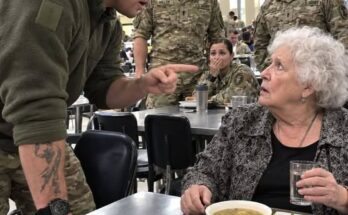
Sergeant Reese stared at me.
Then, slowly, he turned around.
The words above the serving line were impossible to miss.
They had been painted in dark blue letters, each nearly a foot tall.
THE QUINN BRADDOCK DINING FACILITY
Underneath, in smaller gold lettering:
Dedicated to Captain Quinn M. Braddock, Army Nurse Corps — For Extraordinary Courage and Service, 1969
The silence in that room changed.
Before, people had been quiet because they were uncomfortable.
Now they were quiet because no one seemed to know what to do.
Reese read the name once.
Then again.
His shoulders stiffened.
He looked back at me.
Then at the wall.
Then at me again.
For the first time since he had walked over to my table, he did not look angry.
He looked confused.
“You’re…”
His voice died.
One of his friends whispered, “No way.”
The young soldier at the next table slowly stood again.
This time, I did not stop her.
She looked at Reese and said quietly,
“Sergeant, I think you should read the plaque.”
There was a bronze plaque mounted beneath the painted name.
I had noticed it when I came in.
I always noticed it.
I simply preferred not to stand there reading about myself while people ate mashed potatoes.
Reese walked toward it.
His boots sounded very loud against the floor.
He began reading silently.
Then his face changed.
The plaque told only the polished version.
It said that in 1969, during an attack on a forward aid station, Captain Quinn Braddock remained with wounded soldiers after part of the medical position was struck.
It said I organized an evacuation.
It said I repeatedly crossed an exposed area to reach injured men.
It said I refused evacuation after being wounded myself.
It said twelve soldiers survived who were not expected to.
What it did not say was that I had been twenty-four years old and terrified.
It did not say I had vomited behind a sandbag wall that morning.
It did not say my hands shook so badly afterward that another nurse had to button my uniform for me.
It did not say three of the men I treated died anyway.
Plaques make courage look much cleaner than it really is.
Reese stopped reading.
He turned toward me slowly.
His eyes dropped to the brass pin on my coat.
The battalion crest.
Blue shield.
White bird.
The same crest worn by the men whose blood had soaked my uniform fifty-six years earlier.
“Ma’am…”
He removed his cap.
“I didn’t know.”
I looked at him.
“That was the problem.”
He swallowed.
Around us, nobody touched their food.
He looked as if he wanted the floor to open beneath him.
“I thought—”
“I know what you thought.”
He went quiet.
“You thought an old woman had wandered somewhere she didn’t belong.”
His jaw tightened.
“Yes, ma’am.”
“You thought because I looked weak, I could be embarrassed safely.”
He lowered his eyes.
“Yes, ma’am.”
“And you thought your stripes gave you permission to speak to me any way you wanted.”
His face reddened.
This time from shame.
Before he could answer, a voice came from the entrance.
“What exactly is going on here?”
Every soldier in the room seemed to straighten at once.
Colonel Matthew Hayes had entered the dining hall with two officers behind him.
I knew who he was because I had met him that morning.
He was the battalion commander.
And technically, he was the reason I was there.
The facility had been renovated, and someone in public affairs had discovered I still lived less than an hour away.
They invited me to lunch.
No ceremony.
No speech.
That had been my condition.
I had asked for one thing.
Chili.
Colonel Hayes took three steps into the room.
Then he saw me standing beside the table.
He smiled.
“Captain Braddock.”
Reese went completely pale.
Hayes noticed.
His smile disappeared.
“What happened?”
Nobody answered.
Then the young female soldier at the next table spoke.
“Sir, Staff Sergeant Reese was asking Captain Braddock to leave.”
Reese closed his eyes.
Colonel Hayes looked at him.
“Why?”
“Sir, I believed she was unauthorized.”
“Did you check with dining facility staff?”
“No, sir.”
“Did you contact security?”
“No, sir.”
“Did you ask whether she had a visitor credential?”
Reese hesitated.
“I demanded identification, sir.”
Hayes’ voice became colder.
“You demanded?”
“Yes, sir.”
Then one of Reese’s friends quietly added,
“He also told her to remove the battalion crest.”
Colonel Hayes looked at my coat.
Then he looked at the wall.
When he turned back toward Reese, he did not raise his voice.
He didn’t need to.
“You told the woman whose name is on this building that she had no right to wear our crest?”
Reese looked physically ill.
“Yes, sir.”
Hayes remained silent for several seconds.
Then he said, “Staff Sergeant, report to my office after lunch.”
“Yes, sir.”
Reese began to step away.
“Wait,” I said.
Everyone looked at me.
I pointed toward the empty chair across from mine.
“Sit down.”
Reese stared at me.
“Ma’am?”
“You interrupted my chili.”
A few nervous laughs moved through the room.
“Sit.”
He obeyed.
Colonel Hayes raised an eyebrow.
I looked at him.
“With your permission, Colonel.”
He almost smiled.
“Captain, I have a feeling permission is optional.”
That got a real laugh.
The tension broke slightly.
The colonel stepped away.
Reese sat across from me.
His friends remained standing several feet away, unsure whether to leave.
I picked up my spoon.
The chili was cold now.
I ate a bite anyway.
Reese stared at the table.
Finally, he said,
“I’m sorry.”
I kept eating.
“I mean it.”
“I believe you.”
He looked up.
“Are you going to ask the colonel to take my stripes?”
“No.”
He seemed surprised.
“Why not?”
“Because I don’t know you.”
His forehead creased.
“I know one stupid thing you did during lunch.”
I pointed my spoon toward him.
“That is not enough information to decide your entire career.”
He looked down again.
“But it is enough information to tell me you have a problem.”
He nodded.
“Yes, ma’am.”
“You enjoy being the strongest person in the room.”
He did not answer.
“That can be useful in the Army.”
I leaned back.
“Until you start needing someone weaker to prove it.”
That hit him.
I could see it.
For the first time, his expression stopped being embarrassed and became thoughtful.
I continued.
“When I was your age, I knew a sergeant like you.”
He gave me a cautious look.
“Big man. Loud voice. Everyone moved when he entered a room.”
“What happened to him?”
“He became one of the best leaders I ever knew.”
Reese blinked.
“How?”
“Someone finally told him he was a bully.”
A few soldiers nearby smiled.
I took another spoonful of chili.
“He was smart enough to listen.”
Reese sat very still.
Then he asked the question I had been waiting for.
“What happened in 1969?”
I looked toward the wall.
For decades, I had avoided telling that story.
Not because I was ashamed.
Because every time people called me brave, I remembered the ones who did not come home.
But Reese needed to hear it.
Maybe some of the others did too.
So I told them.
I told them about the aid station.
The explosions.
The wounded coming faster than we could treat them.
The medic named Eddie Torres who had been nineteen and kept apologizing because he thought he was bleeding on my uniform.
The lieutenant who asked me to tell his mother he had not been afraid.
The soldier who survived because another man used his own body to shield him.
I told them I had been wounded by flying metal and continued working because there was nowhere else to go.
“I wasn’t fearless,” I said.
Reese listened without moving.
“I was scared almost every second.”
“Then why did you stay?”
I looked around the dining hall.
At all those young faces.
Some confident.
Some nervous.
Some probably heading overseas eventually.
“Because everyone lying on those stretchers was scared too.”
Nobody spoke.
“That is what rank is supposed to mean,” I said.
“Not that you get to frighten people beneath you.”
I looked directly at Reese.
“It means when everyone else is frightened, you are responsible for being useful.”
He nodded slowly.
“Yes, ma’am.”
Lunch resumed eventually.
Not all at once.
First one fork moved.
Then another.
Someone started talking.
The room slowly became a dining hall again.
Before I left, the young female soldier approached me.
Her name was Private First Class Hannah Morales.
“Captain Braddock?”
“Quinn.”
She smiled.
“Quinn, then.”
She hesitated.
“I wanted to say something earlier.”
“I know.”
“I should have.”
I looked at her.
“You were afraid of challenging someone senior.”
She nodded.
“Next time,” I said, “do it respectfully.”
She smiled.
“Yes, ma’am.”
Reese was waiting near the exit.
He stood at attention when I approached.
This time there was no swagger.
“Captain Braddock.”
I stopped.
He held something in his palm.
His battalion crest.
The blue shield with the white bird.
“I wanted you to have mine.”
I shook my head.
“No.”
He looked surprised.
“Why?”
I touched the old brass pin on my coat.
“I already have one.”
Then I closed his fingers around his.
“That one is yours.”
He looked down at it.
“Earn the right to keep wearing it.”
He nodded.
“Yes, ma’am.”
Six months later, I received a letter.
Actual paper.
Handwritten.
Reese told me Colonel Hayes had required him to attend leadership counseling and assigned him additional mentoring duties with new soldiers.
He wrote that he hated me for about three days.
That made me laugh.
Then he wrote:
You told me leadership meant being useful when everyone else was afraid. I think about that every time I’m angry now.
At the bottom was another sentence.
I still have the crest. I’m trying to earn it.
I folded the letter and placed it in the drawer where I keep old photographs.
A year later, I returned to Fort Campbell.
Same dining hall.
Same Thursday chili.
This time, when I walked inside, Sergeant Reese saw me immediately.
He was sitting with six young soldiers.
He stood.
For one terrible second, I thought he was going to announce my presence to the entire room.
Instead, he simply walked over, pulled out a chair, and said,
“Your table, Captain.”
“No speeches?”
“No, ma’am.”
“No salutes?”
He smiled.
“Not indoors.”
“Good. You’re learning.”
He laughed.
Then he brought me a bowl of chili.
As he turned away, I noticed a nervous-looking private accidentally spill a drink.
The young man immediately began apologizing.
Reese looked at him.
For a moment, I watched his old instincts flash across his face.
Then they disappeared.
He grabbed a handful of napkins.
“Relax, Private. It’s water, not a national emergency.”
Then he knelt and helped clean it up.
Nobody laughed at the private.
Nobody humiliated him.
And Sergeant Reese never looked around to see whether anyone had noticed what he had done.
I smiled into my chili.
That mattered to me more than any apology.
The plaque on the wall still had my name on it.
But buildings, medals, and brass pins are only symbols.
What matters is what people do when nobody is forcing them to do the right thing.
That young sergeant had once looked at an eighty-one-year-old woman and seen someone too weak to deserve respect.
A year later, I watched him look at a frightened young soldier and see someone worth protecting.
People sometimes ask whether I was angry that day.
Of course I was.
But age teaches you something anger often forgets.
Sometimes the best way to defeat humiliation is not to return it.
Sometimes you make the person turn around.
You let them read what has been behind them the entire time.
And then you give them the chance to become someone worthy of the uniform they wear.