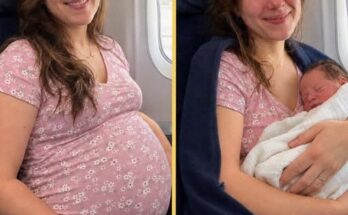
I was 34 weeks pregnant when my husband and I boarded a flight home after my father’s heart attack. I thought the worst part of our trip was behind us.
I was wrong. And when the captain made an unexpected announcement before we landed, I was certain something terrible had happened to my baby.
Earlier that week, Dad had collapsed while watering his tomatoes. My sister, Rachel, found him and called an ambulance. Dad was unconscious when Daniel and I arrived. The doctors couldn’t promise he would recover.
He managed a smile. By the following afternoon, he was complaining about the coffee.
Beside his bed, I described the crib Daniel had assembled backward. I’d chosen our daughter’s name, I said, but wouldn’t tell him until he woke.
On the third morning, his eyes opened.
“You look terrible,” he whispered.
“Nice to see you, too.”
I wanted to stay, but he squeezed my hand and made me promise to return with his granddaughter.
He managed a smile. By the following afternoon, he was complaining about the coffee.
“Go home,” he told me. “You’ve got somebody else to worry about.”
I wanted to stay, but he squeezed my hand and made me promise to return with his granddaughter.
My doctor had cleared me to fly, and until then, the pregnancy had been uneventful. Still, a dull ache had settled across my lower back that morning. I blamed the hospital chairs.
Daniel didn’t like the idea of traveling again so soon.
I had barely slept in three nights, and my legs ached from standing beside Dad’s bed. It was easy to explain away one more discomfort.
Daniel didn’t like the idea of traveling again so soon.
“Want me to find a wheelchair?” he asked at the airport.
“I’m pregnant, not made of glass.”
“I know. I’m still allowed to worry.”
“I said I’d be there. Stop changing things without asking me.”
We boarded behind a man in a navy suit who was speaking sharply into his phone.
“I said I’d be there. Stop changing things without asking me.”
A woman beside him touched his elbow, clearly uncomfortable.
“Please stop,” she whispered.
She took out her phone and began typing.
He ignored her.
She took out her phone and began typing.
“We’ll make it,” she said.
Finally, he hung up without answering.
Across the aisle sat an older woman named Teresa. She offered me a peppermint and asked whether this was our first baby.
I forgot about him once we found our seats.
Across the aisle sat an older woman named Teresa. She offered me a peppermint and asked whether this was our first baby.
When I nodded, she smiled at Daniel.
“Then you’re about to discover a whole new kind of tired.”
For the first hour, everything seemed ordinary. I watched part of a cooking show, ate the crackers Daniel had bought, and texted Rachel.
HE’S ALREADY COMPLAINING ABOUT THE PORTIONS.
She sent a picture of Dad gripping a coffee cup.
HE’S ALREADY COMPLAINING ABOUT THE PORTIONS, she wrote.
I laughed. Then a sharp pain crossed my lower back.
I shifted sideways. A few minutes later, it happened again.
“Are you okay?” Daniel asked.
I went to the bathroom, where another wave left me bent over the sink.
“Probably. She’s been kicking all morning.”
But the next pain made me grip the armrest. I checked the clock.
Seven minutes. Then five.
I told myself I was counting wrong. Knowing what contractions meant was different from feeling them up here.
I went to the bathroom, where another wave left me bent over the sink. On my way back, I had to stop and hold the top of an empty seat.
He flagged down a flight attendant named Olivia.
Daniel saw my face.
“What’s wrong?”
“I think I need some water.”
He flagged down a flight attendant named Olivia.
She crouched beside me. “Are you feeling faint?”
“Can you tell me how far apart the pains are?”
“No. Just cramping.”
“How far along?”
“Thirty-four weeks.”
Her expression changed.
“Can you tell me how far apart the pains are?”
“I’m going to ask if there’s a medical professional aboard.”
Before I could answer, another one hit. Daniel counted quietly until I could breathe again.
“I’m going to ask if there’s a medical professional aboard,” Olivia said.
I caught her sleeve.
“Please don’t scare everyone.”
“My priority is making sure you’re safe.”
He asked about the pain, the baby’s movements, and whether I felt pressure.
A man near the back answered the announcement. He introduced himself as Ramon, a paramedic traveling home, and knelt beside me.
He asked about the pain, the baby’s movements, and whether I felt pressure. Then he asked Olivia to contact the medical team on the ground.
“Am I in labor?” I whispered.
“I think you are.”
“The nursery isn’t finished, her clothes aren’t washed, and the car seat’s still in its box.”
“No. I still have six weeks.”
“I know.”
“The nursery isn’t finished, her clothes aren’t washed, and the car seat’s still in its box.”
Ramon held my gaze.
“None of those things matters right now. Only you and your baby do.”
“We’re almost at our destination. Why can’t we keep going?”
The captain announced a diversion to the nearest suitable airport.
A few people murmured. Someone sighed loudly.
Then a man behind us said, “We’re almost at our destination. Why can’t we keep going?”
I looked back.
It was the man in the navy suit.
Olivia approached him. “Sir, we have a medical emergency.”
“She’s frightened enough. Whatever appointment you have, it can wait.”
“I understand. But has anyone even asked whether she can wait?”
“My wife is in labor,” Daniel said.
The man glanced at me.
“And there are hospitals near the airport we were supposed to land at.”
“The crew has made its decision,” Olivia replied. “Please stay seated.”
I wanted to ask whether he thought I could simply decide not to have a baby. Another contraction silenced me.
Teresa turned toward him. “She’s frightened enough,” she said. “Whatever appointment you have, it can wait.” He opened his mouth, but Olivia raised one hand and pointed firmly at his seat.
I wanted to ask whether he thought I could simply decide not to have a baby. Another contraction silenced me.
Olivia and another attendant cleared space near the rear galley. Ramon helped me lie down while Daniel steadied my shoulders.
Teresa brought her sweater.
“I don’t want her born here.”
“Put this under her head,” she said.
While Ramon prepared supplies, I heard Olivia on the cabin telephone. She said two words: “Priority exit.”
I assumed she meant us.
I gripped Daniel’s hand.
“I don’t want her born here.”
The contractions came almost on top of each other.
“I know.”
“What if she can’t breathe?”
His face drained of color.
Ramon leaned closer. “We’re preparing for her. Listen to me, not the noise.”
The contractions came almost on top of each other. I tried to remember when the ache had begun. Breakfast? The drive to the airport? Had I been in labor for hours without knowing?
Pressure had replaced the pain, and I couldn’t stop myself from pushing.
A voice rose beyond the curtain, followed by Olivia’s firm reply.
“Sir, you need to remain seated.”
I barely heard her. Nothing I did seemed to bring the ground closer. Pressure had replaced the pain, and I couldn’t stop myself from pushing.
“She’s too early,” I cried.
When our daughter arrived, we were still at cruising altitude, roughly 35,000 feet above the ground.
“I know,” Ramon said. “But she’s coming now.”
Daniel pressed his forehead to mine.
“You’re not doing this alone.”
When our daughter arrived, we were still at cruising altitude, roughly 35,000 feet above the ground.
For a terrible moment, there was no cry.
Ramon used supplies from the crew’s delivery kit to clamp and cut the cord.
I heard Ramon speaking, the hum of the engines, Daniel breathing beside me.
“Please,” I whispered.
Then came a thin, furious wail.
“She’s breathing,” Ramon said.
Daniel gave a broken laugh. I burst into tears.
“She needs a hospital as soon as possible, but she’s responding.”
Ramon used supplies from the crew’s delivery kit to clamp and cut the cord. Then he bundled Nora into clean blankets and watched her color and breathing. He also checked me for bleeding while Olivia relayed information to the crew.
“She’s small,” he told us. “She needs a hospital as soon as possible, but she’s responding.”
“Can I touch her?”
He guided my finger to her cheek. She was warm and impossibly tiny.
“You told me we’d decide together.”
“Hi, Nora,” I whispered.
Daniel looked at me.
“You picked Nora?”
“I was going to tell you.”
I watched Ramon keep her warm as the plane finally began descending.
“You told me we’d decide together.”
“Are we really doing this now?”
He shook his head, smiling through tears.
“No. Nora’s perfect.”
Then the captain’s voice came over the speakers.
I watched Ramon keep her warm as the plane finally began descending. Her breathing frightened me because it was so quick. Every few seconds, I asked whether she was all right.
“We’re watching her closely,” he said. “Help is waiting.”
Then the captain’s voice came over the speakers.
Was there something wrong with Nora that nobody had told me?
“Ladies and gentlemen, there’s something important the mother needs to know before we open the doors.”
My stomach tightened.
I looked at Ramon. Was there something wrong with Nora that nobody had told me?
“The mother” meant me. I feared the captain knew something Ramon hadn’t told us.
“Our ground team has arranged for neonatal responders to board through the front door.”
The captain continued.
“Our ground team has arranged for neonatal responders to board through the front door. They need a clear aisle all the way to the rear, where the mother and baby are waiting.”
I started to breathe again.
I remembered the man in the navy suit and the words I’d heard Olivia say into the telephone.
“We’ve also had a request for a passenger to disembark before they board. That request has been denied. For the safety of the mother and child, no one may stand or collect luggage until the crew gives the all-clear.”
A passenger had tried to get off before Nora could be helped.
I remembered the man in the navy suit and the words I’d heard Olivia say into the telephone.
I felt the tires hit the runway, but my attention stayed on Nora’s face.
Daniel stared toward the curtain.
“They’re not going to let him,” he said.
I looked down at our daughter.
“They’d better not.”
After the aircraft stopped, a voice rose from the cabin.
The plane touched down. I felt the tires hit the runway, but my attention stayed on Nora’s face.
After the aircraft stopped, a voice rose from the cabin.
“I’m not asking to hold anybody up. I just need to get off first.”
Olivia answered immediately.
Within minutes, responders entered through the front door and came down the clear aisle to reach us.
“Sir, stay in your seat.”
Within minutes, responders entered through the front door and came down the clear aisle to reach us. One examined Nora while another checked me. Meanwhile, Ramon gave a concise report.
They placed Nora in a transport bassinet.
A curtain shifted, and the man in the navy suit appeared in the aisle, phone in hand.
I reached for her, but the responder needed both hands to secure her safely.
“We’re taking her straight to the ambulance,” she told me. “You’ll follow right behind.”
A curtain shifted, and the man in the navy suit appeared in the aisle, phone in hand.
“So we’re all just waiting?” he asked.
“The baby’s here. She’s crying. She’s fine.”
Olivia stepped between him and the responders.
“Please sit down.”
“The baby’s here. She’s crying. She’s fine.”
Ramon looked up.
“I’m glad she’s okay, but I had somewhere important to be.”
“You can’t judge a premature baby’s condition by looking at her.”
“I’m glad she’s okay,” the man said. “But I had somewhere important to be.”
“We don’t know if she’s okay,” I told him. “Please let them take her.”
He stared at me as though he’d forgotten I could hear him.
The responders wheeled Nora past him, down the aisle, and out the front door.
The woman who’d boarded with him touched his sleeve.
“Please,” she whispered.
He stepped back into his row. The responders wheeled Nora past him, down the aisle, and out the front door. Then his phone rang.
“Emily,” he answered. “Sweetheart, I’m trying. We’ve landed somewhere else.”
“Your wedding starts in two hours. I can still get there by car if I leave now.”
He listened, then turned sharply toward the woman.
“Melissa told you what?”
She lowered her eyes.
“No, Emily. I asked a reasonable question. That’s all.”
That was why he couldn’t bear to wait.
Another pause.
“Your wedding starts in two hours. I can still get there by car if I leave now. I’m supposed to walk you down the aisle.”
I stared.
His daughter’s wedding.
“You know I say things I don’t mean when I’m stressed.”
That was why he couldn’t bear to wait.
He rubbed his forehead.
“What do you mean, you don’t want me there?”
His voice softened.
“You want your mother to walk you down the aisle instead of me?”
“You know I say things I don’t mean when I’m stressed.”
He listened again.
“That was years ago, Emily. You’re still bringing that up?”
The aisle went quiet.
He lowered the phone, looking suddenly much older.
“Your mother?” he asked. “You want your mother to walk you down the aisle instead of me?”
He swallowed.
“You’re really doing this over one mistake?”
Whatever she said next made him fall silent.
As the responders wheeled me past his row, he looked up.
He lowered the phone, looking suddenly much older.
As the responders wheeled me past his row, he looked up.
“I’m sorry,” he said. “I wasn’t thinking.”
I wanted to tell him how frightened I’d been. Instead, I looked toward the exit, where Nora had disappeared.
Nora spent nine days in the neonatal unit.
“Neither was she,” I said quietly. “She just needed help.”
Nora spent nine days in the neonatal unit. She needed breathing support at first, and every monitor alarm made my heart race.
When we reached the hospital, a nurse explained each tube and monitor before touching Nora. I was grateful for every calm word, but I kept staring at her chest, waiting for the next rise.
A month later, the airline asked whether we’d accept a letter from Emily.
Dad called each morning.
“Tell that girl her grandpa’s waiting for a proper introduction,” he said.
A month later, the airline asked whether we’d accept a letter from Emily.
She wasn’t asking us to forgive him; she wanted us to know the choice was hers.
Melissa, her aunt, had used the flight’s Wi-Fi to tell her what her father was saying. Emily wrote that she’d spent years explaining away his anger.
I kept telling myself he meant well, she wrote. I finally realized I was asking everyone else to make the same excuses.
I read her letter twice. She wasn’t asking us to forgive him; she wanted us to know the choice was hers.
Last week, we asked the airline to forward Ramon a photograph of Nora, healthy and smiling in her crib.
Her mother had walked her down the aisle. The wedding had been beautiful.
I didn’t celebrate her father missing it. I hoped he would change.
Last week, we asked the airline to forward Ramon a photograph of Nora, healthy and smiling in her crib.
One day, we’ll tell her about the people who made room for her.
On the back, I wrote, “She made it home. Thank you for helping us get here.”
Nora won’t remember that flight.
But one day, we’ll tell her about the people who made room for her.