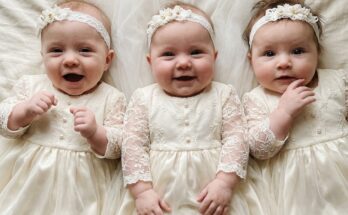
We were happy when my daughter gave birth to triplets. The next morning, three tiny wedding dresses arrived at the hospital. When the babies’ 79-year-old great-grandmother saw them, she fainted. What she knew about those dresses would change our family forever.
After seven years of trying, my daughter Emily finally gave birth to three healthy baby girls.
Our entire family was overjoyed.
But the following morning, something happened that turned our happiness into absolute terror.
I was at the hospital when a nurse brought in a large white box.
“Someone left this at reception for your family.”
There was no sender’s name.
Inside were three miniature wedding dresses.
Real ones.
Tiny white gowns with lace sleeves, pearl buttons, and delicate veils.
Each was small enough for a newborn.
“Who would send something like this?” Emily whispered.
At the bottom of the box lay a card.
“Three brides. Just as we agreed.”
My stomach tightened.
We hadn’t agreed to anything.
An hour later, my 79-year-old mother-in-law, Margaret, arrived to meet her great-granddaughters.
She was smiling until she noticed the dresses.
Then her face went completely white.
She picked up one gown, turned it over, and stared at three tiny blue stitches hidden beneath the collar.
“Oh, dear God—” she whispered.
“Margaret? What’s wrong?”
She looked at the other two dresses.
Her hands began shaking.
“Who brought these here?”
Before I could answer, she collapsed.
The nurses rushed in.
Fortunately, Margaret regained consciousness within minutes.
But when she saw me standing beside her bed, she grabbed my wrist.
“Listen carefully. Don’t let Emily put those dresses on the babies.”
Before I could ask what she meant, my phone buzzed.
An unknown number was calling.
I answered the call.
For several seconds, no one spoke.
Then a man’s voice quietly whispered, “Ask Margaret what happened to her daughter Laura. And don’t believe her when she says Laura died without children.”
The call ended.
I stared at my phone, unable to move.
Laura was a name I had heard only a handful of times during my 26 years of marriage.
Margaret’s only daughter had supposedly died in a car accident at 24.
This was long before I met her son, David.
Whenever he mentioned his sister, his mother became withdrawn, so we had learned not to ask questions.
Now a stranger was telling me that Laura had children.
Three dresses sat on the table beside us.
And Margaret was crying.
“Who was that?” she asked.
I told her what the man had said.
For a moment, she looked as though she might faint again.
Then she turned toward the hospital room where Emily lay with her daughters.
“Please,” she whispered. “Not now. She’s just given birth. Don’t do this to her.”
“Don’t do what? Tell us the truth?”
Margaret lowered her head.
“I never wanted this to happen.”
That was when I knew the dresses were not a prank.
Someone had sent them because they knew a secret Margaret had spent decades trying to bury.
And they had chosen the happiest day of our family’s life to bring it back.
David arrived 20 minutes later. I showed him the dresses and told him about the call.
He examined the blue stitches, then looked at his mother.
“Is this about Laura?”
Margaret flinched. “Please, David.”
“Mom, what is going on?”
She pressed her fingers against her temples. “I need time.”
“For what?” I demanded.
She didn’t answer.
I asked again, “Someone sent wedding dresses to a hospital, made you collapse, and claims Laura had children. How much time do you need?”
Margaret looked at the three sleeping babies through the glass partition.
“Those stitches,” she said quietly.
“What stitches?”
“The ones on the dress. Laura used to put them on everything she made. She said they were her signature. Three blue stitches, always in the same place.”
“Then the person who sent these knew Laura,” David said.
Margaret nodded. “Whoever it is knows more about my daughter than either of you.”
“Then tell us what you know,” I said.
She shook her head. “I can’t.”
I had never seen Margaret behave like that.
She was a proud woman who managed family disagreements with a firm voice and an even firmer stare.
Seeing her frightened made me feel as though the ground beneath us had shifted.
David took her home, promising to return later. Before leaving, Margaret turned to me.
“Whatever you hear, remember that I was trying to protect my family.”
It was the last thing she said before walking away.
I looked at the dresses again.
“Three brides. Just as we agreed.”
Who had agreed to what?
And why had Margaret reacted as though those tiny gowns had come straight from the grave?
That evening, after Emily had been discharged and settled at home with the babies, I began searching through the old family albums.
I found Laura in a photograph taken in the garden of Margaret’s former house.
She had dark hair, a broad smile, and a white dress with delicate lace at the collar.
I brought the photograph closer.
There they were.
Three tiny blue stitches.
The next morning, I visited Margaret.
She sat at her kitchen table, staring at a cup of untouched tea.
When I showed her the photograph, she closed her eyes.
“Tell me about Laura,” I said.
For a long time, she said nothing.
Then she began.
Laura had been 23 when she became pregnant.
The father was a married man who refused to acknowledge the pregnancy.
Margaret, terrified of the scandal, persuaded her daughter to keep the situation quiet.
“When she discovered she was carrying three babies, she was frightened,” Margaret explained.
“Then what happened?”
“She had no money of her own, and the man had abandoned her. I told her that adoption would give the children a better chance.”
“Did Laura agree?”
“At first.”
Margaret’s voice cracked.
“She signed the papers. The babies were placed with different families. But she regretted it almost immediately.”
“But you told everyone she lost her baby.”
“I know.”
“You let your own family believe your grandchildren never existed.”
“I thought I was protecting her.”
“From what? Being a mother?”
Margaret looked away.
She told me that Laura had spent months trying to find the adoptive families.
She wrote letters, made phone calls, and begged Margaret to help her.
Margaret refused.
She believed reopening the matter would destroy the life Laura was trying to rebuild.
Then, six months after the birth, Laura died in a car accident.
“She was coming home from visiting a friend,” Margaret whispered. “The police said she lost control of the car on a wet road. There was nothing anyone could do.”
“And the letters she wrote?”
Margaret’s face crumpled.
“I kept them.”
“Where?”
“In a box in my bedroom.”
I demanded to see them.
She led me upstairs and retrieved an old wooden box from the back of her wardrobe.
Inside were folded letters, hospital documents, and a photograph of three newborn girls lying side by side.
On the back, Laura had written: “My three little brides. One day, I hope you find one another.”
I felt a chill run through me.
The words on the card had not been invented by the stranger.
They had come from Laura herself.
But why had someone used them now?
Margaret picked up one of the letters.
“I promised Laura I would help her find the girls,” she said.
“Did you ever try to find them?”
“After she died, I couldn’t face it. I told myself they were happy with their new families. I told myself they were better off not knowing.”
I looked at the photograph again. Three babies, each wearing a tiny white dress.
The gowns in the hospital box were not identical to the originals.
Still, the resemblance was unmistakable.
Someone had recreated them.
Someone had found Laura’s letters.
And someone was determined to make Margaret answer for what she had done.
The caller rang again that afternoon.
This time, I answered before the first ring had finished.
“Who are you?” I demanded. “What do you want from Margaret?”
“My name is Michael,” he replied. “I’m the husband of the woman who has been searching for her biological family.”
I sat down. “Your wife?”
“She was adopted as a baby. She recently found documents that led her to Laura and to Margaret.”
“How did you know about the triplets?”
“My wife spent years searching for her sisters. She found one adoption record, then another.”
He paused.
“She also discovered that Laura’s mother was still alive. She never got the chance to confront Margaret herself.”
He paused.
“Then I saw the Facebook post you made. Your daughter had given birth to triplets. I knew Margaret was her grandmother. I thought she might finally understand what she had done.”
“So you sent the dresses?”
“Yes.”
“Why wedding dresses?”
“Because of Laura’s letters.”
Michael explained that Laura had left copies of the letters she had written with the adoption agency.
She asked that if her daughters ever came looking for her, they should be given the letters.
In the letters, she called her daughters her three little brides.
She wrote that she hoped they would find each other one day.
She hoped they would get married if they wanted to and have families of their own.
“The dresses were her way of imagining a future she feared she might never see,” said Michael.
I looked at the three gowns on the table.
“And the blue stitches?”
“My wife learned about them from the baby dresses Laura had given the adoption agency, including the one Sarah wore when she was adopted.”
“Why send them to a hospital?”
“Because I learned Margaret’s family was celebrating another birth.”
Michael said he wanted Margaret to see what she had taken away from her own daughter and his wife.
“I wanted her to understand that the children she had given away grew up.”
I swallowed hard. “Who is your wife?”
“Her name was Sarah.”
He gave me a surname I recognized from one of the adoption records in Margaret’s box.
Sarah had been one of Laura’s three daughters.
“Are her sisters alive?” I asked.
“Yes. I found one of them. Her name is Rebecca. She lives a few hours away. The third is still difficult to trace.”
“And what do you want now?”
“I want Margaret to tell the truth to everyone she lied to.”
He paused again.
“I don’t want money. I don’t want revenge. I want the truth my wife spent her life looking for.”
For the first time since the dresses arrived, I understood why someone would go to such lengths to deliver them.
It was not a threat against the babies.
It was a message to a woman who had spent 30 years pretending three children had never existed.
That evening, David and I sat with Margaret in her living room.
I placed Laura’s photograph and the letters on the coffee table.
“Michael called again,” I said. “His wife was Sarah. She was one of Laura’s daughters.”
Margaret covered her mouth. “Sarah?”
“You knew her name?”
“No. But I remember the family who adopted the first baby. They lived in another county. They wrote to me once, years ago, asking about Laura. I never replied.”
David asked, “You received a letter from your granddaughter and ignored it?”
Margaret began to cry.
“I was ashamed. Every time I thought about those children, I remembered Laura begging me to help her find them. I couldn’t bear to admit that I had been wrong.”
“You weren’t just wrong,” David said. “You made a decision for three children and then hid it from everyone.”
“I know.”
“No, Mom. I don’t think you do.”
His voice was low, but I could hear the hurt beneath it.
Margaret reached for his hand. He pulled away.
“I thought I was protecting Laura,” she whispered.
“And what happened instead?” I asked.
She looked at the photograph.
“I lost her anyway.”
For the first time, Margaret did not defend herself.
She told us that Laura had written one final letter, dated two weeks before the accident.
In it, Laura said she had decided to search for her daughters herself.
She no longer wanted to live with the lie that they were better off without her.
Margaret had hidden the letter after Laura’s death.
“Why didn’t you give it to the girls?” David asked.
“Because I was afraid they would hate me.”
“They have every right to be angry,” he replied.
Margaret nodded.
She went upstairs and returned with the letter. Her hands shook as she passed it to me.
I read the final lines aloud.
“I hope my girls find one another. I hope they know that I loved them, even when I was too frightened to fight for them. If they ever come looking, please tell them I never stopped thinking about them.”
Nobody spoke for a long time.
Then Margaret said, “I want to meet them.”
David looked at her, his expression unreadable.
“You should have wanted that 30 years ago.”
Rebecca arrived three days later.
She was about 30, with Laura’s dark hair and the same smile I had seen in the old photograph.
Margaret opened the door herself.
For several seconds, neither woman spoke.
Then Margaret said, “You look like your mother.”
Rebecca’s eyes filled with tears.
“I don’t know what she looked like beyond the photographs I found.”
Margaret stepped aside. “I have more.”
My Sister Sent 12 Rules for Meeting Her Newborn Twins – The Last Made Our 78-Year-Old Mother Cancel Family Dinner
My In-Laws Blamed Me for Years Because Our Daughter Was Born Deaf – At Graduation, She Took the Podium and Began to Sign
80-Year-Old Woman Spent Seven Days Visiting an Old Friend – She Returned Looking Half Her Size with a Suitcase That Wasn’t Hers
“I came because Sarah wants me to find our sister,” Rebecca said. “Sarah still can’t face you.”
Margaret bowed her head. “I’m sorry.”
“I also want to know about my mother.”
Margaret brought out the photographs, letters, and sewing patterns.
They spent hours going through them.
Before leaving, Rebecca agreed to help search for the third sister.
The search took several weeks.
With the help of the adoption agency and records Sarah had collected, they eventually located her.
Her name was Helen.
She had grown up in a family that loved her and had never suspected she had biological sisters.
When Rebecca called her, Helen was silent for nearly a minute.
Then she asked, “Are you sure?”
Rebecca sent her copies of the records and photographs.
Helen agreed to meet them. Sarah came, too.
Their first meeting was awkward and emotional.
They compared childhood memories, laughed at their differences, and cried over the years they had lost.
None of them had become the same person Laura might have raised.
However, all three carried pieces of her in their faces, their gestures, and the stories they had inherited.
Margaret attended the meeting but stayed at the edge of the room until Rebecca invited her to sit with them.
It was not forgiveness.
It was a chance to begin telling the truth.
I also explained everything to Emily: Laura, the adoption, Sarah, and the sisters who had finally found one another.
Emily listened without interrupting.
When I finished, she picked up one of the gowns and examined the tiny blue stitches.
“She called them her little brides,” Emily whispered.
“Yes.”
“She wanted them to grow up together.”
“She did.”
Emily looked toward her daughters, sleeping side by side in their bassinets.
“I can’t imagine being separated from them. I can’t imagine spending the rest of my life not knowing whether they were safe.”
Neither could I.
The next day, Emily asked Margaret to visit.
Margaret arrived carrying a small album of Laura’s photographs.
She sat beside the babies and watched them sleep.
“I’m sorry,” she told Emily. “I can’t undo what I did. I can only tell the truth now.”
Emily took her hand.
“I don’t know if I’ll ever understand why you did it. But I hope you understand what it cost them.”
Margaret nodded, tears running down her face.
“I do now.”
She stayed for an hour, telling Emily stories about Laura.
For the first time, she spoke about her daughter without turning away or changing the subject.
Before she left, she asked whether Emily would keep the dresses.
Emily agreed.
Not as wedding gowns for her daughters, and not as a promise that they would one day marry.
They would remain what they had always been: a reminder of a mother who had loved three children she never got to raise, and of the family secret that had kept them apart.
Margaret had believed that hiding the truth would protect her family.
Instead, the lie had outlived the woman she was trying to protect.
The dresses had arrived at the hospital as a warning, but they had become something else.
They were proof that the past could not be buried simply because the people who remembered it were afraid to speak.
And as I watched Emily cradle her three daughters, I understood the cruelest part of Margaret’s secret.
Laura had never wanted her children to be brides.
She had wanted them to be sisters.
If someone sent three miniature wedding dresses to your newborn grandchildren to expose an old family secret, would you consider the gesture justified or unnecessarily cruel?
If this story caught your attention, you might enjoy
this one too
:
I thought I knew the man I’d married, especially when he promised he’d be the kind of father our daughters could always count on. But the days after I gave birth to our triplets showed me just how wrong I was.