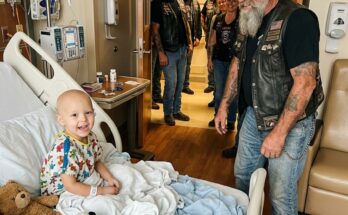
I never expected the most intimidating doctor in the hospital to become my dying son’s favorite person. At first, I was grateful to see my boy smiling again. Then I noticed how often they whispered together, and I began wondering what the doctor wasn’t telling me.
The doctor who walked into my son’s hospital room had tattoos running up both arms and onto his neck. He looked more like someone who belonged in a motorcycle club than beside a hospital bed.
I didn’t trust him.
Three weeks later, 12 bikers walked into that same room, and I nearly demanded that security remove them.
I had no idea those men were about to give my dying son something his own father never had.
Or that my boy had been keeping a secret that would change the doctor’s life, too.
My name is Bridget, and my son, Drew, was 12 when the doctors told me he had approximately three months to live.
I remember sitting beside his bed as two doctors explained his latest scan results.
His cancer had continued spreading despite treatment.
There was nothing more they could do to stop it.
I nodded as though I understood.
Drew was supposed to have decades ahead of him.
He had places he wanted to visit, games he wanted to finish, and a list of things he planned to do when he got older.
He wanted to see the ocean.
He wanted a dog.
More than anything, he wanted a motorcycle.
I’d raised Drew alone. His father had drifted out of our lives years earlier, leaving behind occasional birthday cards and promises that never became anything.
I’d spent 12 years trying to be both parents, telling myself that loving Drew enough would make up for everything else.
Now I couldn’t even promise him another birthday.
A few days after that conversation, Dr. Harris joined Drew’s medical team.
He was enormous, with broad shoulders, a shaved head, and tattoos covering both arms and disappearing under his collar.
My mother was visiting when he first introduced himself.
After he stepped out, she leaned toward me.
“They hired someone with tattoos like that?”
I didn’t answer, but I’d been thinking the same thing. If I’d passed him on the street at night, I probably would have crossed over.
Then I started watching how he treated Drew.
Most doctors spoke to me first, even when Drew was awake. Dr. Harris pulled up a chair and looked my son directly in the eye.
“How are we doing today, champ?”
“Depends,” Drew said. “Are you bringing more needles?”
“Not personally. I’m trying to improve my reputation around here.”
Drew laughed.
It was the first real laugh I’d heard from him in days.
Over the following weeks, Dr. Harris remembered everything Drew told him.
He asked about a game Drew had been playing and remembered the name of a boy at school who’d been bothering him before he got sick.
On difficult mornings, he could get Drew talking when I couldn’t.
Once, I stood outside the room listening as they argued about whether a motorcycle could outrun a race car.
“Depends on the track,” Dr. Harris said.
“That’s cheating. You can’t change the question.”
“Sounds like you need better questions.”
Drew burst out laughing.
Watching them together hurt in a way I couldn’t explain.
My son had found someone he admired, someone who made him forget he was sick for a few minutes.
Someone who reminded me of what he’d missed growing up without his father.
And it wasn’t because I hadn’t tried hard enough.
One afternoon, I returned from the cafeteria and found them whispering, their heads close together.
Drew immediately stopped talking.
“What are you two discussing?”
He glanced at Dr. Harris, trying not to laugh.
“Secret.”
“Oh, really?”
“Doctor-patient confidentiality,” Dr. Harris said, smiling.
I smiled back, but I wasn’t entirely comfortable.
Drew had been talking constantly about motorcycles lately.
He wanted to know how engines worked, why bikers wore leather, and whether motorcycle clubs were like families.
I worried Dr. Harris was encouraging a dream Drew couldn’t possibly fulfill.
That evening, I asked my son what they’d been planning.
“You’ll find out tomorrow.”
“Drew, I need to know you’re not doing anything dangerous.”
He rolled his eyes.
“Mom, I can barely walk to the bathroom. What dangerous thing am I going to do?”
I couldn’t argue with that.
The next afternoon, voices began gathering outside his room.
I heard heavy footsteps, laughter, and someone asking which door was Drew’s.
Then 12 men in leather vests walked inside.
They were big, tattooed, and carrying things I couldn’t identify at first.
One held a helmet. Another carried a folded leather vest. A third had a small package tucked under his arm.
I stood up.
“What’s going on?”
Drew’s eyes widened.
“No way,” he whispered.
Dr. Harris stepped forward and leaned against the side of his bed.
“In your condition, you can’t ride a bike, champ.”
Drew’s smile faltered.
“But we’ve got an idea. And a surprise that’s a whole lot better.”
One of the bikers, a gray-bearded man named Wade, stepped closer.
“Well, Drew, we heard you’ve been wanting to join a motorcycle club.”
Drew nodded so hard I worried he’d make himself dizzy.
Wade held up a small black leather vest.
Across the back, embroidered in silver thread, was Drew’s name.
Under it were the words “Honorary Brother.”
“Every club has its rules,” Wade explained. “Ours says you don’t need a motorcycle to belong. You just need people willing to stand beside you.”
Drew reached for the vest with trembling hands.
“Is this really mine?”
“Sure is.”
When Wade helped him put it on, every biker applauded.
I started crying before I could stop myself.
Dr. Harris explained that he’d cleared the visit with the hospital staff.
If Drew felt well enough later that week, the nurses could help us take him outside for a short ceremony where the bikers would bring their motorcycles.
But something happened before the men left.
Drew noticed the second leather vest Wade had placed on a chair.
It was older than his, with faded patches and worn seams.
“That’s yours, right, Doc?”
Dr. Harris looked toward the chair.
His expression changed.
“Yeah,” he said quietly.
“Then put it on.”
For the first time since I’d met him, Dr. Harris seemed unable to find an answer.
“Not today, buddy.”
Drew looked disappointed.
“But you said…”
Dr. Harris interrupted gently.
“We’ll talk about it later.”
Wade picked up the old vest and folded it again.
The cheerful atmosphere returned, but I noticed Dr. Harris barely spoke for the rest of the visit.
After the bikers left, I found him standing near the nurses’ station.
“Can I ask you something?”
“Of course.”
“Why did my son look so upset when you wouldn’t put on that vest?”
He glanced toward Drew’s room.
“It’s complicated.”
“Then explain it.”
Dr. Harris hesitated.
“I used to ride with those guys. I haven’t in a long time.”
“Why?”
“Personal reasons.”
I studied him.
“Look, I appreciate everything you’ve done. But Drew’s had enough people make promises they couldn’t keep.”
His face softened.
“I understand.”
“I’m not sure you do.”
He nodded, accepting the criticism without arguing.
“You’re right to protect him, Bridget. But I promise I’m not playing with his feelings.”
I wanted to believe him.
That evening, after the excitement had settled, Drew asked me whether I’d liked his new vest.
“It’s beautiful.”
“I’m officially a biker now.”
“You certainly look like one.”
He ran his fingers over the embroidered letters.
Then, unexpectedly, he asked, “Do you remember when Dad said he’d take me riding?”
I sat down.
His father had owned an old motorcycle years earlier.
Drew was six when he promised that someday, when Drew was bigger, they’d take a long trip together.
I’d almost forgotten.
“Yes,” I said.
“I used to think if I learned enough about motorcycles, he’d come back and take me.”
I couldn’t speak.
“He always talked about riding with his buddies. I thought maybe if I became one of them, he’d want to hang out with me.”
“Drew…”
“It’s okay, Mom.”
“No, sweetheart. It isn’t.”
He looked at me.
“I know you don’t like talking about him.”
That hurt because it was true.
Every time Drew mentioned his father, I’d rushed to reassure him that we were perfectly happy without him.
I’d never considered that I might be making it harder for Drew to admit he missed someone.
“You can miss your dad,” I told him. “Even if I don’t. You don’t have to protect my feelings.”
He looked down at his vest.
“Dr. Harris says bikers look after each other.”
“Good ones probably do.”
“That’s why I like his friends. They showed up even though they didn’t have to.”
I held his hand.
For years, I’d thought motorcycles were simply something Drew loved.
Now I understood that he’d been waiting for a promise to be kept.
The following morning, Wade returned alone with photographs from the motorcycle club.
Drew was sleeping, so we sat in the family waiting area.
I thanked Wade for everything, then asked about Dr. Harris.
Wade stared at his coffee.
“Harris used to be one of our most dependable riders.”
“What happened?”
“His younger brother died. After that, he stopped coming around.”
I glanced toward the hallway.
“His brother was a biker?”
“They both were. Those two were inseparable before his brother got sick.”
Wade explained that Dr. Harris had been working long shifts while his brother’s health deteriorated.
“He kept saying he’d take a few days off when things settled down. Trouble was, things never settled down.”
“Did his brother blame him?”
“Not once. But Harris blames himself enough for both of them.”
I thought about the doctor’s patience with Drew and the way he remembered every little detail.
Suddenly, his attention made more sense.
Later that day, I found Dr. Harris sitting beside Drew while he slept.
“Why didn’t you tell me about your brother?” I asked quietly.
He looked surprised.
“Wade mentioned him,” I explained.
Dr. Harris watched Drew for a moment.
“My brother was 19 when he died. I was older, already working at the hospital. I kept thinking there’d be more time.”
“I’m sorry.”
“He loved riding. We used to take trips together whenever I could get away.”
“Why did you stop?”
“I couldn’t enjoy it anymore. Every time I saw the guys, all I could think about was the person who wasn’t there.”
I sat in the chair opposite him.
“My son has spent years missing somebody who’s still alive,” I said. “And I’ve spent years pretending that didn’t hurt him.”
Dr. Harris looked at me.
“I don’t know how to fix that.”
“Neither do I.”
For a while, we sat listening to Drew breathe.
Then I asked, “Did your brother ever want you to stop riding?”
Dr. Harris shook his head.
“No. He would’ve hated it.”
He looked toward the window.
“I know that. Doesn’t make going back easy.”
I didn’t push him.
But I finally understood why Drew had been so disappointed about that old vest.
Or at least I thought I did.
Two days later, the hospital approved a brief outdoor gathering.
Drew’s condition was stable enough that morning, and a nurse agreed to accompany us.
Before we went outside, Wade quietly pulled me aside.
“There’s something you should know.”
He showed me the old leather vest.
“Your boy asked me to bring this.”
“I thought Dr. Harris arranged everything.”
“He arranged Drew’s surprise. Drew arranged this part.”
I stared at him.
Wade explained that Dr. Harris had told Drew about his brother after Drew asked about a small tattoo on his wrist.
The tattoo showed two motorcycle wheels with a date under them.
Drew had wanted to know why someone who loved motorcycles so much didn’t ride anymore.
Eventually, Dr. Harris told him.
“And then your boy asked me whether we could get Harris back into the club,” Wade said.
“How did Drew even contact you?”
“Harris introduced us on a phone call while we were planning the visit. When he stepped out for a minute, Drew asked me to keep one extra surprise.”
I looked at the folded vest.
All this time, I’d believed Dr. Harris was the one giving my son something extraordinary.
I hadn’t realized Drew was trying to return the favor.
“He told me the doctor made him feel like he still had something to look forward to,” Wade continued. “Said he wanted Harris to feel that way again.”
I had to turn away.
My son, who knew he was dying, was worrying about a grown man who’d forgotten how to enjoy his life.
Outside, the motorcycles were parked in two neat rows near a quiet hospital entrance.
Drew stared at them from his wheelchair, wearing his honorary vest.
Wade introduced each rider, then invited Drew to choose his favorite motorcycle.
He picked a dark blue one with polished chrome.
“That one’s yours?” he asked Wade.
“Sure is.”
“Good choice.”
“Thank you. I was hoping you’d approve.”
Everyone laughed.
Then Wade presented Drew with a small patch bearing the club’s emblem.
The bikers stood around his wheelchair for a group photograph.
I thought the ceremony was finished.
But Drew looked toward Dr. Harris.
“Hey, Doc?”
“Yeah, champ?”
“There’s something else.”
Wade handed my son the older vest.
Dr. Harris immediately recognized it.
“Drew…”
“You told me bikers don’t leave their brothers behind,” Drew said.
“That’s right.”
“Then why did you leave yours?”
Nobody spoke.
Dr. Harris crouched beside the wheelchair.
“It’s not that simple, buddy.”
“I know.”
Drew looked at the vest.
“But you still remember your brother, right?”
“Every day.”
“So putting this on won’t make you forget him.”
Dr. Harris lowered his head.
For a moment, I thought he’d refuse again.
Then he carefully took the vest.
“You know,” he said, his voice rough, “my brother would’ve liked you.”
Drew smiled.
Man Kept Asking for His Late Father-in-Law’s Broken Clock – Then It Rang at 2:15 AM
My Parents Forgot My Birthday for Years – When They Saw My Mercedes and Claimed I Didn’t Deserve It, I Made Them Wish They’d Just Stayed Quiet
Woman Kept Smiling After Her MIL Smeared Cake on Her Daughter’s Face – Then Prepared a Lesson for the Next Morning
“Would he have let me join?”
“He would’ve made you president.”
The men laughed softly.
Dr. Harris stood and slipped his arms into the leather vest.
Wade stepped forward and straightened the collar.
Then the bikers made room for him in their circle.
Drew looked up at me with the biggest smile I’d seen in months.
“Mom, there’s 13 of them now.”
I kissed the top of his head.
“You’re counting yourself, aren’t you?”
“Obviously.”
Over the following weeks, Drew’s condition worsened.
There were days when he barely had the strength to speak, but Dr. Harris kept coming to see him. Sometimes he brought photographs from rides. Sometimes they simply sat together.
The bikers sent postcards and short messages. Wade visited when Drew felt up to company.
My mother came one afternoon and found two enormous men sitting beside Drew, listening while he explained his favorite game.
Afterward, she pulled me aside.
“I suppose we were wrong about those tattoos.”
I smiled.
“Very wrong.”
Drew lived almost three months after the day we received his prognosis.
Near the end, he asked me to hang his vest where he could see it.
One evening, he looked at me and said, “Mom, are you going to be okay?”
I wanted to tell him yes.
Instead, I told him the truth.
“I’m going to miss you more than anything.”
He nodded.
“But you have friends now.”
“I do.”
“And Wade said I can always be part of the club.”
“You always will be.”
He smiled faintly.
“Good.”
Drew died peacefully a few days later, with me holding his hand.
Nothing about losing him was easier because of what Dr. Harris had done.
But when the funeral was over, and the quiet became unbearable, I discovered I wasn’t as alone as I’d feared.
Wade called regularly.
The bikers invited me to their gatherings, never pressuring me to attend.
Dr. Harris checked in, too, no longer as Drew’s physician, but as someone who had loved him.
Six weeks later, I attended a memorial ride organized in Drew’s honor.
The motorcycles lined up under a clear blue sky.
Dr. Harris stood beside Wade, wearing his old leather vest.
When he saw me carrying Drew’s smaller one, his eyes filled.
“I thought the club should keep this,” I said.
Wade shook his head gently.
“Bridget, he was one of us. But that belongs with his mother.”
He showed me a photograph mounted inside their meeting room.
It was Drew on the day of the ceremony, grinning between Dr. Harris and the other bikers.
Under it were the words “Our Brother, Always.”
I touched the photograph.
For years, I’d worried that I couldn’t give Drew everything he needed.
I’d been so afraid of failing him that I’d forgotten love was never something one person had to provide alone.
The tattooed doctor I’d once wanted to avoid had given my son a family of men who kept their promises.
And my boy had helped that doctor find his way back to the people he’d lost touch with.
As the engines started, Dr. Harris stepped beside me.
“Ready?” he asked.
I looked down at Drew’s vest, folded carefully in my arms.
Then I looked at the 12 bikers waiting for us, with the doctor standing among them.
“Yeah,” I said. “I think Drew would want us to go.”
For the first time since losing my son, I wasn’t afraid to let someone walk beside me.
If you were Bridget, would you have trusted the tattooed doctor to arrange a surprise for your terminally ill son without knowing all the details?
Loved this story? Here’s
another one
: A man inherits his late father’s broken grandfather clock, but his brother-in-law becomes strangely desperate to take it. Then, one night, the clock suddenly chimes at 2:15 a.m., even though it hasn’t worked in 12 years. What was hidden inside?