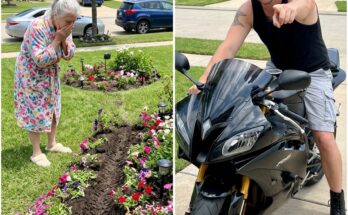
I watched something precious to me get crushed into the dirt, only to be told it was no big deal. I went inside furious, never expecting what I’d see across the street the following morning.
The motorcycle roared past my kitchen window so loudly that the glass rattled! I gripped the sink’s edge until my knuckles turned white. My hands were still damp from washing my coffee cup. I already knew, before I even looked, that the sound meant trouble on my street again.
The glass rattled!
I peeked through the curtain and watched Tyler swing around the corner on his shiny red bike, his helmet dangling from the handlebars as if he thought traffic laws were a suggestion. “Lord have mercy,” I muttered. “That boy’s going to break his neck, and half the neighborhood’s going to send flowers just to be sure.”
“Lord have mercy.”
I’ve lived in this house for almost 30 years. My husband, Abraham, carried me over the threshold when my hair was still brown, and my knees still worked without complaint. The summer we moved in, he spent every free weekend on his hands and knees in the front yard, digging up sod and hauling bags of soil. When he was done, he’d built a flower garden for me right by the walkway.
He’d built a flower garden.
My husband had planted red and yellow flowers because those were the colors he brought me every single anniversary, wrapped in brown paper from the local florist. “So you never forget what day it is,” he used to tease.
“You’re the one who forgets, Abraham. I just play along.”
He used to tease.
He passed 11 years ago this March. I kept the garden exactly where he left it, and every spring, I planted new red and yellow blooms in his memory. They weren’t expensive flowers. But they mattered to me. Every morning, I filled my watering can and tended that bed as if it were a small, breathing thing. Some mornings, I even talked to it. Across the street, Denise would be out on her porch with her broom, sweeping the same three boards she’d swept the day before.
They mattered to me.
My neighbor was in her early 60s, still full of pep. “Morning, Ember,” she’d call over. “Garden’s looking loud today!”
“Loud is the point, Denise!”
“Abraham would be proud!”
“Abraham would say I’m overwatering!” We’d laugh, and that was most mornings for the last few years. Warm, easy, the kind of neighbor a widow was grateful for. Then summer arrived, and Tyler came with it.
“Loud is the point, Denise!”
*** Tyler was 22, home from college, and the son of my neighbor Gerald, who owned half the storefronts in town. Everyone knew the family had money, and his son wore it like cologne. Tyler was loud and spoiled. For months, he’d rev that motorcycle late at night, parking sideways across driveways to block them, and cutting corners through people’s lawns as if the whole block belonged to him. By fall, the neighborhood was tired of him.
The family had money.
I’d watched my next-door neighbor, Mr. Petersen, go out three times to ask him nicely. Tyler had smiled, nodded, and done it again the following night.
“Somebody ought to say something to Gerald,” Mr. Petersen told me one afternoon over the fence. “Somebody ought to. Nobody will. You know how it is. Half the folks on this street rent from that man.” “And the other half owe him a favor,” my neighbor said.
I’d watched my next-door neighbor.
*** Now, watching Tyler tear down the road toward the cul-de-sac that Saturday afternoon, I felt that same little itch under my ribs. He’d been getting bolder every week, cutting closer to porches and skimming closer to mailboxes. “One of these days,” I said to the empty kitchen, “that boy is going to pick the wrong yard.” The motorcycle turned and came roaring back down my street. Not two minutes later, that wrong yard was mine.
I felt that same little itch.
I turned away to do something, and by the time I reached the window, Tyler came ripping around the corner. He swung wide, cut off the road, and drove his back tire straight through Abraham’s flower bed!
I heard the crunch before I saw it. That soft, awful pop of stems giving up. I didn’t run. Seventy-one-year-old women don’t run, and anyway, I wasn’t going to give him the show.
I heard the crunch.
I walked out in my house slippers, holding the porch rail on the way down because pride is one thing and hips are another. Half the red and yellow blooms were flattened into the mud! A ribbon of tire tracks cut clean through the middle, as if somebody had drawn a line through a love letter. Tyler was still straddling the bike, his helmet tipped back, grinning at nothing in particular.
I walked out in my house slippers.
“Young man,” I said. My voice came out steadier than my hands. “Those flowers were for my husband, who passed away.” Tyler glanced at the mud, then at me, and then he did one thing that made my whole chest go cold. He shrugged.
“It’s just grass and flowers. They’ll grow back.”
“They won’t be the same,” I said. “Not the way he’d planted them.”
He shrugged.
“They’re plants.” My neighbor’s son smirked, the way young men do when they’ve never once been told “no.” “Relax. I didn’t do it on purpose.” “You didn’t do it by accident either.” Across the street, I caught a flash of movement. Denise was on her porch watching. Our eyes met. For one long second, I thought, “Good, somebody saw. Somebody will say something.”
“I didn’t do it on purpose.”
Then Denise stepped back and shut her door. That hurt worse than the tire tracks. I can’t explain it any other way. Denise, who brought me soup when I had bronchitis and waved every morning, had gone inside as if she hadn’t seen a thing. Tyler noticed too, and it fed him. “See?” he said, smirking again. “Nobody’s dying over some marigolds.”
That hurt worse.
“They weren’t marigolds.” “Whatever.” He kicked the bike, and the engine screamed to life. “Have a nice day.” Gerald’s son rode off. Slowly this time. Slow enough to make sure I watched him go. I stood at the edge of what used to be my garden for a minute. Maybe longer. I had a whole list of things I wasn’t going to do that afternoon, and yelling and crying in the front yard were near the top.
I watched him go.
I bent down and picked up one broken yellow blossom. The stem was pinched flat. I put it in my apron pocket, anyway. Then I went back inside, closed the door quietly, and sat at the kitchen table. Abraham’s photo was on the fridge, right where it had been for over a decade. The one where he was squinting into the sun, dirt on his knees, holding up a trowel as if it were a trophy.
I put it in my apron pocket.
I looked at him. He looked back.
“I know what you’d say,” I told him, still livid. “You’d say he’s just a kid and to ‘Let it go.'” I picked up my phone. I dialed one number. I knew it by heart. The line picked up on the second ring.
“I know what you’d say.”
“It’s Ember,” I said. “I need to ask you something, and I need you to tell me the truth about whether you can help.” The voice on the other end went quiet for a beat. Then softer. Then sure. I didn’t say much after that. I listened, mostly. I said, “Thank you” twice. When I hung up, my hand wasn’t shaking anymore, which surprised me more than anything else that day.
“I need to ask you something.”
I looked back at my late husband’s photo. “Sorry, love,” I said. “I know what you’d want me to do. I’m not going to do it. Not this time.” I put the flattened yellow blossom in a little jelly jar of water on the windowsill because it felt wrong to throw it out. It wouldn’t come back. I knew that. But it deserved a proper afternoon, anyway.
Then I made myself a cup of tea and sat at the window that looked out on the neighborhood across the way.
It wouldn’t come back.
I didn’t know what would be waiting the following morning. I only knew that something was going to happen. And I would be right here, in this chair, to see it. *** Sunday morning came slow and gold, and I stood at my kitchen window with a coffee I wasn’t really drinking. I told myself I wasn’t waiting for anything. But I was anxious.
I would be right here.
I noticed Tyler coming out at 9:30 a.m., his helmet tucked under one arm, whistling as if he owned the sidewalk. Then he stopped. He stood in the middle of his driveway, staring for a few seconds, and his whole face just quit working. Beside his motorcycle was a little “surprise.” There sat a big ceramic pot stuffed with red and yellow flowers, the exact colors of my bed. Taped to his handlebars was a printed sheet of paper that flapped in the breeze. Leaning against the garage, his arms folded across his weekend polo shirt, was Gerald himself!
Then he stopped.
Tyler’s head snapped up in shock. He looked straight across the street, straight at my window, as if he could feel me watching. I gave a small two-finger wave and walked to my front door. Just as I stepped out, Tyler finally noticed his father. Gerald’s voice carried the way a father’s voice carries when he’s finally decided to be a parent again.
“Read it out loud, Tyler.”
“Dad, come on.” “Read it!”
I gave a small wave.
“I, Tyler, will work with a landscaper to make a full replacement of my neighbor’s garden. Every single bulb will be replaced by my hand under Mrs. Halloran’s supervision.” “And don’t you dare call her ‘ma’am’ and think that covers it!” Gerald scolded. Then he put out one hand, palm up, and waited. Tyler stared at him.
Then he put out one hand.
“Seriously, Dad?” “Keys. Now.” The motorcycle keys landed in Gerald’s palm with a little jingle. I allowed myself a smile that Abraham would’ve called unchristian. I still had my coffee in hand; I sipped it. It had gone cold. I didn’t care one bit. I went back inside with a satisfied smile.
I allowed myself a smile.
*** That afternoon, my doorbell rang, and Tyler stood on my porch in gardening gloves so new the store tag was still swinging off one wrist. He held a plastic tray of red and yellow starter plants as if it might bite him. “My dad said,” he began, then stopped. He started again. “Mrs. Halloran. I’m here to fix your flower bed with the assistance of a landscaper.”
“Ahh… how nice of you.”
“My dad said you’d tell me what to do.”
“I’m here to fix your flower bed.”
I opened the door wider, greeted the landscaper, and pointed down at the muddy scar in my yard. “I certainly will. Come on.” I handed Tyler a trowel. He looked at it as if he’d never held one. “You dig where I point,” I said. “You put the roots in gently. Then you pat the dirt; you don’t pack it. Flowers aren’t concrete.” Gerald’s son turned to look at the landscaper.
I handed Tyler a trowel.
“You heard your elder,” the landscaper said. “Yes, Mrs. Halloran.” “Ember.” “Yes, Ember.” Tyler knelt in the dirt in jeans that probably cost more than my washing machine, and he started digging. The landscaper guided him so that he did it right. I sat on my porch step with my coffee; this time, it was hot, and I watched them.
“You heard your elder.”
For a while, nobody said anything. Gerald’s boy was concentrating in that way children do when they don’t want to find themselves repeating the same thing.
“His name was Abraham,” I said after the second row. Tyler paused. “My husband. He spent a whole summer out here, back when we first moved in. He wanted a garden for me. He picked the red and yellow because those colors meant something for us.”
Nobody said anything.
“Oh.” “Every one of them, for more anniversaries than I can count on both hands, before he passed.” The trowel kept moving, slower now. “I didn’t know that,” my neighbor’s son said.
“I know you didn’t because you didn’t care to ask.”
He worked in silence through the third row, and somewhere in there, the smirk that had lived on his face all summer just slid off and didn’t come back.
“I didn’t know that.”
I still couldn’t figure it out. I sat there watching him pat dirt around Abraham’s flowers, and my mind kept circling the same puzzle. I’d made one phone call yesterday. One. And it hadn’t been to Gerald, and it hadn’t been to the police, and it hadn’t been to any lawyer.
I’d called my sister, a contractor, who’d said she’d handle things for me. But she still hadn’t arrived. So how on earth had Gerald known before the sun came up?
I still couldn’t figure it out.
The screen door across the street creaked open, and out came Denise with a pitcher of lemonade balanced on a tray. Three glasses clinked together as she walked over, as if this were any old Sunday visit.
“Thought you three might be thirsty.”
“Bless you,” I said. Then Gerald came ambling across the street too, his hands in his pockets, and stopped right in front of Denise with the softest look on his face.
Three glasses clinked together.
“You’re so cute,” my neighbor said. Denise turned the color of my flowers! I tilted my head very, very slowly. *** Later that evening, Denise waved me over to her porch with the lemonade we hadn’t finished.
I sat down and finally asked what I’d been holding all day.
“You’re so cute.”
“Denise. Did you have a hand in Gerald knowing about my garden incident before sunrise? I’d called my sister to intervene, but later saw her text saying something important had come up, and she’d come by tomorrow.” My neighbor laughed, a little sheepishly, and swirled her glass. “Because I told him. Last night, after the incident. I waited until Tyler was out with his friends, then I went over.” I blinked at her.
“I told him.”
“You went over?”
“Ember, I’ve been seeing Gerald for almost a year. Quietly. He wasn’t ready for Tyler to know he was dating after losing his wife a few years ago, and I didn’t want the block turning us into a soap opera.” I set my lemonade down very carefully. “That’s why you ducked inside yesterday.”
“I’ve been seeing Gerald.”
“I couldn’t stomp over there as a stranger and chew out his son before Gerald had even had that talk with him. It was the one card I couldn’t play on the sidewalk.” I shook my head, half-laughing, half-stunned. “I thought you’d left me hanging!”
“I couldn’t stomp over.”
“I know you did. I’m sorry for that. The minute Tyler’s truck pulled out, I walked straight to Gerald’s door and told him everything. The flowers on the driveway this morning were my idea. A receipt he couldn’t shrug off.” “Denise,” I said, “you’re a menace!”
“In the best way, I hope!”
“In the very best way.” We sat there giggling like two girls who’d gotten away with something.
“I’m sorry for that.”
*** Over the next few weeks, Tyler finished the bed, learned my late husband’s name, and the late-night revving stopped. Gerald and Denise started walking the block hand in hand, no more hiding. At dusk, I stood in the garden, blooms flourishing again. “The flowers are fine, love,” I whispered. “Turns out I had better neighbors than I knew.”