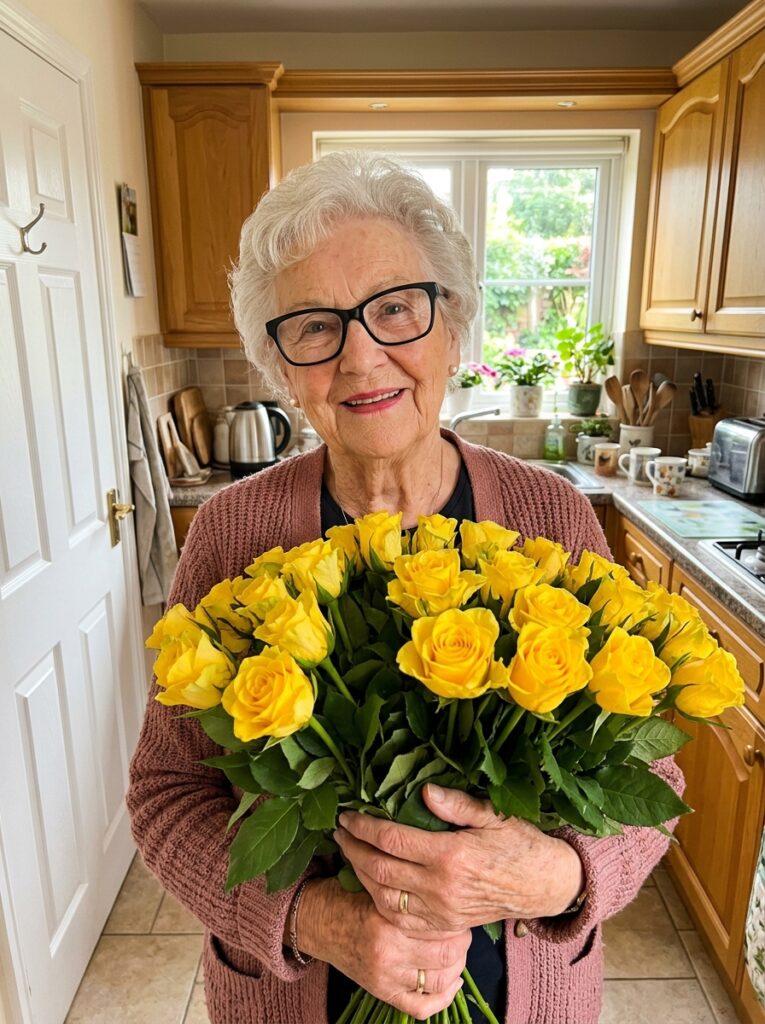
Fifty-six yellow roses arrived on the anniversary I’d spent most of my life observing alone. Hidden among them was a crooked paper rose, old and faded. I almost tossed it aside. Then I noticed something on its stem that took me straight back to the morning my husband left in 1970 and never returned.
The deliveryman had already turned toward his van when I called after him.
“Excuse me. Are you sure these are for me?”
I almost tossed it aside.
He checked the clipboard.
“Mary?”
“Yes.”
“Then they’re yours.”
I looked down at the enormous bouquet filling both my arms.
Yellow roses.
Dozens of them.
I carried them into the kitchen and counted twice.
Fifty-six.
My fingers stopped on the final stem.
Today would have been my 56th wedding anniversary.
“They’re yours.”
I found my largest vase, filled it with water, and began separating the stems.
Something sharp scraped my thumb.
“Ow.”
I pulled my hand back.
It wasn’t a thorn.
Wedged among the fresh roses was something yellow and crumpled.
Paper.
I eased it free.
It wasn’t a thorn.
It was a flower, folded badly from faded yellow paper. One side leaned farther out than the other, and the stem had been reinforced with a narrow strip of brittle tape.
I almost laughed at how ugly it was.
Then I saw a letter written near the bottom.
J.
I almost laughed at how ugly it was.
James.
My husband.
The man who had been missing for 56 years.
I sat down so quickly that one of the roses slid from the table.
“No,” I whispered.
Could it really be James? The man who’d been my husband for only two days, yet somehow remained my husband for the next 56 years?
Could it really be James?
James and I married in my parents’ backyard while he was home on leave. There were 23 guests, one crooked cake, and my mother cried through nearly the entire ceremony.
James teased her afterward.
“I’m borrowing your daughter. I’m not stealing her.”
James teased her afterward.
My mother pointed a cake knife at him.
“You bring her back happy.”
James looked at me.
“That’s the plan.”
Two mornings later, I stood with him at the station wearing the yellow dress he’d liked so much.
“That’s the plan.”
Before boarding, he kissed me and said, “Next anniversary, I’ll buy you the biggest bouquet of yellow roses I can find.”
I told him, “You’d better. I married you for flowers.”
He laughed.
It was the last time I ever heard that laugh.
“I married you for flowers.”
Weeks later, his unit came under heavy fire.
Men died.
Others disappeared.
James was listed missing.
His closest friend, Adrian, eventually came home and sat in my parents’ living room with his hands locked between his knees.
James was listed missing.
“I saw the explosion,” he told me. “Mary, I’m sorry. I don’t think James could have survived.”
There was no body found.
Eventually, there was paperwork.
Presumed dead.
That was all I had.
I never remarried. Some stubborn part of me kept waiting long after there was supposedly nobody left to wait for.
I never remarried.
Until a badly folded paper rose appeared in my kitchen 56 years later.
I searched the bouquet again.
This time I found a small cream envelope tucked beneath the ribbon.
My name was written on the front.
Mary.
Inside was a card.
I searched the bouquet again.
I read the first line.
Then I read it again.
“Darling, you won’t believe why I had to disappear. Adrian lied to you.”
My chair scraped backward.
There was more.
“Adrian lied to you.”
“Act normal. If you still have the yellow dress, bring it with you. Take the roses to the old station at 11:00. Do exactly what I’m asking you to do now.”
I looked at the clock above my stove.
10:17.
Take the roses to the old station at 11:00.
My first thought made me ashamed of myself because it was so impossible.
James was alive.
Somehow.
Somewhere.
My second thought was worse.
If he had been alive all this time, then every anniversary, every Christmas, every birthday I had quietly marked without him had happened while my husband was breathing somewhere else.
My second thought was worse.
I grabbed the card again.
“Adrian lied to you.”
Adrian.
The man who had attended my parents’ funerals.
The one who mailed me a Christmas card every year until arthritis made writing difficult.
The man who had attended my parents’ funerals.
And he was the same man who had looked at the 23-year-old me in the face and said James was almost certainly dead.
I reached for the phone.
Then stopped.
Act normal.
If James had written this, why?
If James had written this, why?
And if James hadn’t written it, who knew about the yellow dress?
I went upstairs.
The dress was still inside a cedar chest in the back of my closet.
I hadn’t unfolded it in years.
And if James hadn’t written it, who knew about the yellow dress?
Its color had softened with age, but it was unmistakably the same yellow cotton dress I’d worn the morning James left.
I ran my thumb over the hem.
Then I saw three crooked stitches near the side seam.
It made me smile against my better judgment.
I saw three crooked stitches near the side seam.
The night after our wedding, I’d caught the dress on a nail beside my parents’ porch. James insisted he could repair it.
He could not.
His stitches wandered like a drunk ant.
I’d laughed until he threatened to divorce me before we made it to 48 hours.
His stitches wandered like a drunk ant.
Now I looked at the crooked paper rose downstairs.
Bad stitches.
Bad folding.
James had always been terrible with his hands when patience was required.
At 10:42, I left my house carrying the folded dress over one arm and the bouquet against my chest.
At 10:42, I left my house carrying the folded dress.
At the old station, I stood beneath the clock with 56 roses and felt 23 years old again in the worst possible way.
At exactly 11:00, I saw an elderly man rise from a bench near the far wall.
For one second I didn’t recognize him.
I saw an elderly man rise from a bench.
Then he took off his cap.
“Mary.”
I froze.
“ADRIAN?”
He was holding an olive-green military duffel.
James’s name was stenciled across the side.
I almost dropped the flowers.
Adrian took one cautious step toward me.
“Mary, please…”
“Where is he?”
He was holding an olive-green military duffel.
Adrian stopped.
I walked toward him.
“Where is James?”
His eyes closed briefly.
That one movement told me more than any answer could have.
“Is he alive?”
“No.”
The word hit harder than it should have.
I had believed James was dead for most of my life.
“Is he alive?”
But for a few minutes that morning, he’d been alive again.
And Adrian had just killed him a second time.
I shoved the card against his chest.
“Then who wrote this?”
He looked down at it.
“I did.”
I stared at him.
“You wrote this?”
“Yes.”
Adrian had just killed him a second time.
“You made me think my husband was alive.”
“I’m aware.”
“Why?”
“Because I needed you to come.”
“You have my telephone number.”
“You wouldn’t have come if I’d told you it was me.”
Adrian looked at the roses.
“I’m sorry, Mary.”
“Stop.”
He fell silent.
“You made me think my husband was alive.”
I pointed at him with the card.
“You don’t get to say that yet.”
I could see his hands trembling around the duffel strap.
I didn’t care.
“I waited 56 years,” I said.
He just stood there, totally tongue-tied.
I held up the ugly paper rose.
“What is this?”
“I waited 56 years.”
He reached out a trembling hand. “That’s…”
I pulled it closer to myself.
“Don’t touch it.”
Adrian lowered his hand.
“James made that,” he muttered.
Advertisement
My anger sharpened.
“James supposedly died in an explosion.”
Adrian looked past me toward the station tracks.
“That’s what I lied about, Mary.”
“James made that.”
For a crazy second, I actually thought James was alive.
“The attack was real,” Adrian recalled. “James was there. So was I. Our unit was scattered afterward, and for a while nobody knew who had made it out.”
“Made it out where?”
Adrian looked at me again.
“We didn’t.”
“James was there. So was I.”
I stared at him.
“We were captured. James was badly hurt before they took us. I was with him afterward.”
The station noise seemed to move farther away.
“How long?” I asked.
“A few weeks.”
My eyes went to the paper rose.
A few weeks.
Not an instant.
“We were captured.”
Not one explosion.
James had lived after the moment I’d spent 56 years imagining as his last.
“You saw him?”
“Every day I could.”
“And he made this?”
James had lived after the moment I’d spent 56 years imagining as his last.
Adrian nodded.
“From a scrap of paper. He folded it one night and told me it was awful. He gave it to me before he died. Told me if I got home, it belonged to you. I kept it inside my field notebook when I came back.”
“He gave it to me before he died.”
A sound escaped me that was almost a laugh.
“It’s awful.”
“I told him that.”
For one brief second, I could picture two young men insulting a terrible paper flower somewhere I couldn’t imagine.
“What happened to him?”
Adrian’s eyes dropped.
“He got weaker.”
“That’s not an answer.”
“No.”
“What happened to him?”
“So answer me.”
Adrian tightened his grip on James’s duffel.
“James knew there was a good chance one of us might get home without the other. He made me promise something.”
I waited.
“He said if I came back and he didn’t, I should tell you he died in the attack.”
“He made me promise something.”
I stared at him.
“He asked you to lie to me?”
“Yes.”
“Why?”
Adrian’s voice softened.
“He didn’t want you imagining what was happening to him.”
I took a step backward.
“He asked you to lie to me?”
“He said you had two days of marriage. He didn’t want those two days replaced by fear. He kept saying you didn’t need to know about the injuries or where we were or how scared he was.”
My eyes burned, but I refused to look away.
“He didn’t want those two days replaced by fear.”
“So he decided what I could handle.”
Adrian said nothing.
“He decided I was better off believing he disappeared in one second.”
“Mary, he was 23.”
“So was I.”
That stopped him.
I looked again at the crooked paper rose.
James had folded it while he was alive.
“Mary, he was 23.”
After the explosion.
After the day I’d spent 56 years believing everything had ended.
My husband had survived long enough to make me a flower.
And then he’d asked another man to erase those weeks from my life.
“Did he talk about me?” I asked.
My husband had survived long enough to make me a flower.
Adrian gave a tired, painful smile.
“Constantly.”
“What did he say?”
Adrian glanced toward the duffel.
“That story takes longer.”
I looked at him.
“Then start walking.”
We went outside.
The veterans’ center was only a few blocks away.
Adrian carried James’s duffel. I carried the roses.
“That story takes longer.”
Halfway there, I stopped.
“One question.”
Adrian turned.
“Did James ever change his mind?”
He didn’t ask what I meant.
And he didn’t answer.
His eyes shifted toward the pavement.
I knew immediately.
“Adrian?”
He pressed his lips together.
“Did James ever tell you not to lie to me?” I asked.
“One question.”
A bus hissed to a stop behind us.
Adrian remained perfectly still.
Then he whispered, “Yes.”
Everything just stood still for a second.
“When?”
“Near the end.”
My hand closed around the paper flower.
“What did he say?”
Adrian looked older than he had five minutes earlier.
“Near the end.”
“He said, ‘Tell her I was here.'”
I waited.
Adrian’s voice broke.
“Then later, he told me, ‘Tell her all of it.'”
I stared at the man who had carried those words home.
The man who had looked me in the face anyway and told me James had probably died in the explosion.
“He said, ‘Tell her I was here.'”
“Then why didn’t you?”
Adrian looked away.
And suddenly I understood that whatever answer came next had nothing to do with James anymore.
Adrian finally looked at me.
“At first, I thought I was keeping my promise.”
“So why keep lying?”
“So why keep lying?”
“Because when I came home, I’d already decided what I was going to tell you. Then I saw you.”
He swallowed.
“You thanked me for being there with him.”
I remembered.
I’d hugged Adrian that day.
“You thanked me for being there with him.”
“After that, telling you the truth meant admitting I’d lied. A year passed. Then five. Then every year made me more ashamed.”
I stared at him.
“You weren’t protecting me for 56 years.”
“No.”
“Maybe you thought you were at first. After that, you were protecting yourself from telling me.”
“You weren’t protecting me for 56 years.”
Adrian lowered his head.
I looked at the paper rose.
“You knew James.”
“Yes.”
“You knew me too.”
His eyes filled.
He looked down at James’s duffel.
“There is something else.”
I waited.
“I know where James is buried.”
I froze.
“I know where James is buried.”
“You know where my husband is buried?”
“Yes.”
“How long have you known?”
Adrian didn’t answer quickly enough.
“How long?”
“Years.”
I stared at him.
“By the time I learned where he was,” he continued. “…telling you meant explaining everything else. So I kept telling myself there was no point reopening it.”
“How long?”
“No point?”
“I know how that sounds, Mary.”
“No. You don’t.”
He lowered his hand.
“I was ashamed.”
I looked at the man who had spent half a century deciding which pieces of my husband I was allowed to have.
“Where is he?”
“I was ashamed.”
Adrian gave me the cemetery name.
Then he offered to take me there.
“No,” I refused. “I’m deciding now.”
I handed him the folded yellow dress.
“Drive.”
Outside the car window, the world moved by in a haze of streetlights and storefronts. Everything had changed.
“I’m deciding now.”
Except my love for my husband. That hadn’t moved an inch.
“Why today?” I asked.
Adrian looked at the roses.
“Because every year I told myself I’d tell you before the next anniversary.” He paused. “Last week, I found out I have cancer. And suddenly I wasn’t sure how many anniversaries I had left to hide behind.”
“Why today?”
My anger loosened for just a second.
“I’m sorry.”
“Don’t be. Not yet.” He looked toward the road. “I should’ve told you while I still had decades ahead of me, not because I got scared of running out of them.”
“I’m sorry.”
At James’s grave, I placed all 56 real roses beneath his name.
Adrian stepped closer.
“Mary…”
“Go sit in the car.”
He obeyed.
For the first time in 56 years, nobody stood between my husband and me.
I held the crooked paper flower.
“You idiot.”
At James’s grave, I placed all 56 real roses beneath his name.
A laugh escaped with my tears.
“I would’ve come.”
I knew I couldn’t have reached James there. But that wasn’t what I meant.
“I would’ve been terrified,” I whispered.
I touched his name.
“But I would’ve come anyway.”
I left Adrian’s perfect roses.
I kept James’s ugly one.
“But I would’ve come anyway.”
At the car, Adrian asked, “Do you hate me?”
“Today I do a little.”
He nodded.
“Ask me another day.”
At 11:57 that night, I placed the crooked paper rose alone in the huge empty vase.
Beside it, I set our wedding photograph.
“Do you hate me?”
One terrible little flower in a vase meant for dozens.
I touched its bent petal.
“You were late.”
Then I smiled.
“But it finally got here.”
“You were late… But it finally got here.”