“You think Daniel’s people are better? You think they love you for nothing? Everyone wants something, Claire.”
I felt a strange calm settle over me. Maybe that was what happened when someone finally said the rotten thing out loud.
“Daniel wanted me when I had nothing you valued.”
My mother’s mouth twisted. “And now you think you’re above us.”
“No. I think I’m away from you.”
That landed.
For one moment, I saw panic in her eyes. Not legal panic. Not social panic. Something more primitive. She was realizing I was not waiting at the edge of the family anymore, hoping to be called back.
She reached for my wrist.
I stepped away before she touched me.
Her hand hung in the air.
“Claire, if I go to prison, I will not survive it.”
I believed her fear.
I did not mistake it for remorse.
“You should have thought of that before you decided I was disposable.”
She began to cry then. Real tears, maybe. It no longer mattered.
Victoria appeared at the end of the hall.
She had heard enough to drop the mask.
“You selfish bitch,” she said.
The words echoed off the polished floor.
My mother flinched, not because Victoria insulted me, but because someone might hear.
I almost smiled.
There was my sister. No cathedral veil. No perfect lighting. Just rage in expensive shoes.
“You ruined my life,” she said.
“No,” I answered. “I stopped carrying it.”
Victoria walked toward me. “Carter won’t speak to me. His parents froze everything. My friends won’t answer my calls. Do you know what that feels like?”
I thought of empty spaces in family photos.
“Yes.”
Her face reddened. “You were jealous of me.”
“Sometimes.”
That surprised her.
I went on. “When we were kids, yes. I was jealous. You got the attention. The praise. The front seat. The benefit of every doubt. But I’m not jealous now.”
“Liar.”
“Victoria, you had everything they could buy for you, and you still had to steal my name.”
For the first time in my life, my sister had no comeback.
The elevator dinged behind me.
Daniel stepped out with Henry. His eyes went to my face first, then to my mother’s hand still hovering near her pearls, then to Victoria standing too close.
“Claire?” he asked.
“I’m done here.”
And I was.
The criminal charges came three weeks later.
Conspiracy to commit financial fraud. Identity theft. Forgery. Falsifying business records. My aunt faced charges too, though hers were smaller because she cooperated fast enough to save herself from the worst.
My father avoided charges, not because he was innocent in any moral sense, but because prosecutors could not prove he had knowingly participated. That was the kind of luck quiet men got. They stood near fires, warmed their hands, and later claimed they had never smelled smoke.
He sent me one email.
I should have protected you. I see that now.
I did not reply.
The sentencing hearing was set for late October. By then, leaves had started collecting along the sidewalks in damp copper piles. Daniel and I had moved into a small house near the library his nonprofit was restoring. The roof needed work. The kitchen cabinets stuck. The backyard had one crooked apple tree and enough sunlight for lavender.
I planted some the week before sentencing.
My hands were muddy when Marisol called.
“There’s a development,” she said. “Your mother wants to submit a statement accepting partial responsibility.”
“Partial?”
“She says she was influenced by Victoria and overwhelmed by social pressure.”
I actually laughed.
Daniel looked up from the porch steps, where he was sanding an old chair.
Marisol continued, “She also wants to mention you by name and ask for family healing.”
The word healing made something harden in me.
“No.”
“You can’t stop her from speaking.”
“I know. But if the court asks whether I support leniency, my answer is no.”
Marisol was quiet for a beat. “Understood.”
That night, Mark sent us the full wedding video, the long version. I had not watched it yet. I thought it would make me sad.
Instead, I saw myself walking toward Daniel under trees bright with late summer light. I saw Helen wiping her eyes. I saw Henry watching me with the proud, careful face of a man who understood vows as law. I saw Naomi singing with one hand pressed to her heart. I saw friends cheering when Daniel kissed me like the world had finally become simple.
Near the end, the camera caught me looking straight toward the lens, laughing.
I paused it there.
For years, my family had kept the ugliest version of me and called it truth.
But here was proof of another woman entirely.
Loved. Chosen. Free.
The next morning, as we walked into court, my mother turned in her seat and mouthed one word.
Please.
For one dangerous second, the daughter I used to be heard her.
Then the woman I had become kept walking.
Part 12
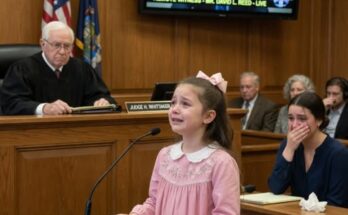
Courtrooms do not look like justice.
They look like wood polish, tired carpet, fluorescent lights, and people pretending their clothes can hold them together. My mother wore navy. Victoria wore black. My father sat three rows behind them, alone, hands folded so tightly his knuckles were white.
I sat with Daniel on one side and Marisol on the other.
Helen sat behind us. Henry beside her.
No one from my old life sat with me.
That hurt less than I expected.
The judge spoke for a long time. He described the fraud in clean, measured sentences. Inflated assets. Forged signatures. False certifications. Misused identity. Attempts to intimidate a witness. Harm to financial institutions, private parties, and the integrity of legal disclosures.
My mother cried quietly.
Victoria stared straight ahead, jaw clenched.
When the judge mentioned me, my mother covered her mouth.
Not when he mentioned the Langfords’ losses. Not when he mentioned Carter. Not when he mentioned restitution. Only when he said my name in public as a victim.
Claire Elise Reed Voss.
My new name.
My mother flinched like the last part offended her most.
The prosecutor played only a short portion of the recordings. Enough. Victoria calling me a ghost. My mother saying I would not question. The voicemail where she told me it was not my business.
Each clip landed in the room with a small, final sound.
Then my mother was allowed to speak.
She stood slowly. For the first time in my life, she seemed unsure of how to arrange her face.
“Your Honor,” she began, “I made terrible mistakes.”
Marisol’s pen stopped moving.
Mistakes.
My mother spoke about pressure. About wanting the best for her daughter. She did not specify which daughter. She spoke about social expectations, financial fear, embarrassment, the need to preserve family dignity. She cried when she mentioned Victoria’s future. She trembled when she mentioned prison.
Then she turned slightly toward me.
“My daughter Claire and I have had a complicated relationship,” she said. “But I hope one day she will understand that everything I did, however wrong, came from a mother’s love.”
I felt Daniel tense beside me.
For years, those words would have dragged me back.
A mother’s love.
As if love were a fog machine you could turn on after setting the house on fire.
The judge looked at me. “Mrs. Voss, would you like to make a statement?”
I had not planned to. I had written one, then torn it up. Written another, then deleted it. Words felt too small.
But when I stood, my knees were steady.
The courtroom blurred at the edges, but my mother’s face stayed sharp.
“My mother asked me not to attend my sister’s wedding because she said I would spoil everything,” I said. “At the time, I thought that was the worst thing she had done to me.”
No one moved.
“I was wrong. She had already used my name, my work, my signature, and my silence. My sister helped. My father looked away. This was not one mistake. It was a system. I was trained to be useful, quiet, and easy to blame.”
My mother closed her eyes.
I kept going.
“I do not support leniency. I do not support family healing as a substitute for accountability. I do not forgive them. Maybe that disappoints people who prefer stories where daughters return home and mothers cry and everything becomes soft. But some homes are not homes. Some apologies are just another way to ask for power back.”
My voice almost broke then, but it didn’t.
“I built a life after they threw me away. I intend to keep it.”
I sat down.
Daniel took my hand under the table.
The sentencing came after lunch.
My mother received four years in prison, followed by supervised release and restitution. Victoria received two years, with additional probation and financial penalties. Aunt Melanie lost her notary commission and took a plea. The civil suit from the Langfords continued, and the house I grew up in was eventually sold to cover part of what my mother and sister had destroyed.
I did not attend the sale.
I heard from a former neighbor that the lilies were gone by then. The tent had left brown scars on the lawn for months.
Carter annulled the marriage. Victoria fought it until fighting became more humiliating than losing. The friends who once arranged themselves around her like jewelry vanished. My mother’s charity boards removed her name from programs. The local paper printed her mugshot smaller than I expected.
My father moved to Arizona.
He sent a Christmas card with no return address.
Inside, he wrote, I hope someday we can talk.
I threw it away with the grocery flyers.
Six months after sentencing, Daniel and I hosted the reopening of the little library near our house. It had flooded two years earlier and never fully recovered until his nonprofit took it on. The building smelled like fresh paint, sawdust, and new carpet. Children ran their hands along low shelves. An old man cried when he saw the local history room restored.
Naomi sent flowers. Helen brought coffee. Henry gave a speech that was mostly about plumbing permits, which somehow made everyone laugh.
I stood near the front desk, watching a little girl in red sneakers choose her first library card.
Daniel slipped his arm around my waist. “You okay?”
I thought about my mother’s foyer. The lilies. The cold air. The glass of water. The sentence meant to erase me.
You’ll spoil everything.
She had been right, just not in the way she meant.
I spoiled the lie. I spoiled the fraud. I spoiled the story where Victoria shined and I disappeared. I spoiled my mother’s plan to use me as a signature with no voice.
Then I built something better out of the wreckage.
My phone buzzed in my pocket.
A prison email notification.
My mother had written again.
The subject line said: Please, Claire. I’m still your mother.
I deleted it without opening it.
Outside, afternoon light poured through the library windows and spread across the floor in bright gold squares. Dust floated in the beams like tiny, weightless things. Daniel laughed at something Lily said near the children’s section. Helen was arguing with the coffee urn. Henry was trying to fix a crooked poster.
No one there needed me to be invisible.
No one there called cruelty love.
I walked to the front doors and opened them wide for the next family coming in.
For the first time, I understood that peace was not the same as forgiveness.
Peace was hearing your mother beg and knowing you did not have to answer.
THE END!