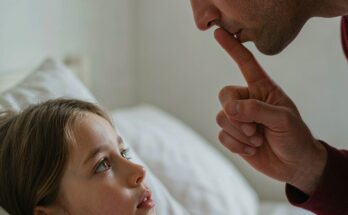
Mitchell had gathered evidence – shipping manifests, coded communications, photos. He was going to turn Hayes in.
“But Hayes found out,” Anna continued, tears now flowing freely. “He told Mitchell to drop it, or his ‘family’ would pay the price. He knew about me. He knew I was pregnant.”
The day of the ambush, everything changed. It was a real firefight, a brutal one. But in the chaos, Mitchell saw his chance. And Hayes saw his.
Mitchell saved us. He drew fire, created the opening for us to escape. That part of the story was true. But he wasn’t hit. He and Buster used the smoke and confusion to slip away.
Colonel Hayes, seeing his problem solve itself, officially listed Mitchell and Buster as killed in action. He doctored the reports, collected the dog tags from a fallen soldier, and closed the case. Mitchell Cross, the orphan with no family, was a hero who was conveniently gone. A loose end, tied up.
“He came to me a week later,” Anna whispered. “In the middle of the night. He looked like a ghost. He said the only way we could be safe, the only way our baby could be safe, was if Mitchell Cross stayed dead.”
So they ran. They changed their names, moved from town to town, always looking over their shoulder. Mitchell worked odd jobs for cash. They lived in fear, waiting for the day Hayes would find them.
“He died, Sam,” Anna said, her voice finally breaking completely. “He really died. Two years ago. A construction accident. It was fast. He was just… gone.”
She had been alone ever since, raising Lily in this small town, praying no one would ever connect the dots.
I stood there, the world tilting on its axis. The anger and betrayal I’d felt just moments ago were being replaced by a cold, hard rage directed at a different man. At Colonel Hayes.
He had let us mourn our friend. He had stood at the memorial service and given a speech about Mitchell’s bravery. All while knowing he had used our brother’s sacrifice to cover his own crimes.
The dark sedan in the parking lot was still there. It wasn’t a coincidence.
“They found you,” I said. It wasn’t a question.
She nodded. “A man came in for coffee last week. He asked a lot of questions. I saw him talking on the phone in the parking lot. He looked right at me.”
They weren’t here for Anna. They were here for the evidence.
“Did Mitchell keep it?” I asked. “The proof against Hayes?”
“Yes,” she said. “He kept everything. He said it was our life insurance. It’s in a box in the attic.”
At that moment, Gabriel came jogging back from around the corner. “Sam, two men just got out of that sedan. They’re coming this way.”
There was no time to think. There was only time to act.
“Anna, get Lily and Buster in our truck. Now,” I commanded. “Derrick, Gabriel, you’re with me. We’re going to get that box. Marcus, Ben, you’re on overwatch. Let’s go.”
We moved with the old, familiar efficiency of a unit that had faced death together a dozen times. Anna ran to our truck, herding a confused Lily and a growling Buster inside.
The rest of us slipped back into the diner through the kitchen. The two men, big guys in cheap suits, were just walking in the front door. They hadn’t seen us.
We took the stairs to the small apartment above the diner two at a time. The attic was dusty and cramped. Anna had pointed to a far corner.
“It’s an old footlocker,” she’d said.
We found it under a pile of old blankets. It was heavy. Derrick and I hauled it down the stairs as Gabriel kept watch. We were halfway through the kitchen when the two men pushed through the swinging doors, blocking our path.
“That doesn’t belong to you,” the first one said, his hand reaching inside his jacket.
Marcus and Ben appeared behind them, silent as shadows, coming in from the back. It was over before it started. No shots fired. Just five combat veterans doing what they were trained to do.
A few minutes later, the two men were tied up in the diner’s dry-storage room with their own belts and shoelaces.
We got the footlocker into the truck and piled in. Anna was in the back, holding a sleeping Lily. I got behind the wheel and drove, not to the cemetery, but away. Away from this town, away from the life of fear she had been living.
That night, in a cheap motel two states away, we opened the box.
It was all there. A burner phone with damning text messages. Copies of manifests. A thumb drive with photos of Hayes meeting with the militia leader. And a journal.
Mitchell’s journal.
I spent hours reading it. He wrote about his guilt over me and Anna. He wrote about his love for his unborn daughter. He wrote about the terrible choice he had to make.
The last entry was dated the day before he died. “If I don’t make it,” he wrote, “I hope Sam finds them one day. He’s the only one I trust to finish this. He’s a better man than me. Tell him I’m sorry. And tell him to be the godfather he was always meant to be.”
Tears streamed down my face. The bitterness was gone, washed away by a wave of grief and understanding. He wasn’t a traitor. He was a father, a cornered man doing the only thing he could to protect his family.
The next day, we made a call. Not to the police, but to a general we had served under, a man we knew to be honorable. We laid it all out.
The fallout was swift and decisive. Colonel Hayes was arrested. His entire network was dismantled. He was tried for treason and sentenced to life in prison.
Mitchell’s official record was amended. The faked death was reclassified as a deep-cover operation to expose corruption. He was posthumously awarded a medal for his service.
And Anna, as his legal widow, received seven years of back pay, full benefits, and his life insurance policy. It was enough to give her and Lily a new start, a life without fear.
We never made it to the cemetery that year. Instead, we found a new purpose.
We rented a house together, all of us, for a few months. A place for Anna and Lily to land on their feet. We became a chaotic, makeshift family of five uncles, a brave mother, a little girl, and a very old dog.
I watched Lily play in the yard with Buster, her laughter bright and free. I taught her how to fish. Derrick showed her how to change the oil in the truck. We were making up for lost time, for the uncle-hood we never knew we had.
The first time she called me Uncle Sam, my heart swelled so much I thought it would burst.
The day we finally left, Anna gave me a hug at the door. “Thank you, Sam,” she said, her eyes clear for the first time since I’d seen her in that diner. “For everything.”
“He asked me to,” I said, my voice thick with emotion. “I was just finishing the mission.”
The pain of her betrayal was a distant scar now, faded like my tattoo. It had been replaced by something bigger: forgiveness, and a profound sense of peace. We had not only honored our friend’s memory, but we had fulfilled his last wish. We had brought his family home.
Life is rarely a straight line. It’s a tangled, messy, and unpredictable journey filled with love, loss, and impossible choices. We carry our scars, both visible and not, as reminders of the battles we’ve fought. But true strength, I’ve learned, isn’t about the absence of wounds. It’s about how we choose to heal them, and how we help heal the wounds of others. Sometimes, the most important missions are the ones you never knew you were on, and the greatest victories are the ones that mend a broken heart.